

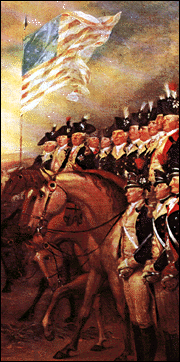
 The Second Continental Congress, then meeting at Philadelphia,
(the lawmakers) chose as commander of the "Continental Army"
George Washington, a 43-year-old delegate
from Virginia, a planter and a ranking militia officer in the
French and Indian Wars.
The Second Continental Congress, then meeting at Philadelphia,
(the lawmakers) chose as commander of the "Continental Army"
George Washington, a 43-year-old delegate
from Virginia, a planter and a ranking militia officer in the
French and Indian Wars.
Britain seemingly had enormous advantages in a war against its
colonies. It possessed a well-established government, a sizable
treasury, a competent army, the most powerful navy in the world,
and a large Loyalist population
in the colonies. By contrast, the American rebels had no chief
executive such as the king, nor a cabinet whose members had assigned
responsibilities. In fact, the Americans had no separate or independent
departments of government such as war, treasury, and foreign
affairs until near the end of the conflict.
|
|
|
The Continental Congress
itself had as its rivals the 13 state legislatures, which often
chose not to cooperate with their delegates in Philadelphia.
Indeed, Congress was an extralegal body, existing at the pleasure
of the states before the Articles of Confederation were ratified
in 1781. |
|
The Americans, however, were not without their own advantages.
A vast reservoir of manpower could be drawn upon. For the most
part, men preferred short-term enlistments--and many who served
came out for a few weeks or months--but they did serve: the best
estimates are that over 200,000 participated on the patriot side.
General Washington was often short of shoes and powder, but rarely
were he and other commanders without men when they needed them
most, although at times American leaders had to take into the
army slaves, pardoned criminals, British deserters, and prisoners
of war. Moreover, Americans owned guns, and they knew how to
use them.
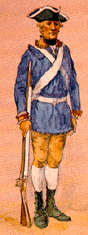
American Colonial
Soldier (Left) |
|
|
If the Continental Army won few fixed battles, it
normally fought reasonably well; it extracted a heavy toll on
the enemy, who usually could not easily obtain reinforcements.
Although only Washington and Maj. Gen. Nathanael
Greene were outstanding commanders, many others were steady
and reliable, including Henry Knox, Benjamin
Lincoln, Anthony Wayne, Daniel Morgan, Baron
von Steuben, the Marquis de Layfayette,
and Benedict Arnold, before he defected
to the enemy in 1780. |
|
The Americans also were fighting on their own
soil and consequently could be more flexible in their military
operations than their opponents. Washington and other Continental
Army commanders usually followed the principle of concentration,
that is, meeting the enemy in force wherever British armies appeared.
In the interior, however, against bands of Loyalists and isolated
British outposts and supply trains, the American militia not
infrequently employed guerrilla or partisan tactics with striking
successes.
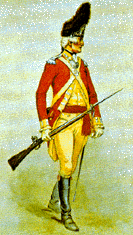
British Soldier (Left) |
|
|
The major contribution of the militia was to control
the home front against the Revolution's internal enemies--whether
Indians or Loyalists--while the Continental Army contended with
British armies in the eastern or coastal regions in more formalized
warfare. |
|
British advantages were steadily negated by
the vastness of the struggle, by waging war 3,000 miles from
Europe against an armed population spread over hundreds of miles,
from the Atlantic to the Mississippi, from Maine to Georgia.
The land was forested, ravined, swampy, and interlaced by myriad
streams and rivers. It was discouraging to win battle after battle
and see Britain's armies bled of men and supplies in the process,
while the beaten rebels always bounced back. It was equally frustrating
to seize at one time or another every American urban center and
yet have nothing more to show for it than the mere possession
of territory, since the Americans had no single vital strategic
center. |
|

|
To the British it seemed to take forever--6 to 12 weeks--for
word of campaign strategies to pass from London to commanders
in the field, for provisions to arrive, and for naval squadrons
to appear in time for cooperation with land forces. The scope
of the contest also reduced the Royal Navy's effectiveness in
blockading the long American coastline. Stores could be landed
at too many rivers, bays, and inlets. Nor could the British employ
their fast frigates and formidable ships of the line (battleships
of the 18th century) against an American fleet.
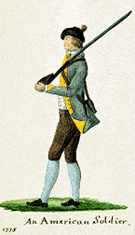
American Colonial
Officer (Left) |
|
|
The patriots took to the sea in single ships, either
privateers or vessels commissioned by Congress.
Consequently, the British-American naval war can be told largely
as a story of individual ship duels. The triumph of John
Paul Jones in the Bonhomme Richard over H.M.S. Serapis in
the North Sea in 1779 was the most famous of these encounters.
Unfortunately for Britain, its generals in the field
were much like the political leaders at home, possessed of average
talents at best. John Burgoyne, Guy
Carleton, Sir Henry Clinton, Charles
Cornwallis, William Howe, and Thomas
Gage were probably reasonably endowed to fight conventional wars
on the plains of western Europe, where orthodox linear formations
were in order. |
|
Eighteenth-century European generals, however, were scarcely
professionals in a modern sense. Military education was apprenticeship
training in the field rather than schooling at such institutions
as the Royal Military Academy at Sandhurst or its U.S. equivalent
at West Point, which were created later. Officers lacked a body
of strategic doctrine from which to choose between alternatives
for practical application. The British generals revealed themselves
grossly inept at improvisation in a unique struggle in America
that demanded rapid movement, original tactics, winter campaigning,
and -- most important -- contending with a people in arms.
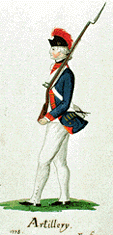
American Artillery
Officer (Left) |
|
|
Moreover, some British commanders, notably the Howe
brothers, were deliberately slow in prosecuting the war because
they favored a political reconciliation with the rebels.
For all these reasons American generals, even with
amateurish militia backgrounds, were not at so serious a disadvantage
as they might have been in a subsequent period of history. American
officers who had fought with the British army in the French
and Indian Wars, observing its procedures and reading the
standard military treatises, found in the Revolution that the
pattern of warfare as practiced by the so-called experts had
hardly changed at all. Washington and his comrades lacked experience
in directing massive formations and planning campaigns; but,
for that matter, British generals--and admirals too--had themselves
been subordinate officers in the last war with France. |
(See Bibliography below)
| Back
to Timeline |
or click on your browser's "back to previous page"
button
 ©
©
Author: Don Higginbotham - Permission given by the author.
Picture Credits: New York Public Library; The American
Heritage History of the American Revolution, p. 153.
Bibliography: Alden, John R., A History of the American
Revolution (1969); Bailyn, Bernard, Ideological Origins
of the American Revolution (1967); Bemis, Samuel Flagg, The
Diplomacy of the American Revolution (1957; repr. 1983); Dupuy,
Richard E., The American Revolution, a Global War (1977);
Higginbotham, Don, War of American Independence (1971);
Langguth, A. J., Patriots (1988); Morgan, Edmund S., Birth
of the Republic, 2d ed. (1977); Morris, Richard B., The
American Revolution: A Short History (1979) and The Forging
of the Union 1781-1789 (1987); Shy, John, A People Numerous
and Armed (1976); Stokesbury, James L., A Short History
of the American Revolution (1991); Tuchman, Barbara, The
First Salute (1988); Wood, Gordon, Creation of the American
Republic (1969).
© Copyright "The American Revoulution Home Page" - Ronald
W. McGranahan 1998 - 2004 All Rights Reserved