|
Cornwallis attended the military academy at Turin,
and while serving in Germany during the Seven
Years' War rose to Lieutenant Colonel. On succeeding to his
father's title as 2d Earl in 1762, Cornwallis became active politically
with the Whigs and took his seat in the House of Lords where
his abilities and connections led to appointments as Aide-de-Camp
to the King, Chief Circuit Court Justice south of the Trent River,
and Joint Vice-Treasurer of Ireland. He was sympathetic
to the grievances of the American Colonists and voted against
the Declaratory Act in 1766.
Although opposed to the measures that provoked the
American Revolution, he accepted as a duty a command in North
America with the rank of Major General. During the American
Revolution Cornwallis served with distinction. He aided the British
victory at the Battle of Long
Island on Aug. 27–28, 1776. Later that year he
pursued Washington's army across New
Jersey, halting at New Brunswick on orders from Gen. William
Howe. Hurrying forward again after Washington's victory at Trenton on Dec. 26, 1776, Cornwallis failed
to entrap the patriots and went into winter quarters. Cornwallis
was largely responsible for the British victory at Brandywine,
Pa., Sept. 11, 1777, and led British forces into Philadelphia
on the 28th.
After a brief visit to England he returned as a Lieutenant
General, second in command to Sir Henry
Clinton. He opposed the evacuation of Philadelphia
but accompanied the British Army on its retreat to New York and
repulsed the Americans under Gen. Charles Lee at the Battle
of Monmouth on June 28, 1778. He again returned to
England to attend his ill wife, who died in 1779, but rejoined
Clinton in August 1779 and participated in the siege of Charleston,
S.C. (April 1–May 12, 1780). When the city fell, Clinton
returned to New York. Cornwallis took command of British forces
in the South. |

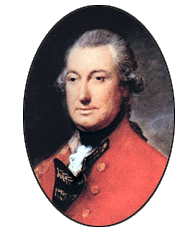
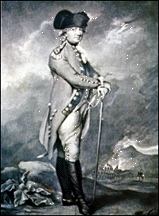

 General Charles
Cornwallis
General Charles
Cornwallis