|
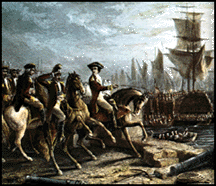
In early summer, Howe's army was on Staten Island
preparing to seize New York City. He occupied the city after
defeating Washington in the Battle
of Long Island (August 1776). Not counting the siege of Boston,
Howe met Washington in four major battles in 14 months. Twice
he achieved brilliant victories—at Long Island and at the
Brandywine in September 1777.
The Battle of White Plains (October 1776) was inconclusive, although
Washington abandoned the field, but at Germantown (October 1777)
Howe narrowly escaped serious trouble. After this battle, he
withdrew to winter quarters in Philadelphia.
Howe's advance from New York toward Philadelphia in
the summer of 1777 has been criticized because he took his troops
by ship up the Chesapeake Bay when he might have saved nearly
a month by going up the Delaware River. Furthermore, because
he attacked Philadelphia, Howe has been accused of failing to
assist Gen. John Burgoyne in his advance
from Canada toward Albany. But this criticism is hardly just,
for Howe had no orders to assist Burgoyne.
~ Later Years ~
When Howe, in Philadelphia, received only a small
portion of the reinforcements he had requested, he felt that
he had lost the king's confidence, and in November 1777 he sought
relief from his command. In May 1778 he was replaced by Sir
Henry Clinton and returned to England. Howe continued in
royal favor, however, and was knighted and made a lieutenant
general for his victory in the Battle of Long Island. He became
a full general in 1793. When his brother Adm. Lord Richard Howe
died in 1799, he succeeded him as 5th Viscount Howe. He had married
in 1765 but had no children. He died in Plymouth, England, July
12, 1814.
Howe was an excellent tactician but was somewhat lacking
in strategic sense. His great fault was his failure to follow
up his successes. Sluggish and indolent by nature, he missed
many chances to advance the British cause—for example, his
failure to bottle up Washington's army on Manhattan Island, New
York, after his victory on Long Island. He was an indulgent commander,
popular with his troops, and friendly to all. He may be regarded
as a competent but not a great general. |

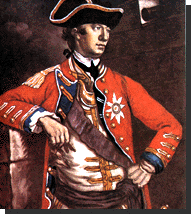

 Sir
William Howe
Sir
William Howe