
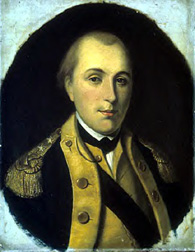
 Marquis de
Lafayette Marquis de
Lafayette
"The play, sir, is over."
October, 1781
The French general the Marquis de Lafayette, called the
hero of two worlds, was prominent in both the American Revolution
and the French Revolution. Born on Sept. 6, 1757, to a noble
family in the Auvergne, he defied the French authorities in 1777
by crossing the Atlantic to offer his services to the Continental
Congress at Philadelphia. He was a friend of George
Washington, who became his model, and served under him at
the Battle of the Brandywine
and at Valley Forge. |
|
|
In 1779 he went to France to expedite the dispatch
of a French army, but he returned to distinguish himself again
at Yorktown (1781). Brave in battle and
staunch in adversity, Lafayette won enduring popularity in America,
and his fame did much to make liberal ideals acceptable in Europe. |
|
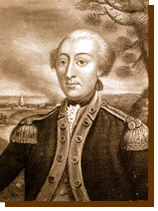
As discontent in France mounted, Lafayette (left)
advocated the convocation of the States-General in 1789. He
became a deputy and proposed a model Declaration of Rights. Elected
commander of the National Guard on July 15, 1789, he appeared
gallantly with his troops at the Festival of Federation on July
14, 1790, to celebrate the apparent coming of age of a free and
united community. |
|
|
However, Lafayette proved unable to fulfill the promise
of his youth. Although he had enormous potential power as a mediator,
he had neither a realistic policy of his own nor the flexibility
to support the more practical comte de Mirabeau. Despised
by the court as a renegade aristocrat whose bourgeois army was
unable to protect the royal family, he was also hated by the
populace for trying to suppress disorder, especially after he
fired on a crowd in Paris in July 1791. |
|
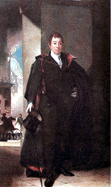
In 1792, as an army commander, Lafayette
made a futile attempt to save the monarchy and then deserted
to the Austrians, who promptly imprisoned him as a dangerous
revolutionary. Released in 1797 at Napoleon Bonaparte's insistence,
Lafayette was allowed to return to France in 1799.
In 1815 he was one of those who demanded Napoleon
I's abdication. |
|
|
In 1824, Lafayette made a triumphant tour of the United
States. By then his home, La Grange, was a place of pilgrimage
for liberals throughout the world. When the July Revolution of
1830 occurred, he was again called on to command the National
Guard, to identify the monarchy of Louis Philippe with the ideals
of 1789.
He died in Paris on May 20, 1834; his name continues
to signify freedom. |
(See Bibliography Below)
| Back to Timeline | or click
on your browser's "back to previous page" button
 ©
©
Picture Credit: Marquis de Lafayette (1779)
by Charles Willson Peale, Washington and Lee University (top);
Independence National Historic Park, Philadelphia (bottom).
Bibliography: Bernier, Olivier, Lafayette: Hero of Two
Worlds (1983); Buckman, Peter, Lafayette: A Biography
(1977); Gerson, Noel B., Statue in Search of a Pedestal: A
Biography of the Marquis de Lafayette (1976); Gottschalk,
Louis R., Lafayette Comes to America (1935; repr. 1974),
Lafayette Joins the American Army (1937; repr. 1974), Lafayette
and the Close of the American Revolution (1942; repr. 1974),
Lafayette between the American and French Revolution (1950;
repr. 1974), Lafayette in the French Revolution, through the
October Days (1969), and Lafayette in the French Revolution:
From the October Days through the Federation (1973); Horn,
Pierre, Marquis de Lafayette (1989); Idzerda, Stanley J.,
et al., eds., Lafayette in the Age of the American Revolution:
Selected Letters and Papers, 1776-1790, 4 vols. (1977-81).
© Copyright "The American Revoulution Home Page" - Ronald
W. McGranahan 1998 - 2004. All Rights Reserved.