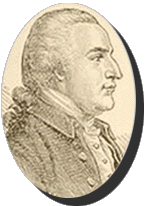
Benedict Arnold
Benedict Arnold
 Benedict Arnold, b. Norwich, Conn., Jan. 14, 1741, was an American Revolutionary general and America's most infamous traitor. At the age of 14, Arnold was a druggist's apprentice, but he ran away twice to serve in the colonial militia during the French and Indian War (1754-63).   When the American Revolution broke out, Arnold marched his Connecticut militia company to Massachusetts, where he was made a colonel. His force, along with Ethan Allen's Green Mountain Boys, captured Ticonderoga on May 10, 1775.

Arnold then led a force of 1,100 men through Maine in the dead of winter to invade Canada. His march remains a military classic. Linking up with another American force under Richard Montgomery, he led an unsuccessful attack on Quebec in December and was wounded. For his courage, he was promoted to brigadier general in January 1776.

Before his defection, Arnold had a brilliant career in the Continental Army.  In October 1776 he fought a series of naval battles on Lake Champlain (see also the link below) that helped delay a British invasion from Canada.  When the British raided Danbury, Conn., in April 1777, Arnold drove them off.  He particularly distinguished himself in the Saratoga campaign as second in command to Horatio Gates.  During the second battle of Saratoga on Oct. 7, 1777, Arnold led a headlong charge, captured a key redoubt, was again wounded, and made the British surrender inevitable.  One of his soldiers called Arnold "as brave a man as ever lived."

Excellent "Battle of Lake Champlain" Website!
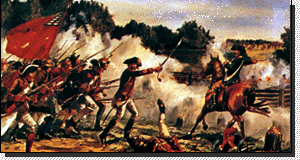
Arnold At Saratoga
Arnold Leading the Charge at Freeman's Farm

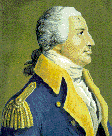
Benedict Arnold
Arnold suffered many disappointments that embittered him. When he was promoted to major general in February 1777, others he thought less deserving preceded him in rank. Gates received the credit for the victory at Saratoga. Named (June 1778) commander in Philadelphia, Arnold was accused of overstepping his authority. His second marriage (1779) to Margaret Shippen, the daughter of a Loyalist, also aroused suspicions.

His bitterness, along with a need for money to pay heavy debts, led Arnold to negotiate with the British. He conceived a plan to betray West Point, a post that he commanded.

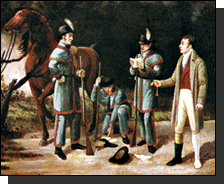
John Andre is Captured 

His attempted treachery was revealed when John Andre (left), a British major, was captured in September 1780 carrying Arnold's message.  Arnold escaped to the enemy lines and was commissioned a brigadier general in the British army.  For his property losses, he claimed and was paid about $10,000.  He led two British expeditions, one that burned Richmond, Va., and the other against New London, Conn.


Arnold went to England in 1781 and turned to trade. Worn by depression and suffering from a nervous disease, he died in London on June 14, 1801.


(See Bibliography Below)

| Back to Timeline | or click on your browser's "back to previous page" button

    ©

Author: George Athan Billias
Picture Credit: American Heritage (Middle); Andre: DAR Museum
Bibliography: Bakeless, J. Turncoats, Traitors and Heroes (1959); Flexner, James T., The Traitor and the Spy (1953); Van Doren, Carl, Secret History of the American Revolution (1941; repr. 1973); Wright, Esmond, "Benedict Arnold and The Loyalists," History Today, October 1986.
© Copyright "The American Revoulution Homepage" - Ronald W. McGranahan 1998 - 2004 All Rights Reserved