|
Greene had little formal schooling, but he was an
avid reader, and under the guidance of Ezra Stiles, a clergyman,
later president of Yale College, he acquired a good education.
In 1770, Greene moved to Coventry, R. I., to manage his
father's forge. He served in the Rhode Island Assembly from 1770
to 1772 and again in 1775. He was expelled from the Quaker meeting
in 1773 for attending a military parade. In 1776 he participated
in the defense of New York City, was promoted to Major General,
and, in December, played an important role in Washington's surprise
attack on Trenton.
During 1777-78 he worked closely with Washington at Morristown,
Brandywine, Germantown, Valley Forge, and Monmouth.
He was appointed Quartermaster General in 1778 and served in
that position until 1780.
~ Early Military Career ~
Foreseeing trouble between the American colonies and
Britain, Greene helped to organize a local military company in
1774. He suffered from a stiff knee, which caused a slight limp,
and because of this the company felt that he should not be an
officer.He served simply as a private.
In May 1775, after the outbreak of the Revolution,
the Rhode Island Assembly authorized the raising of a force of
1,500 soldiers, and Greene was named Brigadier in command. In
early June the brigade joined Washington's army besieging Boston.
Greene served through the siege and then was sent by Washington
to take charge of the defenses of New York City pending his arrival.
After the Battle of
Long Island (Aug. 27–28, 1776), during which he was
seriously ill, Greene advised that the Americans should retreat
from New York to avoid being trapped on Manhattan Island by the
British. His advice was not taken, and the army had a narrow
escape.
Washington had come to depend on Greene, and their
relationship soon became confidential. Before long, Greene was
virtually second in command. He took an active part in all the
army's operations until March 1778, when Washington asked him
to leave the fighting line and assume the duties of Quartermaster
General, which had been poorly handled. Greene agreed reluctantly
and served for more than two years, except for a brief interval
when he fought in the Battle
of Monmouth (June 28, 1778). In July 1780, Greene returned
to active service. In the autumn he presided at the trial
of Maj. John André, the British spy, who was hanged.
Greene's generalship was largely responsible for the
triumph of the American forces in the South.
After the Americans were defeated in the Battle of Camden, S.
C. (Aug. 16, 1780), Greene was chosen to succeed Gen.
Horatio Gates in command of the Southern war theater and
in early December he took over the leadership of a shattered
and destitute army.
He quickly reorganized it and devised a strategy of
retreat northward into North Carolina, goading Lord
Cornwallis, the British commander, into following him.
His strategy succeeded in dividing the British forces, making
possible the victory at Cowpens
in January 1781. Within eight months Greene freed most of the
Carolinas from British control. At the Battle of Guilford
Courthouse on March 15, 1781, Greene suffered a defeat, but his
troops fell back in good order without serious loss. Cornwallis,
who was far from his base, was compelled by lack of supplies
to withdraw. Greene had lost the battle but won the campaign.
His strategic skill thereafter brought the war in the South to
a successful close.
In 1785 he retired near Savannah to a plantation given
to him by Georgia. |

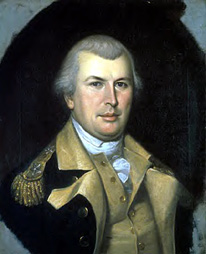

 Major General
Nathanael Greene
Major General
Nathanael Greene