|
Rejoining the army in 1756, Burgoyne served in Europe
during the Seven Years' War. He was
elected to Parliament in 1761 and achieved prominence in 1772
by demanding an investigation of the East India Company. Appointed
Major General in 1772, Burgoyne was sent to Boston, Mass., in
May 1775. He witnessed the Battle of Bunker
Hill on June 17 and later returned to England.
In 1776, Burgoyne was named second in command to Sir
Guy Carleton for an invasion of New York from Canada. The British
captured Crown Point on Lake
Champlain, but Burgoyne returned to London in disgust at
Carleton's leadership. He persuaded the king and prime minister
to let him lead an invasion from Canada. In June 1777, commanding
an army of about 7,000, Burgoyne reoccupied Crown Point and on
July 6 captured Fort Ticonderoga.
As Burgoyne moved slowly southward, however, disaster
overtook him. Col. Barry St. Leger, who was to bring him support
from the west, was stopped by the Americans, and Gen.
William Howe failed to send him reinforcements from the south.
Brought to a virtual standstill, Burgoyne tried twice to break
through the American lines at Bemis Heights. Eventually he was
forced to surrender to the greatly superior forces of Gen.
Horatio Gates at Saratoga on Oct.
17, 1777.
Returning to England, Burgoyne was severely criticized
for his capitulation. He entered politics again, briefly, but
after 1783 he devoted himself to literary and social life. His
first play, Maid of the Oaks (1774), had enjoyed some success,
and his last, The Heiress (1786), proved quite popular. Burgoyne
died in London on Aug. 4, 1792, and was buried in Westminster
Abbey. |

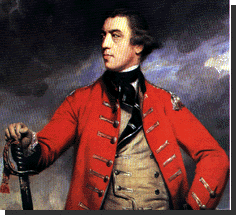

 Major
General John Burgoyne
Major
General John Burgoyne