~ Common Sense ~

Common Sense, a famous revolutionary pamphlet by Thomas Paine, published in January 1776, that advocated America's complete independence of Britain. It followed the natural-rights tenets of the British philosopher John Locke, whose writings had justified independence as the will of the people and revolution as a device for bringing happiness. Although the arguments were not original with Paine, Paine's passionate language and direct appeal to the people prepared them for the ideas expressed in the Declaration of Independence. Fighting with Britain had been under way for some nine months before publication of the pamphlet, but the political direction of the revolution was not yet clear. For many, Common Sense crystallized the revolution's goals.

In writing the pamphlet, Paine was encouraged by the Philadelphia physician and patriot Benjamin Rush. Rush read the manuscript, secured Benjamin Franklin's comments, suggested the title, and arranged for anonymous publication by Robert Bell of Philadelphia. Common Sense was an immediate success. Paine estimated that not less than 100,000 copies were run off and boasted that the pamphlet's popularity was “beyond anything since the invention of printing.” Rush noted that its effect on Americans was “sudden and extensive.” It was “read by public men, repeated in clubs, spouted in schools.”

Everywhere, it aroused debate about monarchy, the origin of government, English constitutional ideas, and independence. John Adams, although himself a strong proponent of independence, assailed the governmental principles of Common Sense as either “honest ignorance or knavish hypocrisy” and wrote his own Thoughts on Government (1776) in rebuttal.

Common Sense traces the origin of government to a human desire to restrain lawlessness. But government can be diverted to corrupt purposes by the people who created it. Therefore, the simpler the government, the easier it is for the people to discover its weakness and make the necessary adjustments.

In Britain “it is wholly owing to the … people, and not to the constitution of the government, that the crown is not as oppressive … as in Turkey.” The monarchy, Paine asserted, had corrupted virtue, impoverished the nation, weakened the voice of Parliament, and poisoned people's minds. The “royal brute of Britain” had usurped the rightful place of law.

Paine argued that the political connection with England was both unnatural and harmful to Americans. Reconciliation would only cause “more calamities. … It is repugnant to reason, to the universal order of things, to all examples from former ages, to suppose that this continent can longer remain subject to any external power.” In short, the welfare of America, as well as its destiny, in Paine's view, demanded steps toward immediate independence.

Author: John A. Schutz
University of Southern California


~ The Crisis ~

The Crisis, the general name given to a series of 16 political pamphlets by Thomas Paine.  The pamphlets, published between 1776 and 1783, exhibit the political acumen and the common sense for which Paine was remarkable.

The first and most famous of the pamphlets, originally published as an article in the Pennsylvania Journal on Dec. 19, 1776, begins with the famous sentence “These are the times that try men's souls.” It was written during Washington's retreat across the Delaware and by order of the commander was read to groups of his dispirited and suffering soldiers. Its opening sentence was adopted as the watchword of the advance on Trenton, and it is believed to have inspired much of the courage that won that victory.

The 13th pamphlet, published on April 19, 1783, bears the title Thoughts on the Peace, and Probable Advantages thereof. It opens with the words “The times that tried men's souls are over.”


Minutemen

 Minutemen

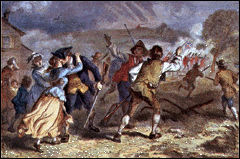
In the American Revolution the minutemen (a patriot-soldier) were special militia units that supposedly could be called to arms "at a minute's notice." The first of these units, organized by the Massachusetts provincial congress in 1774, (Worcester county, Mass.) fought at the Battles of Lexington and Concord in 1775. The regiments were reorganized to eliminate Tory influence. The Massachusetts Provincial Congress directed that regimental reorganization be extended to other counties, though the process was never completed. In the opening engagements at Lexington and Concord, Mass., on April 19, 1775, minutemen joined the militiamen to fight the British. The minutemen were disbanded in a subsequent reorganization of the forces in Massachusetts. On the recommendation of the Continental Congress, Maryland, New Hampshire, and Connecticut organized minutemen.

Statues in Lexington and Concord and in Westport, Conn., honor the minutemen. The Minute Man National Historical Park includes North Bridge at Concord and 4 miles (6 km) of road along which fighting took place.


~ Navigation Acts ~

The Navigation Acts, a series of statutes passed in the 17th century by the English Parliament, formed the basis of the colonial system in the early, or first, British Empire.  The British Navigation Acts are important in U.S. history because the irritation they caused in the colonies contributed to the revolution of 1776. But these acts were less restrictive than those of some other colonial powers, such as Spain.

The English had passed navigation acts as early as 1381, but the policy commonly associated with the term began in the period of Oliver Cromwell with the object of reducing Dutch maritime supremacy and strengthening British shipping and commerce. The Navigation Act of 1651 required all products of America, Asia, and Africa to be imported into England and its possessions in ships manned predominantly by English subjects; European produce could be imported into England only in English ships or those of the country of origin.

The Navigation Act of 1660 prohibited all foreign ships from trade between England and its colonies and restricted that trade to English-built and English-owned vessels with an English captain and a crew that was 75 percent English. It also enumerated certain commodities, such as sugar, tobacco, and dyes, that the colonies could export only to England or to another British colony.

The Staple Act of 1663 forbade the shipping of European goods to the colonies except through England or Wales, and additional acts in 1673 and 1696 tried to plug various loopholes and provide stricter enforcement.

After the restoration of Charles II, a new act was passed in 1661 largely repeating the earlier act, but denying to the Channel Islands, Scotland, and, by an act of 1671, Ireland, the privileges of the act. The acts were meant to encourage English navigation, to increase the supply of English seamen, to favor the export of English products, to favor the import of raw materials needed for English industry or consumption, and to maintain a balance of English exports over English imports. They also were intended to ensure the dependence of the colonies, Scotland (until the Union of 1907) and Ireland on England.

The effect of these navigation acts has been controversial. They did not destroy Dutch trade, but led to several Anglo-Dutch wars. They may for a time have contributed to uniting the British Empire, but they were factors in the eventual separation of the American colonies and of Ireland. They were, however, continued with little change until after the American Revolution, although occasionally exceptions were made by orders in council.

The United States navigation policy, in reaction to the British Navigation Acts from which the colonists had suffered, at first favored “the most perfect equality and reciprocity” as manifested in several treaties. After the Constitution was adopted, however, Congress enacted a law in 1789 discriminating on tonnage dues and customs rates in favor of American vessels and giving such vessels a virtual monopoly of the coasting trade. Only U.S.-built vessels owned by American citizens and commanded by American masters could register as American vessels and gain these advantages.

Originally aimed at excluding the Dutch from the profits of English trade and often passed as much at the instigation of English merchants as from deliberate government policy, the Navigation Acts incorporated basic mercantilist assumptions that the volume of world trade was fixed and that colonies existed for the benefit of the parent country.  The acts eventually aroused much hostility in the American colonies, where they were a target of the agitation before the American Revolution. They were finally repealed in 1849 after Britain had espoused the policy of Free Trade.

Authors: Quincy Wright, University of Chicago; Ronald W. McGranahan (contributing).
Bibliography: Dickerson, O. M., The Navigation Acts and the American Revolution (1951; repr. 1974); Harper, L. A., The English Navigation Laws (1939; repr. 1964); Lewis, A., and Runyan, T., European Naval and Maritime History (1986).


~ Albany Congress ~

The Albany Congress was a meeting held at Albany, N.Y., in June-July 1754, attended by representatives of the colonies of New York, Pennsylvania, Maryland, Massachusetts, Connecticut, Rhode Island, and New Hampshire and of the five Iroquois nations whose plan for a federal union of the colonies was a precursor of the U.S. Constitution.. Although its purpose was to cement ties between the colonies and the Iroquois in preparation for war with the French, it is chiefly remembered as the occasion when Benjamin Franklin presented his Albany Plan of Union.  Franklin proposed that the colonies form a self-governing federation under the British crown. Even though the plan was not realized, in many respects it foreshadowed the later union of the American states.

The congress was called by the British crown to effect ways of improving the common defense of the colonies on the eve of the French and Indian War. It was also aimed at conciliating the Indians, with whom the French in America were actively seeking alliances.

Commissioners from Massachusetts, New Hampshire, Rhode Island, Connecticut, New York, Pennsylvania, and Maryland met at Albany, N.Y., in June 1754, with representatives of the six nations of the Iroquois. Agreements, most of them not lasting, were concluded.

The historic work of the congress lay in the delegates' advocacy of a colonial union, which they agreed was essential to the preservation of the colonies. Benjamin Franklin, a delegate, drafted a model constitution called the “Albany Plan of Union.”

Franklin's draft was a farseeing proposal to distribute power between a central colonial government and the governments of the member colonies. The central government was to consist of a president-general chosen by the crown, and a congress chosen by the separate colonial assemblies. This government would deal with problems of war and peace, taxation, defense, westward expansion, and trade—subject to a presidential veto. Representation was to be apportioned according to the size of each colony's contribution to the central treasury.

Many of Franklin's ideas were later embodied in the Articles of Confederation and the federal Constitution, but the plan was too far in advance of its time. Not a single colony ratified it. The colonists thought it conceded too much power to the central government, and the crown regarded it as too democratic.


~ The Loyalists ~

In American history, the Loyalists, or Tories, were the men and women who refused to renounce allegiance to the British crown after July 1776; they demonstrated that the American Revoulution was a civil war as well as a quest for independence.  Approximately 500,000 persons, 20 percent of the white population, actively opposed independence; probably a like number were passive Loyalists. There were Loyalists in every colony, but they were most numerous in the Mid-Atlantic states and in the South.

The population of the American colonies in the Revolutionary period was divided politically into three groups: rebels (patriots) or Whigs, neutralists, and loyalists. The loyalists opposed independence and its maintenance by force, although the majority of them disapproved of the onerous British legislation. Many leading loyalists originally were noted Whigs, such as Daniel Dulany of Maryland, who wrote a pamphlet opposing the Stamp Act in 1765. The loyalists differed with the Whigs primarily over methods of opposition, holding that constitutional protest was preferable to the anarchy that would accompany rebellion.

Although the incidence of loyalism was greatest among crown officials, Anglican clergy, social and economic elites, and cultural minorities, the king's friends came from all racial, religious, ethnic, economic, class, and occupational groups. Some, like Joseph Galloway of Pennsylvania, were Whig-Loyalists who opposed British policies but also rejected secession from the empire. Sometimes families were divided; Benjamin Franklin's son William was a Loyalist. Vested interest, temperament, or political philosophy could separate Patriot from Loyalist.

As much as the Patriots did, the Loyalists put their lives, fortunes, and honor on the line during the Revolution. Besides those who served in the regular British Army, some 19,000 men fought in over 40 Loyalist units, the largest of which was Cortlandt Skinner's New Jersey Volunteers. Refugees gathered in British-occupied New York City, where the Board of Associated Loyalists, headed by William Franklin, helped direct military activities. During the war crown supporters suffered physical abuse, ostracism, disenfranchisement, confiscation of property, imprisonment, banishment, even death. However, only 4,118 Loyalists requested compensation from Britain's Royal Claims Commission after the war, receiving a total of about 3,000,000 pounds.

The Revolution forced approximately 100,000 persons, 2.4 percent of the population (compared with 0.5 percent in the French Revolution), into exile.

Because the loyalists posed a serious threat to the revolution, the states passed a variety of laws to curb them, including acts of banishment and confiscation. In the course of this upheaval, a vast amount of property was taken. Loyalists also suffered everything from social ostracism to tarring and feathering and even murder.

By the peace treaty of 1783, Congress recommended that the 13 United States allow the loyalists 12 months in which to return and obtain restitution for their losses. Further confiscation was to cease. However, confiscation and persecution often continued. Most loyalists could not gain redress, and many found it too risky to return home. Some particularly flagrant loyalists, such as Galloway, never were permitted reentry. Nevertheless, by 1790 antiloyalist legislation was a thing of the past.

Meanwhile the British government continued, at great expense, to indemnify many loyalists with pensions and compensation for confiscated property. Assistance was given to those relocating in the West Indies and Canada. Some fortunate émigrés found jobs in the British armed forces, the church, and government service.

The migration of some 40,000 loyalists into what remained of British North America virtually created English-speaking Canada by reinforcing the meager population of Nova Scotia and populating new regions that became the provinces of New Brunswick and Ontario. These émigrés supplied the backbone of Canadian resistance to the American invasion during the War of 1812. Loyalist migration started a new era in the Bahamas and had important consequences in Jamaica and some other West Indian islands. The bulk of the loyalists, however, remained in the United States and tried to live down the past. A few of them ultimately had successful political careers, usually as Federalist office holders.

The effect of the loyalists on later American history can only be guessed. The loss of 80,000 citizens has been termed a disaster comparable to the expulsion of the Huguenots from 17th century France, weakening artistic endeavor, robbing the country of a native conservatism and of diplomatic and political talent, and strengthening traditions of violence and intolerance. On the other hand, some have viewed the exodus positively as removing a barrier to American democracy.

For the most part the loyalists were soon forgotten. Rapidly a myth arose to the effect that, apart from a few wicked traitors, like Benedict Arnold, the American Revolution had been a unanimous movement. More recently, a newer historical focus has come to consider the revolution a civil war and pays serious attention to the loyalist role and plight.

The United Empire Loyalists, a hereditary organization created by the Canadian government in 1789 to honor those who rallied to the crown before the peace of 1783, remains today the Loyalist counterpart to the Sons and Daughters of the American Revolution.

See Also: Thomas Hutchinson - Last civilian royal Governor of Massachusetts

Authors: Wallace Brown, University of New Brunswick; Ronald W. McGranahan (contributing).
Bibliography: Allen, R., ed., The Loyal Americans (1983); Brown, W., The King's Friends (1965); Calhoon, R. C., The Loyalists in Revolutionary America (1973) and The Loyalist Perception and Other Essays (1989); Colley, L., In Defense of Oligarchy (1982).


~ The French Alliance ~

The new year, 1778, was a time of transition in the Revolutionary War because of Britain's inability to win in the northern colonies and because of the increasing part played by France. The French foreign minister, the Comte de Vergennes, eager to settle an old score with Britain, convinced his royal master Louis XVI to permit France to funnel secret aid to the patriots in 1776 and 1777. That aid took the form of the government's handing over munitions, arms, and clothing to the playwright Caron de Beaumarchais and his fake "Hortalez and Company," which in turn arranged with Benjamin Franklin and other patriot commissioners in Paris to have them shipped across the Atlantic.

Vergennes, however, was not willing to risk war with Britain until he was sure that the Americans had the ability to continue the fight and the commitment to eschew reconciliation with George III. Gates's victory at Saratoga, combined with rumors that Britain would offer America major concessions in return for peace, finally pushed France over the brink.  Formal treaties of commerce and alliance were signed by American and French diplomats on Feb. 6, 1778.

France became the first nation to recognize the infant country; it renounced all claims to North America east of the Mississippi River and agreed with the United States that neither would lay down its arms until American independence was guaranteed. Already Spain, a French ally, was giving America modest aid. It declared war on Britain in 1779, but without joining the United States in a formal alliance.


~ Constitutional Convention ~

The Constitutional Convention, which wrote the Constitution of the United States, convened in Philadelphia on May 25, 1787. It was called by the Continental Congress and several states in response to the impending bankruptcy of Congress and a sense of emergency arising from an armed revolt--Shay's Rebellion--in New England. The convention's assigned task, following proposals made at the Annapolis Convention the previous September, was to formulate amendments to the Articles of Confederation.

The delegates, however, immediately set about writing a new constitution.
Fifty-five delegates representing 12 states attended at least part of the sessions. Thirty-four of them were lawyers; most of the others were planters or merchants. Although George Washington, who presided, was 55, and John Dickinson was 54, Benjamin Franklin 81, and Roger Sherman 66, most of the delegates were young men in their 20s and 30s. Conspicuously absent were the radical leaders of the drive for independence in 1775-76, such as John Adams, Patrick Henry, and Thomas Jefferson. The delegates' knowledge concerning government, both theoretical and practical, made the convention perhaps the most brilliant such gathering ever assembled.

During the first phase (May 23-July 26) the delegates developed the general outlines of a national government. They readily agreed to create a three-branch government (legislative, executive, and judicial), but the delegates were sharply divided over the basis of representation. Edmund Randolph presented the so-called Virginia Plan, drawn up mainly by James Madison, that called for a bicameral legislature with representation proportional to population, the upper house to be elected by the lower. This proposal, which clearly favored the larger states, was countered by the so-called New Jersey Plan of William Paterson (1745-1806), which provided for a unicameral legislature in which all the states were equally represented. The issue was settled by a compromise proposed by Roger Sherman and Oliver Ellsworth of Connecticut. A bicameral legislature was finally approved, giving the states equal representation in the upper house and basing representation in the lower on population.

During the second phase (July 27-August 6) the convention recessed while a five-man Committee of Detail organized its resolutions into the rough draft of a constitution. During the third phase (August 6-September 6) the delegates debated the committee's draft and fought over conflicting interests such as those between commerce and agriculture and between slaveholders and others. The most controversial issue was the composition of the executive branch and the means of electing the executive; this was settled on Sept. 6 with the adoption of the Electoral College suggested by Franklin. The last phase was mainly the work of the Committee on Style, headed by Governor Morris, who put the document in finished form.

On September 17 the Constitution was signed by 39 of the 42 delegates present. A period of national debate followed, during which the case for support of the Constitution was forcibly presented in the Federalist essays of Alexander Hamilton, John Jay, and James Madison. The last of the 13 states to ratify the Constitution was Rhode Island on May 29, 1790.

Bibliography: Farrand, Max, ed., Records of the Federal Convention of 1787, 4 vols., rev. ed. (1937; repr. 1986); Kammen, Michael, ed., The Origins of the American Constitution (1986); McDonald, Forrest, We the People (1958) and E Pluribus Unum (1965; repr. 1979); Mitchell, Broadus and Louise Pearson, A Biography of the Constitution of the United States: Its Origin, Formation, Adoption and Interpretation, 2d ed. (1975); Rossiter, Clinton, 1787: The Grand Convention (1966; repr. 1987).


~ Sons of Liberty ~

The Sons of Liberty was a secret American intercolonial organization founded in November 1765 to oppose the Stamp Act. The term "sons of liberty" was traditionally used to designate those dedicated to the defense of civil liberties, but it took on special meaning when a group led by John Lamb and Isaac Sears formed the Sons of Liberty in New York City.  Chapters soon appeared throughout the colonies, mainly in cities and larger towns.

Although representing a cross section of society, the Sons of Liberty were mostly tradesmen, laborers, and shopkeepers. Besides transmitting intelligence to other chapters, local members resisted implementation of the Stamp Act by persuasion, pressure, or violence. In some places, notably New York and Connecticut, the group also functioned as a paramilitary association. The organization disbanded after repeal of the Stamp Act in March 1766; thereafter sons of liberty became a generic term applied to persons or groups who supported the independence movement.

Bibliography: Maier, Pauline, From Resistance to Revolution: Colonial Radicals and the Development of American Opposition to Britain, 1765-1776 (1972); Walsh, Richard, Charleston's Sons of Liberty: A Study of the Artisans (1959).


| Back to Timeline | or click on your browser's "page back" button

    ©

Copyright © The American Revolution Home Page  Ronald W. McGranahan 1998 - 2004 All Rights Reserved