
�������������������������


|
�The Battle of Trenton (Dec. 26, 1776) was a
crucial early victory for the American forces in the American
Revolution. On Christmas night 1776, Gen.
George Washington and about 2,500 Continental
soldiers crossed the ice-clogged Delaware River from Pennsylvania;
early the next morning they surprised Hessian mercenaries in
the British service encamped at Trenton, N.J. |
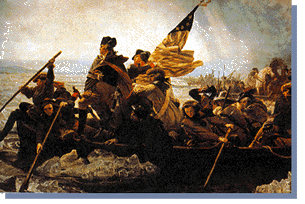
Washington Crossing the Delaware
|
By four in the morning there were nine long miles
to cover before wintry dawn. There was no smoking or talking
or halting or straggling -- surprise was essential on the road
that led to sleeping Trenton and its garrison of tough German
professionals.
Soaked muskets became useless, but Washington ordered:
"Tell General Sullivan to use
the bayonet. I am resolved to take Trenton." �And for
once, bayonets were available. Ice formed on the roads. Men fell
in a clatter of equipment, were pried to their feet, and went
stumbling on. Overhead the eastern sky began to pale. The columns
broke into what a soldier later called a "long trot."
The hundred-odd scattered houses of Trenton lay silent
under the storm, and ice glinted on picket fences, orchards,
and the hulking stone barracks built to house Royal troops during
the old French wars.
On high ground at present Princeton Avenue, Washington
appeared with his staff, and threw in Lord Stirling's brigade,
spearheaded by George Weedon's 3rd Virginia. Americans under
Captain William Washington and Lt. James Monroe cut down the
gunners about two Hessian fieldpieces. Arthur St. Claire's brigade
was in, and John Stark, leading its right element, "dealt
death wherever he found resistance and broke down all opposition
before him."
As their firearms dried out, riflemen took aim and
muskets began to pop all along the line. Colonel Johann Raul,
Commanding Officer of the Hessian troops, still dazed from his
holiday celebrations, raged up and down King and Queen streets,
bravely trying to rally his men. Then he was down, mortally wounded.
Sullivan swung his whole command up from the river to meet St.
Claire crashing down from the north, and the remnants of the
Trenton garrison downed arms in a dripping, winrty orchard.
The whole affair had lasted less than three-quarters
of an hour.
American casualties were light, but the Hessian commander
was mortally wounded in the ensuing battle, and more than 900
of his men were captured. Washington also came away with badly
needed arms and stores. After their earlier defeats in New York,
the Trenton victory restored the Americans' flagging morale. |
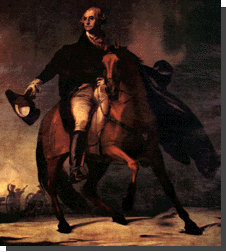
Washington Triumphant at Trenton
Picture Credits: Metropolitan Museum of Fine Art (top);
Union League of Philadelphia (bottom).
Bibliography: Bill, Alfred Hoyt, The Campaign of Princeton,
1776-1777 (1948; repr. 1975); Ketchum, Richard M., The
Winter Soldiers (1973) and The American Heritage History
of The American Revolution (1971); Smith, Samuel S., The
Battle of Trenton (1965).
� Copyright "The American Revoulution Home Page" - Ronald
W. McGranahan 1998 - 02 All Rights Reserved

The Battle of Monmouth was an indecisive engagement
in the American Revolution fought on June 28, 1778, near Monmouth
Courthouse (now Freehold), N.J. �The American army of about
13,000 men, including 2,000 Jersey militia, was led by George
Washington, who took a personal hand in the fighting, while
the British, numbering some 10,000 troops, were commanded by
Sir Henry Clinton. �The British
evacuated Philadelphia on June 18 and Clinton set out for New
York by land across New Jersey, with Washington, having broken
camp at Valley Forge, in pursuit. As
Clinton paused to rest at Monmouth Courthouse, Gen. Charles Lee
led an advance force of 5,400 men against the British rear guard.�
But due to Lee's bungling tactics the Americans soon fell into
confusion and began a disorderly retreat.
Washington now came on the scene, sharply upbraided
Lee, and rallied the troops. The Americans proceeded to repulse
two British attacks in heavy hand-to-hand combat. By sundown,
the intense heat of the day had taken its toll on both sides,
and the British slipped away under cover of darkness. American
casualties totaled 69 killed, 161 wounded, and 37 dead of sunstroke.
The British reported 147 killed and 170 wounded.� Lee was
court-martialed for disobeying orders. During the battle, the
heroism of the wife of one of the American soldiers who assisted
the American forces gave rise to the legend of Molly
Pitcher.
It was the last major conflict in the North and the
war's biggest one-day battle.
Monmouth Battlefield State Park was opened to visitors
in 1977.
|
Bibliography: Blacksby, A. D., Washington and the
American Revolution (1986); Smith, Samuel S., The Battle
of Monmouth (1964); Stryker, William S., The Battle of
Monmouth (1927; repr. 1970); Thayer, Theodore, The Making
of a Scapegoat: Washington and Lee at Monmouth (1976); Wood,
W., Battles of the Revolutionary War, 1775-1781 (1990).
� Copyright "The American Revoulution Home Page" - Ronald
W. McGranahan 1998 - 2002 All Rights Reserved

�From the summer of 1776 the strategic initiative
was taken by the British, who believed that the real core of
the insurrection was in the northern tier of colonies, especially
in New England. To bring the war to an end in 1776, British planners
sent reinforcements to Maj. Gen. Guy Carleton, governor of Quebec,
who had already defeated Arnold and Montgomery. Carleton should
push the Americans from their remaining toeholds in Canada and
pursue them down the Lake Champlain-Hudson River trough, which
might be a means of cutting the colonies in half.
Simultaneously, a much larger army headed by Maj.
Gen. William Howe, who had replaced Gage
as supreme commander, should capture New York City and its splendid
harbor, a strategic base from which it could advance up the Hudson,
unite with Carleton, and overrun New England. But Carleton, after
driving his opponents back, was delayed by problems of supply
and the difficulties of wilderness campaigning. Then, near Valcour
Island on Lake Champlain, his naval complement was checkmated
by a tiny American fleet hastily assembled by Benedict
Arnold. Time was always of the essence in fall campaigning,
and the lateness of the season now prompted Carleton to return
to Canada for the winter.
Howe's chances of completing his part of the two-pronged offensive
seemed more promising than Carleton's. Howe launched his campaign
with the largest force he or any other British general had at
his disposal during the war: 32,000 soldiers, together with 400
transports and 73 warships under his brother, Vice Admiral Richard,
Earl Howe, with whom he shared the American supreme command.
From a military viewpoint, Washington
should not have attempted to retain New York City, with its hard-to-defend
islands, rivers, bays, and inlets, although Congress
saw strong psychological reasons for holding a major city whose
loss might dispirit patriots everywhere. As it was, Washington
suffered a defeat on Long Island (Aug.
27, 1776). Fortunately for him, Howe did not attempt to follow
up his victory quickly. The explanation may be that the Howe
brothers, who were also peace commissioners, hoped to convince
the Americans to lay down their arms, apparently in the belief
that leniency might encourage the rebels to do so. If that was
their theory, it failed.
Washington fought a series of rearguard actions with Howe on
Manhattan Island, with the result that it took the sluggish Howe
from August to November to clear his opponents from New York
City and the surrounding area. Howe, like Carleton, never made
his move along the Hudson, but contented himself with pursuing
the retreating Washington across New Jersey until the Americans
managed to escape over the Delaware River into Pennsylvania (Dec.
7, 1776) |
Author: Don Higginbotham - Permission given by the author.
Bibliography: Alden, John R., A History of the American
Revolution (1969); Bailyn, Bernard, Ideological Origins
of the American Revolution (1967); Bemis, Samuel Flagg, The
Diplomacy of the American Revolution (1957; repr. 1983); Dupuy,
Richard E., The American Revolution, a Global War (1977);
Higginbotham, Don, War of American Independence (1971);
Langguth, A. J., Patriots (1988); Morgan, Edmund S., Birth
of the Republic, 2d ed. (1977); Morris, Richard B., The
American Revolution: A Short History (1979) and The Forging
of the Union 1781-1789 (1987); Shy, John, A People Numerous
and Armed (1976); Stokesbury, James L., A Short History
of the American Revolution (1991); Tuchman, Barbara, The
First Salute (1988); Wood, Gordon, Creation of the American
Republic (1969).
� Copyright "The American Revoulution Home Page" - Ronald
W. McGranahan 1998 - 2002 All Rights Reserved

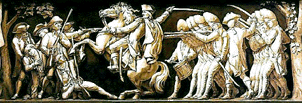
|
The Battle of the Brandywine, fought on Sept. 11,
1777 along Brandywine Creek in Pennsylvania, 25 miles (40 km)
southwest of Philadelphia, was a victory for the British during
the American Revolution. �Intending to capture Philadelphia, Gen. William Howe landed on Chesapeake Bay
with 15,000 men and moved north toward the city. George
Washington met him at Brandywine Creek, near Chadds Ford,
Pa., with an army of 11,000.� Howe successfully used a flanking
movement to drive the Americans from the field, but Washington
managed to withdraw most of his troops safely.
Early in 1777, British military leaders discussed
how to cut New England off from the other colonies. It was decided
that Gen. John Burgoyne was to march
on Albany, N. Y., while Gen. William Howe advanced on Philadelphia.
On July 23, 1777, Howe sailed from New York with more than 15,000
troops, arriving at Head of Elk on Chesapeake Bay on August 25.
Gen. George Washington quickly marched 11,000 men to challenge
Howe, and the two armies converged at Chad's (Chadd's) Ford,
Pa., on Brandywine Creek.
Gen. Nathanael Greene commanded
the American center. To his left was the Pennsylvania militia
under Gen. John Armstrong, and on the right were three divisions
under Gen. John Sullivan. While Gen.
Wilhelm von Knyphausen feinted an attack against the American
center, Gen. Charles Cornwallis led the
remaining British forces northward. Quietly crossing the Brandywine
above its forks, Cornwallis suddenly fell on Sullivan's troops
from the rear.
When Washington learned that his right wing was in
danger, he sent Greene and two brigades from the center to aid
Sullivan. Greene's splendid stand saved the Americans from possible
disaster. The American army, though badly battered, was still
intact. Howe's capture of Philadelphia proved of no strategic
value, but as a result were able to occupy Philadelphia during
the winter of 1777. |
Bibliography: Canby, H. S., The Brandywine, 2d ed.
(1977); Smith, S. S., The Battle of Brandywine (1976).
� Copyright "The American Revoulution Home Page" - Ronald
W. McGranahan 1998 - 2002 All Rights Reserved

|
�The Battle of Cowpens was an American victory
during the American Revolution.� On Jan. 17, 1781, Brig.
Gen. Daniel Morgan, with about 1,000 men, met a British force
of 1,100 under Col. Banastre Tarleton
at the Cow Pens, north of present Spartanburg, S.C.
Gen. Nathanael Greene, on
assuming command of the Continental army in the South, where
the British under Lord Cornwallis were
making substantial gains, decided to take the offensive. To move
against Cornwallis' flanks, he divided his army, sending one
detachment southeast and another southwest. From Charlotte, N.
C., Morgan marched 58 miles (93 km) southwest and camped by the
Pacolet River on Dec. 25, 1780, with about 1,690 men. Cornwallis
sent Tarleton with about 1,040 men to engage Morgan.
Morgan took a position near Hannah's Cowpens between
the Pacolet River and Thickety Creek. He placed his main force
on two hills. In front of them he deployed a line of riflemen
and a line of 300 militia. On the morning of January 17, Tarleton
attacked. He pushed back the two front lines but suffered losses.
While the patriot militia withdrew by a prearranged route, the
British, sensing victory, charged the American line on the first
hill. They were routed by the Maryland and Delaware Continentals.
Tarleton escaped, but at least 600 of his men were
killed, wounded, or captured. Morgan had won a momentous victory
with minor losses. The British campaign in the South was seriously
affected. A portion of the field is now the Cowpens National
Battlefield Site. |
Author: Paul C. Bowers, Jr., Ohio State University
� Copyright "The American Revoulution Home Page" - Ronald
W. McGranahan 1998 - 2002 All Rights Reserved

|
The Battle of Long Island, an engagement of the American
Revolution, fought on Aug. 27�30, 1776. After the British
abandoned Boston on March 17, 1776, General
Washington moved his army to New York City, believing it
to be the next point of attack. On August 22, the British transported
an army of 32,000 from Staten Island across the Narrows to Long
Island. Washington knew that to defend New York, he must hold
Brooklyn, just across the East River on Long Island. Accordingly,
he moved some 7,000 men to increase the Brooklyn forces to about
19,000.
The Americans hurriedly built fortifications on Brooklyn
Heights and established an outer defensive position behind a
long ridge running eastward from Gowanus Bay at the western end
of Long Island. Unfortunately, Israel Putnam, the local commander,
failed to provide any defense for his eastern flank at Jamaica
Pass.
On August 27 the British attacked the American right
in a holding attack, while a large body made an end-run through
the undefended Jamaica Pass. Despite brave fighting on the American
right, the entire defense collapsed in utter confusion. The Americans,
with a loss of 1,012 against 392 for the British, fell back to
the entrenched positions on Brooklyn Heights.
Fortunately for Washington, Howe did not attempt to
follow up his victory quickly. The explanation may be that the
Howe brothers, who were also peace commissioners, hoped to convince
the Americans to lay down their arms, apparently in the belief
that leniency might encourage the rebels to do so. If that was
their theory, it failed.
Washington recognized the futility of further resistance
on Long Island. On the stormy night of August 29�30, through
a combination of good luck and good management, he moved the
entire American force across to the New York shore with the loss
of only three stragglers.
Washington fought a series of rearguard actions with
Howe on Manhattan Island, with the result that it took the sluggish
Howe from August to November to clear his opponents from New
York City and the surrounding area. Howe, like Carleton, never
made his move along the Hudson, but contented himself with pursuing
the retreating Washington across New Jersey until the Americans
managed to escape over the Delaware River into Pennsylvania (Dec.
7, 1776). |
Authors: Edward P. Hamilton, Director, Fort
Ticonderoga; Ronald W. McGranahan (contributing).
� Copyright "The American Revoulution Home Page" - Ronald
W. McGranahan 1998 - 2002 All Rights Reserved

Ticonderoga, a stone fort between Lake Champlain and
Lake George in what is now northern New York State, was an object
of contention during the French and Indian
War of 1754-63 and the American Revolution. The French built
it in 1755 as an outpost of Fort Saint Frederic (Crown Point)
and named it Carillon. In 1758 the marquis de Montcalm repulsed
a British assault led by Maj. Gen. James Abercrombie in one of
the bloodiest battles of the colonial wars. Jeffrey Amherst succeeded
in taking it from the French the following year.
At the beginning of the Revolutionary War, Ethan
Allen and his Green Mountain Boys seized (May 1775) Ticonderoga
from the British. Gen. John Burgoyne
recaptured it in 1777, but the British abandoned it later in
the year. Restored in the early 20th century, it stands today
as a historic monument. |
Author: Don Higginbotham - Permission Given By The Author
Bibliography: Hamilton, E. P., Fort Ticonderoga: Key
to a Continent (1964).
� Copyright "The American Revoulution Home Page" - Ronald
W. McGranahan 1998 - 2002 All Rights Reserved
| Back to Timeline
| or click on your browser's "back to previous page"
button
 �����
� Copyright "The American Revoulution Home Page" - Ronald
W. McGranahan 1998 - 2004 All Rights Reserved
�����
� Copyright "The American Revoulution Home Page" - Ronald
W. McGranahan 1998 - 2004 All Rights Reserved