








THE MAN WHO BROKE A THOUSAND CHAINS
PART II
(Click on anything in color to view photograph or image)
RECAPTURED!
Robert Burns approached his wife Emily. It was time to end their sham marriage and to divorce, so Burns would be free to marry his true love, Lillian. At first Emily was agreeable, but her attitude hardened as time passed. After weeks of bitter negotiations, and threats of exposure and betrayal, she finally agreed to a financial settlement. She also agreed to continue to keep his secret. However, on March 28, 1929, a letter was mailed from Chicago to Georgia, notifying prison officials there where they could find the fugitive Robert Elliot Burns.
On May 22, 1929, two Chicago detectives arrived at Burns' office armed with an arrest warrant from the state of Georgia. He was arrested and held for extradition while his friends immediately went to work to free him. His brother Vincent also arrived from Palisade, New Jersey, where he served as a minister, to help plead his case. Burns had few options. Since he had been released on bail he could flee the area or he could fight extradition. A third option was to turn himself over to the Georgia authorities and plead for mercy and justice.
In order to help fight his extradition, his friends publicized his case nationwide. They arranged for interviews with Burns for all the leading newspapers, magazines and newsreel companies. His tales of chain gang brutality and corruption in Georgia helped to swing public opinion in his favor, but it also helped to antagonize and infuriate state officials. It would not be the last time that his celebrity status would prove to be his undoing.
Burns decided to drop his fight against extradition after Georgia prison officials assured him he would not be returned to the chain gang, and he would almost surely be released in 45 to 90 days, although his friends and lawyer argued strenuously against his decision. With the intense public interest in his case throughout the country, Burns was confident Georgia could never renege on their agreement. With Georgia's assurances and Lillian's promise to wait for him, Burns left Chicago on June 24, 1929 on a train bound for Atlanta. When he met with the Georgia attorney he had hired he was assured once again he should be released in 90 days. But if there was a problem the attorney promised, "I can positively secure your release after twelve months." Burns was dumbfounded. "Twelve months?" This was impossible! It was the first sign that things may not go as promised.
Exactly seven years and five days after his escape, Burns arrived back at the Campbell County chain Gang from which he had escaped. He was a celebrity, and local people would often come to view him through the fence, while newspaper reporters interviewed him on an almost daily basis. He stayed there for five weeks, and was treated according to Georgia's agreement. He was made a trustee and was given a job in the warden's office. However, it appeared Georgia was just waiting for public sentiment to die down, for after five weeks he was transferred to the Troup County stockade, the toughest, most brutal camp in Georgia, and returned to the endless toil of the chain gang. There was one improvement in the treatment of prisoners, Burns discovered. The strap had been outlawed since he had escaped, and instead a new punishment was being used, the "stocks."
Burns' first hearing before the Prison Commission that could grant him parole was held two month after his arrival. It was attended by his attorneys, his brother Vincent, and various friends and business associates. Despite their impassioned pleas for justice, his parole was turned down. Even a personal appeal by his mother to the Governor proved fruitless. His next hearing was scheduled almost a year later in July, 1930. Again the same arguments were made for his release, but the Prison Commission withheld their decision. As the months passed by, the Commission still refused to rule one way or the other. By September, Burns was convinced they were just stalling till public interest died down and they could decide against him without adverse publicity. He was now sure the only way he would leave the chain gang was the same way he had left eight years earlier, escape!
ON THE LAM AGAIN
Burns knew his only hope of escape was with the help of an outsider, but he had no one in mind. Having secreted $150.00 into the prison (with the help of his brother), he had the money to bribe someone, he just need to find the right person. As luck would have it, Burns met his accomplice while working on a road with the crew. By now he was a trustee, which allowed him some freedom to separate from the work gang and to move about without chains. Often people passing by would recognize him from the newspapers and strike up a conversation. On one such occasion he flashed a $50.00 bill at a poor local farmer and asked his help. The farmer agreed to help for $100.00, and arranged to be waiting nearby in the woods with an automobile and a change of clothes. Two days later on September 3, 1930, Burns raced 300 yards into the woods to a prearranged place and jumped into the farmer's car. They were gone before the guards could react.
The driver left Burns at nearby College Park, and he made his way north by rail and bus. Again lady luck smiled upon him, and after four days he was in Newark with $5.00 in his pocket and no real plan. His first stop was at his brother's home in nearby Palisade (now Fort Lee), where he served as the minister of the Union Congregational Church. Arriving at Vincent's house a few blocks from the church, he found it empty. His brother was away. He next tried his mother in Massachusetts and was relieved to find that his brother was visiting there. Vincent arranged to wire $25.00 to him so he could survive till Vincent could get home. A few days later, they were all reunited at Vincent's home in Palisade.
As before, Burns felt it was best to hide in a large city, so he made his way back to Newark to search for a job. The Great Depression still prevailed, and finding a job was not easy. Many nights he found himself sleeping on the streets. He decided to return to a business he was familiar with and applied for a job with the Newark Ledger (now the Star-Ledger) as an advertising salesman, using the alias John Pashley. He quickly proved successful and was soon living the life of a normal white-collar worker. His success proved short lived, however, when a fellow employee recognized him from his days in Chicago and reported him to his boss. The newspaper did not call the police, but they did ask for his resignation.
The quickness with which he was recognized made Burns uneasy. From then on he decided to stay more underground and to move and change jobs often. He worked at various occupations including sales, roadwork and deliveryman. He also changed his alias to Richard Crane. He maintained contact with Lillian Salo, and twice he sent money for her to travel to Newark, but on both occasions she never arrived. After he was stood up for the second time she stopped writing. These were the worst times for Burns. He was depressed, physically ill and had lost hope.
He was on his way back from Penn Station after the second disappointing non-reunion with Lillian when in his dazed condition he bumped into someone a few blocks away. The man stared at him for a second, and Burns could sense recognition. He hurried away, thinking the stranger may be a policeman, but he could here the man's footsteps behind him. He began to run, but the man's footsteps quickened to match his pace. They raced blindly through the foggy night until Burns tried to throw off his pursuer by ducking into a speakeasy. The man followed and the two stood face to face. It was impossible, but it was true! They shook hands as they spoke. "Hello, Burns," said the man.
"Hello, Moore," Burns replied. It was Moore who along with Flagg and himself had held up the grocery store back in 1922! Moore was an escapee like himself. What were the odds that two fugitives from the same chain gang serving time for the same crime would meet 1500 miles away! What an amazing coincidence that their paths would cross again. They two escapees enjoyed a few drinks together, and Burns' mood and outlook improved. He even began dating a woman he met that night at the saloon.
THE CONVICT MAKES A DIFFERENCE
Early in 1931, with the assistance and encouragement of his brother Vincent, Robert Elliot Burns began to write his story for "True Detective Magazine." Entitled "I Am a Fugitive from a Georgia Chain Gang," Burns pulled no punches with his account, depicting the corruption and brutality of the chain gang system. It was serialized over six months and proved a tremendous hit, reaching over ten million people.
Things began to look up for the fugitive. His story was a success, he found steady employment at a factory in Chrome (Carteret), and Lillian had contacted him again. She explained that she had been unable to come to Newark on the last occasion because of illness, and was then too embarrassed to write again. The explanation was reasonable, at least to someone in love as Burns was. His job at the United States Metals Refining Company in Chrome was probably the most interesting he had during his time on the run. He was lowered onto huge slag piles of molten metal, where he would place dynamite in strategic places to clear room for more slag. He became a dynamite expert, and when a large brick stack needed to be taken down at a nearby factory, he was hired to do the job. The job became an event and hundreds came to view the stack's demolition. For the next few weeks, if moviegoers looked carefully, they could see the fugitive as "Dynamite Dick" on the big screen, for the event was filmed by a national newsreel company. All good things must come to an end, however. Burns was eventually recognized by a fellow employee and on the run again.
Burns settled again in Newark, and asked his brother Vincent to rewrite his story for publication in book form. Vincent, besides serving as pastor in Palisade, was an accomplished poet and writer. He even had his own radio show on the subject of poetry at WOR studios in Bamberger's department store in Newark. After a number of rejections, Vanguard Press released it, and it was as big a hit as the magazine serialization. Almost immediately Warner Brothers purchased the film rights and asked Robert Burns to act as technical advisor.
THE FUGITIVE GOES HOLLYWOOD
In the Spring of 1932, Robert Burns left for Hollywood by train. On the way he had decided to stop in Chicago to see Lillian who again had stopped writing. He was taking a great risk, for Georgia officials had become incensed that the fugitive was not only defaming them and their great state, but also profiting by doing so. They were now offering a reward for his capture, and he was well known in Chicago.
When he arrived at Lillian's apartment, he found she had recently moved. The new tenant gave him her forwarding address. When he found her new home it was located in one of the more exclusive suburbs of Chicago, and when he rang the doorbell, a maid answered. "How could Lillian afford such a house", he thought. When she came to the door their eyes met. "Lillian drew back with a little gasp of surprise," he wrote. "She was as cold as a cake of ice. There was scorn, even fear, in her eyes."
"Please go away - I am married," she said as she closed the door. She had promised to wait, promised to love him forever, and now she was scared and embarrassed to even be seen with him! After all the letters and promises she was married! Burns took the next train to Hollywood dazed and heartbroken.
Burns arrived in Hollywood and proceeded to get to work. Expecting a large hulk of a man, the production crew was amazed that someone as frail looking as Burns could survive everything he had written about. A newspaper had reported that Burns was assisting with the movie, so he needed to be careful and keep a watchful eye out for Georgia detectives. Although the studio assured him that with their influence with California officials he had nothing to worry about, he was taking no chances. At the first sign of trouble he was leaving. That first sign arrived a few weeks later when a detective arrived at the studio asking questions. Burns never even said goodbye. All he left was a note that read, "It's getting hot. I'm off. Burns."
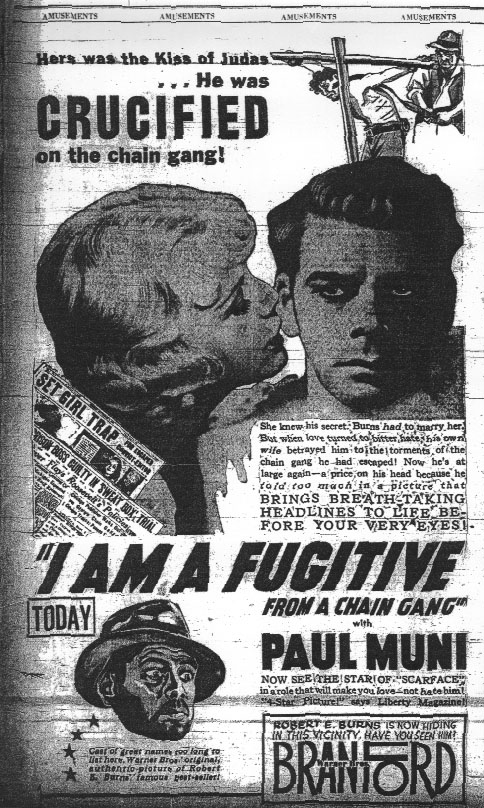
The movie, "I Am a Fugitive from a Chain Gang," opened in Atlanta, Georgia, on November 11, 1932, at the Warner Brothers Theatre. All references to the State of Georgia were deleted form the film under threat of lawsuit. The film starred Paul Muni as the fugitive, an excellent choice because of his physical resemblance to Burns as well as his excellent acting ability and star power. The reviews were almost universally positive, and it was praised as "gripping," "powerful" and "moving." Two days later it premiered in New York City, and Warner Brothers arranged for a box to be reserved for Vincent Burns and guests. Although the audience enjoyed the film immensely, Vincent Burns later wrote, "I was wholly unprepared for the shock that was mine that night."
Although the film was mostly faithful to Robert and Vincent Burns' story (though somewhat "spiced" up), Vincent's character was portrayed as an ineffective do-gooder who was partially responsible for his brother's recapture. At one time Warner Brothers had considered having him appear in the film as himself, and now his role was reduced to this! His was so insulted by this portrayal, he considered suing the studio, but after a few days he decided to if not forget it, at least accept it.
On November 15, 1932, "I Am a Fugitive from a Chain Gang" opened in Robert Burns' hometown, Newark, at the Branford Theatre. Vincent Burns had been asked by the manager to make a speech prior to its first showing, and he did so, not knowing his brother was sitting in the audience. He had been warned that the Newark police would be staked-out at the theatre, but he could not resist seeing the film for the first time. He disguised himself by not wearing his glasses. The ruse worked, although another near-sighted theatre patron was arrested and held for a short time.
CLICK HERE TO CONTINUE TO PART III