








THE MAN WHO BROKE A THOUSAND CHAINS
PART III
(Click on anything in color to view photograph or image)
THE STATE OF GEORGIA MAKES ITS MOVE
Robert Elliot Burns became more and more comfortable in the State of New Jersey. He felt protected by his brother's friends in high office and position, and favorable public sentiment. But the State of Georgia never gave up trying to recapture him. With every speech and interview Burns gave, Georgia intensified the pressure. And with every speech and interview Burns gave, officials in the State of New Jersey, who had pledged their support, became more and more nervous. Once again, his celebrity status proved his undoing. The final straw was an interview Burns gave to a local newspaper, The Newark Call, which told of his location and even included a picture of him. The police chief in Newark took it as a personal insult that Burns would flaunt his presence in his jurisdiction. It did not help matters that the police department was in the midst of a scandal and needed to divert public attention elsewhere.
In December, 1932, a newspaper reporter learned that the Newark Police Department was planning to arrest Burns, and tipped him off at while he was having lunch at the Robert Treat Hotel. Burns immediately called his brother Vincent who contacted Governor A. Harry Moore to intercede on their behalf. Governor Moore had with both men on two earlier occasions and promised his support if necessary. But he was now alarmed at the publicity and newspaper reports. "I'll do my best for you," he said, "But you know I can make no promises now."
Vincent Burns decided to take matters into in own hands and traveled to Trenton to visit his good friend Harold Hoffman, the head of the Division of Motor Vehicles and a political power in North Jersey. Hoffman gave Vincent a note addressed to Newark's police commissioner asking him to assist in any way possible. On December 14, 1932, Vincent went to Newark City Hall to see the police commissioner. His fugitive brother accompanied him, but to be safe, he remained at a nearby bookstore next door to the Mosque Theatre on Broad Street. The police commissioner was not in, and Vincent was escorted to see the police chief at Police Headquarters next door. When he met with chief, Vincent knew his brother was in serious trouble. The chief was bound and determined to arrest Robert Burns at the first possible instance.
So alarmed was Vincent Burns after his meeting with the police chief, he did not immediately return to meet his brother. Instead he stopped at various places along the way in case he was being followed. When he finally arrived back at the bookstore his brother was frantic. "What took so long?" he asked. They two men crossed Broad Street to grab a bite at the diner and plan their strategy. Just as they were about to enter the building they were blocked by a large man with his right hand shoved deep in his pocket. "Doctor, the chief would like to see you. And bring your friend along."
CAPTURED AGAIN!
The jig was up! Robert Elliot Burns was a prisoner once again with no assurance of deliverance. One look into the cold, unfeeling eyes of the chief of police caused Burns to almost lose hope. In fact, the chief made a point of taunting him. "You've thumbed your nose at the law one time too often, Burns. If you think you can spit on the law and get away with it you're very much mistaken. I read your book. I saw your picture. And it's just a lot of hooey! I come from the South and there are no such cruelties as you described in the chain gang. Now we're going to give you a little time to cool off behind bars!" He added, flourishing a copy of Burns' recent interview with The Newark Call, "What do you mean by saying Governor Moore will not send you back? We'll see about that! He'll have to extradite you or be impeached!"
Burns was led to cell at the police station to be held until an appearance before a judge to set bail. Vincent immediately went to work again, hiring a lawyer, Charles Handler, and contacting his friends in politics, business and the religious community. He also raised enough money to cover the expected bail of $1,000 or $2,000 dollars so the prisoner could be released pending his extradition hearing. They were all taken aback when on the following morning the judge set bail at $25,000! There was no way they could raise that kind of money, so Burns was transferred to the Essex County Jail on Newark Street.
Once again Robert Burns became despondent. He was convinced the "fix was in," and there was no way to avoid returning to the hell of the chain gang. For every bit of promising news his brother would bring to him, another rumor or scandal would appear in the newspapers. First, Sydney Flagg, the ringleader of the botched robbery which caused his imprisonment to begin with, claimed in a newpaper story that Burns had abetted in many other crimes with him, not just the one he was arrested for. Burns vehemently denied the charges, and when the dates Flagg gave were scrutinized, they did not match reality. Burns was still in New Jersey when many of the supposed crimes occurred.
Another charge could not so easily be denied, however. A few days before his extradition hearing a newspaper published a report that Burns was wanted in the State of New York for forgery. There was some truth to this story. In fact, when the fugitive had appeared at his brother's seminary ten years earlier to borrow $50.00, it was in order to flee to avoid the charge. Burns claimed the entire affair was a "setup." New York decided they did not have enough evidence, ten years after the fact, to try him, so they notified New Jersey they had no interest in extraditing him. This blemish stained Burns, however, and he lost some public and political support.
The majority of the public was still convinced that Robert Burns should be free, and they had no hesitation writing and wiring the governor to tell him so. Vincent continued to plead his brother case by letter, speaking engagements and on his radio show. The prisoner, however, remained despondent. The day before his hearing he swore to his brother that he would not go back to Georgia, no matter what Governor Moore ruled. He asked Vincent to arrange for poison to be slipped into his cell just in case. "If the verdict goes against me, all that Georgia will get is a corpse." Vincent, of course, refused.
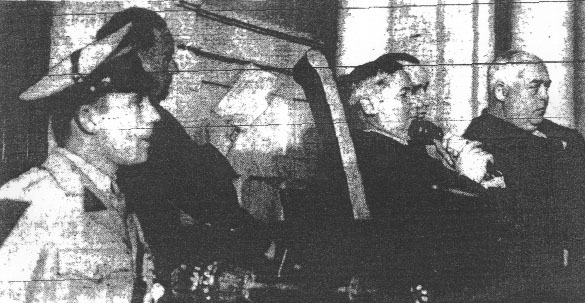
On December 21, 1932, New Jersey Governor A. Harry Moore called the extradition hearing into session. Troup County Warden Harold Hardy and Police Chief R. B. Carter represented the State of Georgia. They outlined their case against Burns, and insisted Governor Moore return him to serve his sentence. Burns and his attorney insisted Georgia had reneged on the deal they made in Chicago in 1929. Burns had served more than the agreed upon ninety days and had reimbursed the state for the cost of his extradition as promised. Therefore he should be freed. Georgia argued they had never made any such agreement. But when Burns' attorney produced a copy of the check for reimbursement and a letter from the presiding judge at the Chicago hearing outlining the agreement, Moore interrupted the proceedings. "I have heard enough. I am constrained to deny extradition."
As soon as the assembled crowd realized what Governor Moore had said, pandemonium broke out. Vincent and his mother raced over to hug the now free prisoner. The audience broke into spontaneous cheering and applause which "raised the rafters of the assembly hall at Trenton." Hundreds of people pushed forward to congratulate Burns and shake his and the Governor's hands. When Burns and his family made it over to where Moore was standing, his mother said, "Governor Moore, you've made this the most wonderful Christmas of our lives." Burns himself was too choked up to speak, and instead kissed the Governor's hand. "Burns, you can stay in New Jersey as long as you lead an honest life. The way to thank me is to live as a good citizen. Never mind the publicity stuff."
New Jersey most famous fugitive was now free, at least in the State of New Jersey. Georgia could not touch him as long as he stayed there. For the first time in ten long years, Robert Elliot Burns could walk the streets without fear of arrest and imprisonment. He could once again live the life of a normal citizen without looking over his shoulders. It took a decade, but he could truly be at peace again.
Despite Governor Moore's direction to avoid publicity, Robert Burns found it hard to give up his life of stardom. He continued to speak at various theatres showing "I Am a Fugitive from a Chain Gang," and traveled with a vaudeville show for a short time. He also appeared at fairs, resorts, and even in Atlantic City. In 1938, he wrote a book about the experiences of a fellow chain gang prisoner, Jack "Killer" Martin, entitled "Escape to Prison." This book, though not as popular with the general public, was even more descriptive of the utter brutality of prison life in the South. Eventually, Burns did settle down. He married a woman named Clara Graykoska, and together they had four children. He moved to Union, New Jersey, and worked the rest of his life as a tax consultant. Georgia made a few more attempts at extradition after A. Harry Moore left office, but later governors found no reason to overturn his decision. Finally, in 1945, Burns returned to the South at the invitation of Georgia Governor Ellis Arnall, to gain a full commutation of his sentence. This time Georgia kept its promise and Burns was now a free man in all forty-eight states.
If Robert Elliot Burns could finally leave the limelight, his brother Vincent Burns never could. Perhaps it was his portrayal in the movie, or perhaps he just needed the publicity, but Vincent could not give up his celebrity status. In 1934, just as the Lindbergh kidnapping case was coming to a close, a crazed Vincent yelled through an open window into the courtroom that Bruno Hauptman was innocent and another man had confessed his guilt to him. The minister was led off in handcuffs and barely avoided contempt charges. He did however make the front page of many newspapers. His involvement with political and social causes finally led to a much-publicized split with his congregation, and eventually with the church itself. His wife may have explained it best in her 1936 divorce suit when she said, "He had become unbearably vainglorious and an indefensible slave to an ever expanding desire for publicity." In 1941, Vincent attempted to be restored to the ministry in order to serve as a chaplain in World War II, but was unsuccessful. He was, however, successful with his poetry and prose, churning out over a dozen books over the next 30 years, including, "Out of these Chains," a sequel to "I Am a Fugitive from a Georgia Chain Gang," and "Female Convict," an expose of women prisons. But his forte was extremely patriotic and religious poetry. In 1951 he settled in Maryland, and in 1962 Maryland Governor Tawes named him the second Poet Laureate of the state, creating a stir of controversy. He died in 1970.
On June 5, 1955, Robert Elliot Burns died at the age of 63 after a long battle with cancer. Funeral services were held at St. Michael's Roman Catholic Cemetery in Union, and he was buried at Beverly National Cemetery in Burlington County, New Jersey. His death may have ended Burns' life, but it did not end his legend. HBO films retold his story in 1987 with Val Kilmer in the starring role. He has also been the subject of numerous newspaper stories, magazine articles, and television documentaries over the years.
Burns' book, and the film it inspired, eventually led to dissolution
of the chain gang in the South and the corrupt system that created
it. It is arguably one of the most important movies ever made in the
history of film. Due to his courage and perseverance, thousands of
prisoners were spared the brutality of chain gang life. He released
many from their chains, and kept many from ever wearing them. That is
why Robert Elliot Burns will forever be known as "the man who
broke a thousand chains."
This
is the story of courage,
Oh
hear it, ye children of men,
Of
a man who kept his self-hood
Though
chained in a prison pen.
Of
a will that would not be broken,
Of
a Heart that arose serene
In
the midst of the darkest wrongs
This
world has ever seen.
You
defamed their sacred commandments,
Their
honorable laws, they said,
And
now a nations derision
Is
heaped upon their head.
The
world has seen their dishonor
And
the earth their deep disgrace -
No
wrong can be hid forever
From
the light of God's face.
They
ridiculed you and betrayed you
And
your pleadings year by year,
More
sinned against than sinning,
You
kept your record clear
They
could chain you, beat you, confine you
But
Something in you could speak
Words
that would break their system
And
free the hordes of the weak.
In
all your travail and labor
And
in all of your grief and pains,
Though
lashings and grim dangers
And
curse of the heavy chains,
You
kept your heart untainted
Of
hatred's poisonous brew
And
prayed for your cruel captors
The
while they were beating you.
Through
darkness, despair and struggle
And
days that were hopeless and hard
You
have become the agent
Of
the providence of God,
The
brother of Christ who came to earth
To
all the chains that bind,
To
free the slaves and the captive
And
the darkened human mind.
Vincent Godfrey Burns
"Out of These Chains"
1957 Reissue