FRENCH NAVAL LEADERS
AND THE
FRENCH NAVY
IN THE
AMERICAN WAR FOR INDEPENDENCE
|
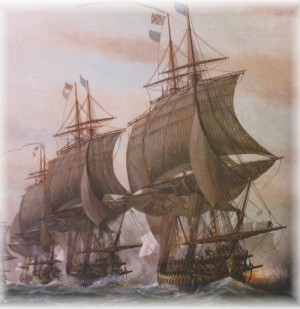
French ships of the line, Ville de Paris and Auguste, engaged in the famous 'Second Battle of the Virginia Capes' in September 1781. Detail from oil painting by Zveg and held by the US Naval Historic Center, Washington, DC.
|
|
Brief Introduction of the Royale Marine during 1775-1783
The French Navy's role in the success of the American Revolution is seldom acknowledged in general American histories. Yet it is difficult to see how American independence could have been won -- at least in that particular war -- against a regime that was the world's acknowledge leading naval power in terms of ship inventory and recent combat exploits. Certainly, the undisputed expert on the war, General Washington, appreciated the critical importance of naval presence in the North American theater. As long as the British navy could support their army's operations along the eastern coastline, the rebellion was doomed.
The French naval success at the Second Battle of the Virginia Capes in September 1781 was �the keystone' of the Yorktown Campaign, and provides dramatic testimony of the French Navy's contribution to the American cause in that theater of operations. In all due respect to the modest Continental and American state navies, and to the spectacular performances of the American privateers, it was the Royal French Navy that was the only �standing navy' to serve the American army in terms of engaging British naval formations and supporting land operations in North America.
The American rebels did not produce the arms and gunpowder needed to confront the British forces sent to put down the rebellion. Even before the French Alliance in 1778, the American rebels sought and received from Europe the needed mat�riel, the military engineers and other officers with professional skills, and the funds to finance the war. These basic resources that sustained the American forces in the field until Yorktown were delivered largely due to armed escorts of the French Navy. American privateers, operating out of European ports, received significant personnel and mat�riel support directly from the French Navy. It was the French navy that achieved a dominance in possession of the vital West Indian islands that were the life line in logistical support of the Americans. The professional French expeditionary army and siege train that joined Washington in 1780 were transported by a French naval squadron; this factor and the French fleet that appeared off the Virginia coast at the end of August 1781 are symbolic of the �projection of French armed forces across the Atlantic', penetrating the numerically superior British Navy's efforts to isolate the colonies.
However, as important as the North American theater was, the French Navy forced the British to fight a global war that reached from the Hudson Bay to the Indian Ocean, from Newfoundland to the northen coast of South America and western coast of Africa. Eventually France was able to elicit the assistance of the Spanish Navy to at least confront the British numerical strength which helped in the global dispersion of the war. Just as importantly, French naval power continued to maintain a dynamic offensive in the Bay of Bengal, in the Mediterranean, and in the Caribbean as the peace treaties were being negotiated in 1783.
The breath and scope of the French naval participation in the American War for Independence may be hidden from those who are confined to Anglophone sources of the history. The explanation requires an analysis too lengthy to be addressed here. On a positive side, one might note an overview observation Jack Coggins makes in his �Introduction' to Ships and Seamen of the American Revolution � vessels, crews, weapons, gear, naval tactics, and actions of the War for Independence (Stackpole, 1969) p.11:
"The average American history book tends to treat the naval side of the war as a series of ship-vs.-ship incidents and dwells more on its military aspects. But the struggle for North America was fought not only at Trenton, Monmouth, Camden, and King's Mountain. It was fought in the cold, gray seas of the western approaches off Ushant; off Cadiz, and in the shadow of grim Gibraltar; and in the clear tropical water of the West Indies. Renowned as the long fight of the Bonhomme Richard and the Serapis, and the capture by the Thorn of two English sloops of war, it was not by such isolated incidents that independence was won. Ships' actions there were in plenty, and the privateers who swarmed out of American [and European!] ports did grievous hurt to England's merchant marine. But the decisive factor was the often complicated and sometimes almost bloodless behind-the-scenes maneuvering of the fleets of great naval powers." [webpage edit injected within brackets as well as use of bold front]
However, Coggins goes on to say that "a detailed history of the world-wide sea war of 1778-1783 [was] ... beyond the scope" of his book. Fortunately for the Anglophones, there are two scholarly works that provide considerable background on this topic:
Ernest H. Jenkins. A History of the French Navy from Its Beginnings to the Present Day (Annapolis: Naval Institute Press, 1973), especially �Chapter X: Reform: Recovery: Revenge', pp.142-200.
Jonathan R. Dull. The French Navy and American Independence; A Study of Arms and Diplomacy, 1774-1787, (Princeton University Press, NJ, 1975).
The geographic scope of the French naval participation is identified in webpage:
'Table Summary of Movements of French Naval Fleets During the War for American Independence'.
Other related topics on this subject are at the following webpages:
'World War Context of the American Revolution'.
'Yorktown Campaign (1781)'.
'Second Battle of the Virginia Capes (1781)'.
'West Indies Score Card During the American War for Independence'.
Presently, this rest of this page is a 'working draft' to acknowledge the contribution of specific French naval leaders listed below.
|
- Links [not yet activated] to specific pages on others who influenced the roll of the French Navy in the American war:
- Choiseul and de Choiseul-Praslin
- Louis XVI -- 'The Sailor King'
- Comte de Vergennes
- Antoine-Raymond-Gualbert-Gabriel de Sartine, comte d'Alby
- Charles de La Crois, Marquis de Castries
|

|
COMTE DE GRASSE
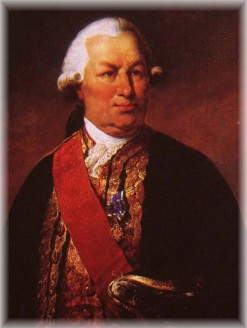
François Joseph Paul, Comte de Grasse (1722-1788).
|
Arguably the most famous of the French naval leaders in the American Revolution. His fame was won as victor of the Second Battle of the Virginia Capes, where his fleet of 24 French ships of the line drove off the 19 British ships under Admiral Graves in early September 1781, thus isolating the British forces of Cornwallis at Yorktown.
It was one of the those strategically decisive, tactically indecisive engagements that mark strange turning points in the history of warfare. Late in the morning of 5 September, Admiral Graves' British squadron approached the mouth (between the capes Henry and Charles) of the Chesapeake, and sighted Admiral de Grasse's French squadron just inside the bay. De Grasse immediately set sail, deploying his ships though some were under strength due to being surprised. The two fleets aligned in southeast, parallel courses. The opposing armadas exchanged furious broadside fire, and drifted south until near sunset. The two squadrons maneuvered against one another for three days. Both sides suffered considerable structural damage to their ships, though none were sunk or captured, and incurred heavy personal casualties.
On 9 September, De Grasse took the lead on Graves and returned to the Chesapeake, where he resumed the French blockade by the time the British squadron reached the bay the morning of 13th. Graves dared not continue the contest, and returned to New York for needed repairs. Eventually one of his ships sank due to damage. During the engagement at sea, the small French naval squadron, under Barras, slipped into the Chesapeake (10 September) with the French heavy artillery from Newport that would be critical to the Allied siege of Yorktown.
A note of clarification. There had been an earlier 'Battle of the Virginia Capes'. On 16 March 1781, a French squadron under des Touches fought a British squadron under Arbuthnot for about an hour. [See des Touches below]
- See the following Expédition Particulière webpages:
- Second Naval Battle of the Virginia Capes (1781).
- Strategic Assessment of the Battle of the Saints (12 April 1782).
- West Indies Score Card During the American Revolution.
|
|
A modern note, based upon an article "Four Cannons for the Admiral, A Personal Reminisence" by Oliver Jackson Sands, Jr. in Virginia Cavalcade, Autumn 1981, pp.96-101.
Ch�teau Tilly, comte de Grasse's home, 35 miles southeast of Paris.
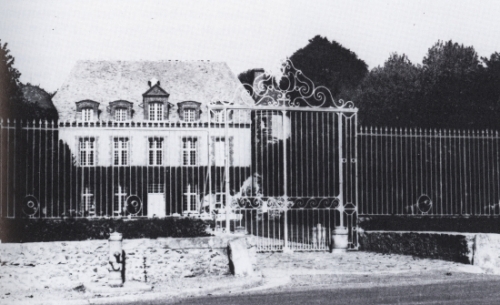
Four British cannons that were captured at Yorktown were shipped by the Americans and placed at the entrance of ch�teau Tilly. These were taken and melted down during the French Revolution. Five of the admiral's grandchildren escaped to the US and became US citizens. The ch�teau was restored in 1972. Americans had cast and presented replacement cannons at Tilly in June 1976.
These were cast from a mold made from one of the original British cannon from Yorktown (1781) that was given to the US Military Academy at West Point, NY.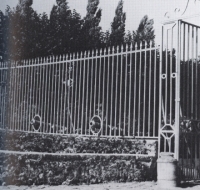
This latter act appears to have been in response to a 1964 initiative of the French society of the Cincinnati, who presented to the US two batteries of five eighteenth-century French cannon to be placed on the battlefield at Yorktown. The cannon were not original, but had been cast in the original eighteenth-century molds that the French had preserved at the Toulon arsenal.
|
Return to top of this webpage.
|
COMTE D'ESTAING
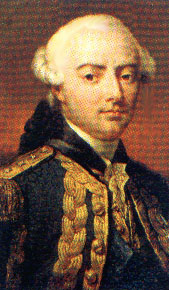
|
Admiral d'Estaing began his military career as a commander of land forces. He was captured twice by the British in battles for the East Indies, where he began to command naval operations. In 1763, he was made 'Lt. General' in the French Navy, and made Vice Admiral in 1777.
In 1778 he commanded a fleet sent to North America. He participated in poorly coordinated French-American operations at New York (11-22 July) and at Newport (29-31 August). He sailed to the West Indies in November, where he failed in attempt to re take Santa Lucia, but succeeded in capturing St. Vincent and Grenada. He also bested the British in a sea battle on 6 July, but did not follow up. He has generally been criticized as being too cautious a naval commander.
|
Charles Henri Jean-Baptiste, Comte d'Estaing (1729-94). Painting by Pierre Franque, château de Versailles.
|
|
D'Estaing's personal bravery was not doubted, as attested during his return to North American waters in fall of 1779. He directed an allied siege of the British fortifications at Savannah (9 October). He was wounded leading a land assault, and the siege had to be broken off. Some historians place blame for d'Estaing's failed allied ventures on his autocratic manner, which contrasted dramatically with that of Rochambeau.
D'Estaing was well liked by the king and his career did not suffer from his exploits in North America. His campaigns in the West Indies ended generally positive for French interests; whereas, his efforts in the American colonies were failures. This contrasted with de Grasse's later experience, which was singularly productive for the American cause, but ended most poorly for France with his defeat and capture in the naval Battle of Dominica [or "the Saints"] (12 April 1782) in the West Indies. In early 1783, d'Estaing was placed in command of a new French and Spanish armada being assembled at Cadiz to deploy to the West Indies and launch another assault against Jamaica. The venture was aborted when the Peace treaties were signed that year. D'Estaing did not fare well in the French Revolution and was executed in April 1794.
| |
Return to top of this webpage.
|
|
|
LE BAILLI DE SUFFREN
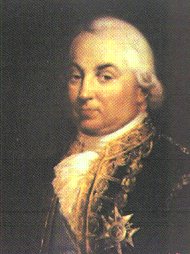
Admiral Pierre-André de Suffren Saint-Tropez, called 'Bailli de Suffren', (1729-1788).
Oil painting by Pompeo Batoni (c.1785). Held by Musée National du Château de Versailles et de Trianon.
|
Chevalier-commander André de Suffren has the distinction of being acclaimed as France's finest admiral that fought in the American War for Independence. Suffren's fame is due mostly to his 1782-1783 campaign in the East Indies. As this campaign was fought on 'the other side of the world' -- well off from the horizon of North America and with no American participation -- and is often overlooked in most historical accounts. Even before his ventures in the Bay of Bengal, Suffren had established himself as a well experienced seaman.
From a noble family in Provence, the young Suffren entered the gardes de la Marine in 1743. He followed the tradition of many French naval cadets from Southern France by joining the Ordre des Chevaliers de Malte in 1749. But unlike many others, such as de Grasse, who left the Order so as to marry, Suffren never married, remained a member all his life and achieved the Maltese Order rank of Bailli.
Suffren fought in earlier wars that took him to the West Indies in 1746, and saw him captured by the British the following year in the Bay of Biscay. After some time with the galleys of the Knights of Malta, Suffren returned to the French navy and participated in the capture of the British held Minorca in the Seven Years' War. He was again captured by British in a later battle off Lagos. He went on to command the French xebec [three- masted Mediterranean corsairs' vessel] Caméléon in a campaign against the Barbary Pirates. He served again with the Order of Malta from 1767 to 1771, before returning to the French navy to train officers. Commanding the 64 gun Fantastique, Suffren deployed to North America as part of d'Estaing's fleet in 1778.
Suffren immediatley established his reputation for daring and aggressive maneuvers when he, with his Fantasque plus three frigates (Aimable, Chim�re, Engageante), forced an entrance into Newport harbor (5 August 1778). The surprised British squadron in the harbor panicked and ran aground three frigates and a galley, all of which were burned by their captains. The British scuttled their other ships in an effort to bar the entrance of the main French fleet. However, de Estaing's fleet managed to enter on 8 August. In June of the following year, with d'Estaing in the West Indies, Suffren led the avant garde of the French fleet off Grenada.
Though his Fantastique sustained the main effort (over 60 crew killed) against the opposing British squadron under Byron, Suffren held the French line. After this, Suffren was rewarded by being put in charge of 2 ships-of-the-line and 3 frigates to raid the merchant convoys. Though Suffren was openly critical of d'Estaing's apparent timid naval tactics, the latter did not let this prevent him from recommending Suffren to be given command of a squadron that was to deploy in 1781 to defend Dutch possessions at the Cape of Good Hope.
Suffren led a French naval squadron out of Brest at the same time De Grasse's larger fleet deployed to North America in 1781. Suffren's squadron headed toward the South Atlantic. Enroute, he surprised and seriously damaged an English naval squadron at La Praya in the Cape Verde Islands (16 April 1781). Suffren then went to the Dutch colony at the Cape of Good Hope and off loaded French troops to aid in the defense. Proceeding east, around the Cape, Suffren joined with another French squadron at Île de France [Mauritius], a major French port in the Indian Ocean. The French fleet proceeded east to the Bay of Bengal, where Suffren would for nearly two years maneuver and fight against much better provisioned British naval formations. Suffren's only shore assistance was from the Indian Mysore leader, Hyder Ali, who was also fighting the British, and use of small Dutch ports in Ceylon. Suffren returned to France a hero and was awarded the rank of a vice-admiral.
Suffren's famous 1782-1783 campaign is described in a separate webpage, which is linked below.
See webpage on Suffren's East Indian Campaign (1782-1783) -- the last battles of the American Revolution fought on the other side of the world
|
Return to top of this webpage.
|
LA MOTTE--PICQUET
Jean Guillaume Toussaint, comte de La Motte-Picquet de La Vinoy�re (1720-1791).
[known popularly as �La Motte-Picquet']
La Motte-Picquet was one of the finest of the French naval tacticians in the War for America. He was born
Picquet, seigneur de La Motte, but was created by the King comte de La Motte-Picquet. His contemporaries and historians know him as
'La Motte-Picquet'.
|
Return to top of this webpage.
|
CHEVALIER DE TERNAY
Charles Louis d'Arsac, Chevalier de Ternay (1722-1780)
Chevalier de Ternay (1722-1780) was a veteran of many wars and had a most distinguished career. Returning from retirement he was put in charge of the squadron to escort Rochambeau's expeditionary corps to North America in 1780. Ternay's sailed out of the Brest harbor 15 April 1780. It consisted of 7 'men of war' [or 'ships of the Line'], 3 frigates, 2 cutters, 1corvette, all of which escorted 35 other ships that were either transports, or war ships serving as supply ships. These ships carried for the most part the French Expeditionary army under le comte de Rochambeau, which proved to be a critical element in the ultimate military victory at Yorktown in 1781.
Chevalier de Ternay is credited with good judgment in his selected route crossing the Atlantic in face of a potential challenge by any of a large number of British naval forces, against which the French large transport formation would be at a disadvantage. As it developed, Ternay did meet a British fleet of four of the line and fifty-gunner under Commodore Cornwallis, in late June, off Bermuda. A short 'running' exchange of cannon fire developed. In spite of the superior number of French warships, and the temptation to seize one of the British ships that had separated from its formation, Ternay discontinued the action. He took his main mission to be conducting his convoy
safely to North America, and would not risk it by attempting to pick up some trophies on the way.
Ternay's squadron entered Narragansett Bay, Newport, Rhode Island, 10 July 1780. Rochambeau and his expeditionary corps began disembarking 12 July. The French naval squadron assumed a strong defensive position and was soon �blockaded' by 13 British ships of the line under Admiral Graves who took a position off Sandy Hook.
Ternay died of a fever in Newport on 15 December 1780. Chevalier Des Touches [Destouches] succeeded Ternay as fleet commander, until the arrival of comte de Barras, in May 1781, who assumed command of the French naval squadron at Newport.
|
Return to top of this webpage.
|
CHEVALIER DES TOUCHES
Charles-Ren�-Dominique Gochet, Chevalier des Touches (?-?)
Admiral Charles-Ren�-Dominique Gochet, Chevalier des Touches took over command of the French naval squadron at Newport, RI, following the death of Admiral Ternay in December 1780. Des Touches was responsible for two initiatives, which were approved by Rochambeau and Washington:
In January 1781, Des Touches dispached a small squadron (L'Eveill� (64) and 3 frigates) under Tilly to attack the British movements in the Chesapeake. They captured the British Le Romulus (44) and brought her back to Newport.
Later, Washington and Rochambeau attempted to execute a combined operation against British forces, under Arnold, in Virginia. Washington dispached La Fayette with his American force to march overland, using some inland waterways, to the Portsmouth area of Virginia. There, Lafayette's force was to be joined by a French force of 1,200+ and 16 siege cannons, under Viomesnil, that was to be transported by Des Touches' naval squadron. Destouches' French convoy was intercepted on 16 March 1781 and fought a British squadron under Arbuthnot for about an hour. Though the British received the worst in the exchange, Des Touches decided not to attempt to force an entrance to the Chesapeake and sailed back to Rhode Island. The result was nearly the opposite of the later, September 1781 'second' battle of the Virginia Capes [See de Grasse, above]. Arbuthnot managed to keep open a line of communications to Arnold's British land army, conducting a campaign of devastation in Virginia. Destouches' failure to land about 1,200 troops compromised the efforts of an American force, commanded by Lafayette, that had marched south and would enter into Virginia in April of that year. The British were able to reinforce in Virginia with troops under General Phillips, who assumed British command in the theater until Cornwallis arrived.
Des Touches remained in command of the French Newport naval Squadron until the arrival of Barras in May 1781.
See webpages:
First Naval Battle of the Virginia Capes (16 March 1781).
Lafayette's Virginia Campaign of 1781.
|
Return to top of this webpage.
|
COMTE DE BARRAS
Jacques-Melchoir Saint-Laurent, Comte de Barras (?-c.1800)
 Jacques-Melchoir Saint-Laurent, comte de Barras arrived at Newport, Rhode Island on 8 May aboard La Concorde to take command of the French naval squadron. He was over 60 years old and had considerable naval experience. He commanded the vanguard of d'Estaing's fleet that forced the entry of the Newport harbor in August 1778. He proved to be a cautious, but very capable naval leader.
Barras refused to convoy the French army to the Chesapeake when proposed by Washington and Rochambeau, wisely considering the scheme too risky for his small French naval squadron in waters where much larger number of British ships could assemble against the French. Barras also did not want to move his squadron to Boston as Washington and Rochambeau had decided at the Wethersferd Conference of May 1781. At first he expressed a reluctance to join his squadron with the larger fleet under De Grasse when the allied commanders learned of the latter's intention to go to the Chesapeake and Washington and Rochambeau decided to redeploy their combined armies to the same area. Barras was technically senior in date of rank to de Grasse, but the latter had been give the larger force and designated to be in command of all French naval assets in its operating theater. Barras even considered raiding Newfoundland in stead of supporting the Yorktown campaign. However, eventually cooperated and brought the valuable French siege train with him when he entered the Chesapeake Bay 10 September 1781, as fleets that fought the 5 September �Second Battle of the Virginia Capes' were still out to sea.
Later, in February 1782, Barras distinguished himself in the West Indies by capturing Montserrat from the British. Barras returned to Boston, and dispached la P�rouse, in August 1782, on naval raids to devastate British forts in the Hudson Bay. Barras retired from service as a Lt General in 1783.
|
Return to top of this webpage.
|
MARQUIS DE VAUDREUIL
Louis-Philippe Rigaud Marquis de Vaudreuil (1724 - 1802)
[Second in command under de Grasse, assumed command of the fleet after battle of the Saintes (12 April 1782)]
Return to top of this webpage.
|
COMTE DE GUICHEN
Luc-Urbain Comte de Guichen (1712 - 1790)
[Succeeds d'Estaing in North America]
Return to top of this webpage.
|
BOUGAINVILLE
Louis-Antoine de BOUGAINVILLE (1729-1811)
|
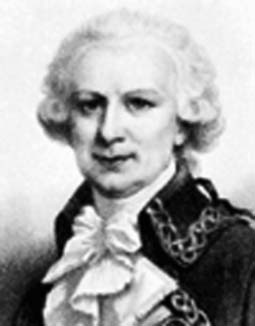
Bougainville, painted by Émile Lassalle
One of the most remarkable French naval commanders to serve in the American war, though he never held a major command in that conflict. He commanded ships in both fleets of d'Estaing and de Grasse that fought in North America. Bougainville's daring and professional performance was praised on several occasions, but de Grasse blamed Bougainville for errors at the disaster of the Battle of the Saintes (12 April 1782). The critical judgement by a French naval board, against Bougainville, who had a long distinguished record, remains a controversial issue. It did not prevent Bougainville from going on to acquire further distinction in the service of France.
Bougainville's greatest fame is as a French naval explorer, a reputation he acquired prior to serving in the American war. In December 1766, Bougainville sailed from Nantes in the frigate La Boudeuse. He was
accompanied by naturalists and other scientists. He passed through the Strait of Magellan and into the South Pacific in July 1767. In late March 1768 he discovered islands in the archipelago of Tuamoto, now French Polynesia. Continuing he landed on Tahiti about the same time
the British sea captian, Cook, would depart England on his first scientific exploration in August of 1768. Bougainville continued to sail west until reaching what is now named Bougainville reef, just to the east of the Great Barrier reef. His course took him to an Archipelago which he named after Louis XV of France � now the island group of Papua New Guinea. He sailed on to discover Choiseul island, Bougainville Island and the Bougainville Strait. Bougainville's voyage took him to New Britain, Buru in the Moluccas, Batavia (now Jakarta) in Java, before returning in March 1769 to Saint-Malo, in Brittany. While at Tahiti, a woman was discovered aboard Bougainville's ship. She was Jeanne Bar�, who had disguised herself as a seaman and would be the frist female to completely circumnavigate the globe. This added to the other record set in that Bougainville was the first French sea captian to sail round the world in a French ship.
Bougainville's remarkable life spanned many years and included many careers. Before the American Revolution he had published an acclaimed work on mathematics and served with distinction as an army officer in Canada and in Europe during the Seven Years' War. After the American Revolution he survived the French Revolution and served in offices under Napoleon Bonaparte. For further information on Bougainville see:
"A short biography of Louis-Antoine de Bougainville"
|
Return to top of this webpage.
|
|

|
Return to
Expédition Particulière
page.
|
|
ThisD R A F T page was was posted 2 February 2004; revised 22 February 2004.
|