


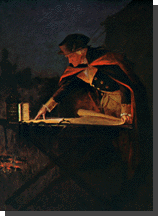
Yorktown - Night Before Battle
|
The 1781 Yorktown Campaign, in Virginia, was
the final major military episode of the American Revolution.
The campaign involved a remarkable degree of cooperation and
coordination between French and American forces over a vast region
of North America and the West Indies: a French army in Rhode
Island under the comte de Rochambeau, an American army outside
New York City under Gen. George Washington,
an assortment of American regulars and militia in Virginia under
the Marquis de Lafayette, a small
French naval squadron at Newport under the comte de Barras, and
a formidable French fleet in the West Indies under the comte
de Grasse. |
|
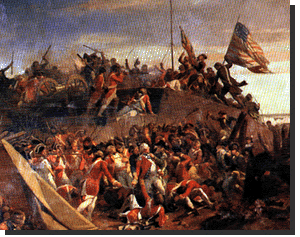
In a furious onslaught against British defenders,
patriot troops storm a redoubt (left and below) protecting the
British garrison at Yorktown on October 14th, 1781. By
bayonet alone, the Americans took the stronghold; their commander,
the young Colonel Alexander Hamilton,
had ordered his men to charge with their guns unloaded. With
a simultaneous French attack, the assault weakened the British
lines and hastened Yorktown's surrender five days later. |
|

|
The objective of the French-American allies
was to trap Charles Cornwallis, the British
commander in the south, who had established
himself at Yorktown on the Virginia peninsula after having failed
to destroy the American army of Gen. Nathanael
Greene in the Carolinas. The various contingents all converged
on Chesapeake Bay at virtually the same time. Siege operations
against Yorktown opened on Oct. 6, 1781, as French and American
artillery began a nearly incessant bombardment of Cornwallis's
positions. Sir Henry Clinton in New
York City hastened a naval expedition to the relief of the Yorktown
garrison, but it was beaten back by de Grasse. |
|
|
On October 17, Cornwallis asked for an armistice
and proposed terms unacceptable to General Washington. With
no hope remaining, Cornwallis surrendered his nearly 8,000-man
force to the 17,000-man Franco-American army on Oct. 19.
For all practical purposes, the American War of Independence
was over. |
|
Once Cornwallis decided to surrender he had
no alternative but to accept Washington's terms. These were,
on the whole, both just and generous. The British army was to
surrender to the Americans; the navy to the French. Officers
were to retain their side arms and private property; soldiers
to be kept in Virginia, Maryland or Pennsylvania; Cornwallis
and some other officers permitted to return home on parole. |
|
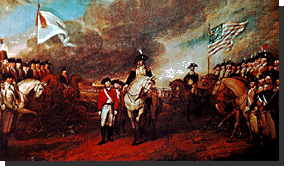
The ceremony itself was to take place on October
19th. As Cornwallis was not equal to making his surrender in
person, his second in command, General Charles O'Hara, officiated;
Washington's second in command, General Lincoln, received O'Hara's
sword (left). |
|
|
A New Jersey officer reported that "
. . . the British officers in general behaved like boys who had
been whipped at school. Some bit their lips; some pouted; others
cried. Their round, broad-rimmed hats were well-adapted to the
occasion, hiding those faces they were ashamed to show." "The Spirit of 'Seventy Six" |
|
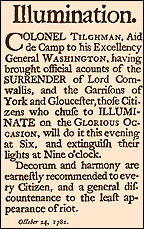
Despite posted
appeals for calm (left), wild American celebrations broke
out. |
|
MAP
of The Siege of Yorktown (540K)
(See Bibliography Below)
| Back to Timeline
| or click on your browser's "back to previous page"
button
 ©
©
Authors: Don Higginbotham - Permission given by the
author; Bart McDowell (contributing).
Picture Credits: Fraunces Tavern, New York City
(top); State Capitol, Commonwealth of Virginia (second) Wilmington
Society of the Fine Arts, Delaware Art Center (third); The Granger
Collection (4th).
Bibliography: Davis, Burke, The Campaign that Won America:
The Story of Yorktown (1970); Fleming, Thomas J., Beat
the Last Drum: The Siege of Yorktown, 1781 (1963); Selby,
John, The Road to Yorktown (1976); Thayer, Theodore G.,
Yorktown, Campaign of Strategic Options (1975);
Commager, Henry S., and Morris, Richard B., editors, The Spirit
of 'Seventy Six (1967); McDowell, Bart, The Revolutionary
War (1967).
© Copyright "The American Revoulution Homepage" - Ronald
W. McGranahan 1998 - 2004 - All Rights Reserved