|
Gates retired from the army on half pay in 1765 as
a major and in 1772 moved with his family to Virginia, following
the advice of his old comrade-in-arms George
Washington. Gates accepted appointment as a lieutenant colonel
in the Virginia militia, and when the Revolution broke out, he
took the American side. In June 1775 he was made adjutant general
of the army, with the rank of Brigadier General. He was a capable
and experienced administrator and a conscientious worker.
~ Commander of the Northern
Army ~
After the evacuation of Boston in 1776, Gates, now
a major general, was appointed to command the northern American
army, which had retreated from Canada. Here he came into jurisdictional
conflict with Gen. Philip Schuyler, commander of the Northern
Department. Congress settled the matter in favor of Schuyler,
and Gates served for a time in Philadelphia.
In the spring of 1777 rivalry again occurred between
Schuyler and Gates. Finally, in August 1777, Gates took command
of Schuyler's defeated army as it fell back from Ticonderoga
before Gen. John Burgoyne's advance.
Two battles near Saratoga and Burgoyne's
surrender followed, adding luster to Gates' reputation, although
some critics whispered that he personally had little to do with
winning the battles.
Gates was appointed president of the Board of War
late in 1777. At this time the “Conway Cabal,” involving
Gen. Thomas Conway, is supposed to have sought to replace Washington
with Gates. Some members of Congress did wish Washington's removal
as commander in chief, but there is considerable doubt whether
any real conspiracy existed.
~ Commander of the Southern
Army ~
In October 1778, Gates was appointed to the command
in Boston. A year later he left the army for a period and retired
to his plantation. In the spring of 1780 he took the field again
as commander of the southern army, which was an almost destitute
force consisting largely of untrained militia. Near Camden, S.C.,
on August 16, the British attacked Gates' army, which broke and
ran in wild confusion. Gates has received much blame for this
defeat, but it seems probable that few generals could have done
better, given the condition of the troops under his command.
Gates was soon replaced by Gen.
Nathanael Greene and did not return to active duty until
August 1782. His only son died during the war, and his wife shortly
after. In 1786, Gates married a wealthy widow. He sold his Virginia
plantation in 1790, emancipated his slaves, and moved to a farm
within the limits of what is now New York City. Gates served
one term in the New York legislature. He died on his farm on
April 10, 1806. |

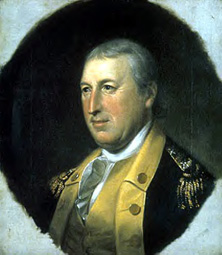

 Brigadier
General Horatio Gates
Brigadier
General Horatio Gates