








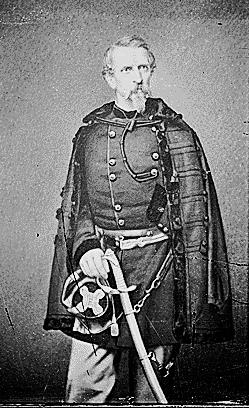
THE ONE-ARMED DEVIL - GENERAL PHILIP KEARNY
PART II
Click on anything in color to view photo or image.
What Am I If No Longer American
Major Philip Kearny spent the next six months at home in New York, but he did take the honorable discharge the army offered. He was given a hero's welcome and for the next three years served as recruiting chief in the city. This time, however, his wife Diana did not so easily forgive what she considered desertion on his part. As Kearny rehabbed and learned to function with only one arm, their troubles escalated. Not even the birth of another daughter could stop the constant bickering between them. Finally almost exactly two years to the day of his wounding in Mexico, she left New York. Although it was thought at the time to be temporary, they never again lived together. After only eight years of marriage, she had had enough.
If the loss of his wife affected Kearny he did not show it. He continued his recruiting duties and rehabilitation, and eventually was able to overcome his disability, even riding a horse with his old abandon holding the reins in his mouth while he used his right hand to hold his sword. His dissatisfaction with the army continued unabated. He complained that he was never rewarded properly for his heroism in Mexico, and now he felt shunted aside unable to get back in the field. Finally in July, 1851, Kearny received orders to rejoin his old command in California, just in time to confront the Rouge River tribe that had gone on a rampage attacking farms and settlers. Kearny marched his men to Oregon and routed the warriors ending hostilities.
If Kearny expected to be rewarded with another promotion for his labors he was sadly mistaken. By now the army was fed up with him and his temperament. Never an easy man to deal with, he had become increasingly hostile and ambivalent to his superiors, openly questioning their judgment and qualifications. It may not have helped matters that his estranged wife was the sister-in-law of the respected, late General Henry Atkinson. Not even his mentor and friend, General Winfield Scott could assist him with his ambitions. Finally, Kearny admitted defeat and resigned his commission in October, 1851. It was promptly accepted. "I had hoped for at least a token murmur of demurral," he later wrote.
Kearny's military career may have been over, but he was still young (36) and rich. He immediately began a world tour which eventually culminated in his beloved Paris, where he had so enjoyed himself a decade earlier. His heroic reputation there, first formed from his adventures in Algiers, had only increased with the news of his courage in Mexico and Oregon. It was there he came upon a young twenty year old engaged woman by the name of Agnes Maxwell. She was visiting Paris from her home in New York City. Kearny forgot about his wife and four children, and Agnes forgot about her husband-to-be, and they began openly living together in Paris. His legal and embarrassed wife, Diana, angrily refused a divorce when he visited her in 1854 to request one.
By 1855, Agnes and Kearny had left New York to settle in his new mansion, Bellegrove, overlooking the Passaic River in what is now Kearny, New Jersey. They had come here to escape the disapproving tongues of New York society. Bellegrove was located only a short distance and across the river from his family's old manor in Newark. In 1858, Diana finally acceded to his demands for a divorce, but so angry was she at her young replacement, she stipulated in the divorce decree that he could never marry again as long as she lived.
As soon as the divorce was granted, Kearny began to look for a way around Diana's unusual stipulation. He found it when his lawyers argued that it was only valid in New York State, and Kearny was free to marry Agnes in New Jersey where they now lived. However, New York did not agree with this interpretation, and for a time Kearny would avoid his native city for fear of arrest on the charge of bigamy.
Of course the quiet life of a country squire did not suite Kearny for long. In 1859 he traveled to France again and volunteered for the campaign against Austria that year. He fought with tremendous courage and distinction and when again offered the Legion of Honor, he accepted becoming the first American so honored. He stayed in Paris until 1861, when the outbreak of the Civil War back home spurred him to action. He was recruited by the South to join their cause and lend his support as an officer when the war erupted. Although he may have sympathized with many of the South's concerns, and was friendly with many of their military leaders, he told them, "What am I, if no longer American." Kearny returned home to offer his service to the Union.
It Is a Sweet and Pleasing Thing to Die For Ones Country
Philip Kearny arrived in Washington ready to serve in whatever capacity the government needed. Since so many seasoned military leaders had joined with the Southern cause, the Union was desperate for skilled leadership. Yet amazingly, Kearny was ignored. His reputation for difficulty seemed to overshadow his reputation for courage and leadership. Also, the Agnes Maxwell scandal outraged many in the War Department. When he realized he was not going to be granted a commission in the army he tried to join as a lowly private, but was again rejected because of his infirmity.
Kearny headed home to Bellegrove angry and disappointed. His disappointment would not last. In July, 1861, New Jersey recognized the War Department's folly and commissioned him as a Brigadier General, and placed him in command of the New Jersey Brigade stationed near Alexandria, Virginia. He found his new brigade barely trained and undisciplined. He immediately began to change that with constant drills and marches while awaiting the seemingly never to be fought battles. He was tough, but he was fair, and he always looked out for his men, making sure they were properly fed and outfitted even at his own personal expense. He urged General George McClellan, head of the Union forces to attack Richmond, the Southern capital, and possibly end the war quickly, but McClellan held the army back. The longer McClellan hesitated, the more frustrated Kearny became, finally culminating in series of published letters criticizing the commander. The army was again outraged. But what made the army hate Kearny, made his men love him. They too were clamoring for battle.
Finally in March, 1862, McClellan began the Peninsula Campaign in an effort to advance towards Richmond. Kearny and his men gained honor in the campaign and in May he was appointed commander of the 3rd Division as the Union Army continued to advance slowly up the Virginia Peninsula. Boasting that he could, "Make my men follow me to hell," he made good his claim, rushing his troops to the aid of General Joe Hooker at Williamsburg. At one point his troops were bogged down by enemy gunfire in a heavily wooded area. When he told them to return fire, they replied that they could not see the enemy. He charged forward on his horse, his reins in his mouth, drawing the southern troops out of hiding to shoot at him. Racing back to his own line he shouted, "Now you know where they are boys! Go get them!" Twice he escaped ambushes and he had at least one horse shot from under him during the campaign. Southern soldiers in a mix of amazement and admiration began referring to him as, "The One-Armed Devil."
Despite Kearny and his troops' brilliant performance, the Peninsula Campaign was a dismal failure, as he had earlier predicted. In July, McClellan ordered a retreat. That same month, Kearny was promoted to Major General, and whispers began in Washington about replacing McClellan with a more aggressive commander. Kearny was rumored to be the leading candidate. But Kearny's legendary luck was about to run out.
In late August the army began to push towards Manassas, Virginia, for the disastrous second battle of Bull Run under the command of General John Pope. On August 29, Kearny led his division on a desperate charge at the Confederate left at Groveton. He almost won, but was forced back by superior forces. The following day, Stonewall Jackson battered the Union lines on all fronts and as night fell only a few troops fought on. Kearny's men were one of those few. As even they finally retreated he was heard shouting, "Are there only imbeciles to lead us?"
The South continued the pressure the following day as a terrific rain storm raged. As night approached the Confederate troops tried to flank the Union army at Chantilly. Kearny, who often acted as his own scout, rode out to survey the area ahead. He galloped straight into a Southern outpost. The order was given to halt and surrender, but Kearny had escaped from more difficult situations. Rearing his horse he galloped away as the soldiers fired after him. Witnesses remembered him shouting, "They can't hit a barn!" A single bullet proved him wrong. It entered the base of his spine and ended his life.
The day following his death, the body of General Philip Kearny was transported by under a flag of truce and with an honor guard back to the Union front. The body was then sent to Washington for embalming, and then to his home, Bellegrove where it lay in state. On September 8, Kearny was paraded and honored for a final time, first in Newark and then in Jersey City. He was then brought by ferry to New York City and after services buried in the family crypt at Trinity Church. But even in death Kearny was restless. In 1912, despite protestations from members of the family, his body was moved to Arlington National Cemetery where an elaborate memorial was built.
Years earlier in New York, when he was presented a sword in honor of his charge in the Mexican War, Kearny said, "I must ever so strongly bear in mind that in a Republic particularly applies the motto, "It is a sweet and pleasing thing to die for ones country." He died as he would have wanted, a hero recklessly fighting for his nation. The man had become a legend.
While there was no truth to the rumor that Philip Kearny's son by Diana, John Watts Kearny, had tried to join the Confederate Army so he could shoot at his father, there was no love lost between them. The son sided with the mother during the divorce and rarely, if ever, spoke to his father after it. Despite this, upon Philip's death, it is said he received the largest inheritance in the history of the United States to that date. Eventually he settled in Bellegrove, and the estate stayed in the family's hands until it was torn down in 1926 to make room for a real estate development.
A statue of Philip Kearny, which originally stood at the State House in Trenton, was dedicated at Military Park in Newark in 1880. The ceremony was attended by Ulysses S. Grant, William T. Sherman and the then Governor George McClellan. But even Kearny's statue caused controversy. In 1925 it was moved to another part of the park to make room for the "Wars of America" monument. In 1961, the statue was reset on the pedestal facing west, its back to the Passaic River and the town of Kearny that was his home and was named in his honor. The argument between Newark and Kearny continued on and off for over 30 years. Finally in the 1990's the statue was taken down for restoration and in a compromise, an exact copy was made for the Township of Kearny which was unveiled in 1994 in front of the Kearny Post Office. Some of the bricks recovered from Bellegrove were used in the base of the statue.
In a famous Hollywood movie there is a line, "When the legend
becomes fact, print the legend." So has the true life of General
Philip Kearny been forgotten. There have been numerous biographies of
him, but most gloss over his fallacies in both war and peace. Some
never even mention his second marriage and the scandal it created, or
Kearny's sometimes pompous and ingratiating attitude. As John T.
Cunningham wrote, "Each [biographies of Kearny] in his own way
failed to clarify a life. Rather, both drew tighter the web of
legend." When Kearny died he took much of the truth with him.
Although there are many statues and plaques honoring him, and even a
town in New Jersey named for him, little remains to tell his true
story. "This life can be told straight - and it must soon be
told, lest Phil Kearny escape forever into mythology," wrote
Cunningham, "Phil Kearny, you see, was not really a legend."
Sources
Images of America - Kearny
Barbara Krasner & the Kearny Museum
Arcadia Publishing, Charlston, SC 2000 BUY
THIS BOOK
General Philip Kearny, Battle Soldier of Five Wars
Thomas Kearny
GP Putnam & Sons, NY, NY 1937
Kearny the Magnificent
Irving Werstein
John Day Company, NY, NY 1962 BUY
THIS BOOK
Personal and Military History of Philip Kearny
John Watts de Peyster
Rice & Gage, NY, NY 1869
Proceedings of the New Jersey Historical Society
"Phil Kearny: Greater Than Legend"
John T. Cunningham
Volume LXXIX, Number 3, July, 1961
Harpers Magazine
NY, NY
Undated, C1876
Harpers New Monthly Magazine
NY, NY
Undated, C1865
The New York Evening Post
NY, NY
April 11, 1912
Special Thanks To:
The Keany Museum
Kearny, NJ
The New Jersey Historical Society
Newark, NJ
The Newark Public Library
Newark, NJ