








GUESTS FROM GIBBET ISLAND
The small village of Communipaw defied its British conquerors. Unlike New York City, its larger neighbor across the bay, the tiny town retained its Dutch heritage and refused to be "Anglicized." Located near where Liberty State Park in Jersey City now stands, the hamlet was isolated, accessible only by one road that led to neighboring Bergen, or by water. At the center of Communipaw stood the tavern and inn known as the Die Wilde Gans, or The Wild Goose, run by the well-known and respected Teunis Van Gieson.
The Wild Goose was the meeting place for all the loyal burghers throughout the east shore of today's Bergen and Hudson Counties, and many a night was spent eating, drinking and retelling stories of the good-old-days before the arrival of the hated English. Van Gieson ran the inn with the help of his wife and a servant by the name of Pluto. Pluto was a mystery. He had washed ashore one day, more dead than alive, and was cared for and nursed back to health by the kindly Van Teunis and his wife. Unable to even speak any understandable language at first, Pluto eventually picked up some of the Dutch tongue, if not its manners. He was gruff and often violent, and answered to no one, not even his benefactor, Van Gieson. Perhaps, in his own way, Pluto was thankful for the innkeeper's help, for he did help with the chores at the Wild Goose, cutting firewood, fishing and hunting to stock the larder, and tending to the horses and other livestock. But he could never be ordered to do anything, immediately rebelling at the slightest command. Pluto was most at home on the water, alone in his little skiff. He became something of a legend in town for his prowess on the bay, and the worse the weather, the more he enjoyed himself. If a great storm was brewing offshore, Pluto would immediately launch his boat and head to his favorite sailing spots.
Pluto remained a loner until the arrival of Van Gieson's nephew, Yan Yost Vanderscamp. The young rascal proved to be an immediate problem to his uncle, trying his patience with his laziness, lack of respect and practical jokes. Pluto became a partner in his exploits, and together they wrecked havoc among the neighbors, growing more wicked and audacious as the years went by. Pluto taught Vanderscamp everything he knew about the water, and eventually, they turned to theft and piracy on a small scale, sailing through the bay and its many coves, rivers and tributaries in search of unguarded fishing nets and crops. Often they would disappear for days at a time, so it was not unusual at first when they did not return home to the Wild Goose one day. However, as the days turned to weeks, concern on the part of Van Gieson increased and he began searching for them, to no avail. The old innkeeper was inconsolable, but the rest of Communipaw was relieved.
As the years went by, Teunis Van Gieson and his wife grew older and eventually died, leaving the Wild Goose empty. One day, many years later, a long, black schooner arrived and anchored offshore in the bay. A small boat made its way from the ship to the shore containing a group of unkempt and rough looking men. The town was astounded to find that two of the men were the long lost Vanderscamp, who had returned to claim his inheritance and reopen the Wild Goose, and his servant Pluto.
If the townspeople hoped that the years away had mellowed Vanderscamp and Pluto, they quickly learned how mistaken those hopes were. Pluto was as mean and ornery as always, and Vanderscamp was as wild as ever. The Wild Goose went from being a quiet Dutch public house, to a tavern of ill refute. Wild and outrageous behavior became the norm, and no self respecting Netherlander would cross its doorstep. Its only visitors were ruffians who arrived from the sea who often stayed for weeks after week. Occasionally, after a night of drinking, the drunken sailors would wander through the village and no man or woman was safe from their criminal conduct or lecherous grasps. On some days, Vanderscamp would wander the town and make himself at home in his neighbors' houses, no matter their objections. The villagers of Communipaw were a peaceful sort, and the roguish and violent Vanderscamp had the upper hand. He made the most of it. The frightened townspeople could refuse him nothing, and took to hiding at home and keeping their doors locked and bolted.
Conditions in Communipaw would remain troubled until Vanderscamp and Pluto would again take to the seas, and the Wild Goose would be shuttered until he arrived again back home and the cycle would be repeated. It gradually dawned on the good villagers as to the nature of their primary business. For these were the days of Captain Kidd and Blackbeard, and it soon became apparent that they were following in their footsteps and had become pirates. Finally the British authorities were called in and several of the Vanderscamp's compatriots were arrested and tried. The three worst pirates, who were among the most riotous of the patron of the Wild Goose, were taken to Gibbet Island, just of the coast of the village, and hanged in chains within sight of their favorite haunt. Vanderscamp and Pluto had escaped to the high seas before officials could formally charge them, and the village of Communipaw breathed a sigh of relief, believing themselves rid of the troublesome pair for eternity.
Eternity proved shorter than they hoped, for a few years later a small boat made its way past the rotting, hanging corpses on Gibbet Island to the shore of Communipaw. In the boast were Vanderscamp, Pluto and a woman who proved to be Vanderscamps's wife. However, this time Vanderscamp was a changed man. Perhaps it was the influence of his wife, who neighbors described as shrewish, or just advancing age, but this time when the Wild Goose reopened there were no wild parties into the night, and no outlandish behavior by its patrons. The visitors now were not the riotous types of before, but a secretive sort who arrived in the dark and rarely spoke to anyone in the village. Whether they were pirates or smugglers was of no concern to the private Dutchmen of the town. As long as they left the village in peace, they were left in peace.
This peace was shattered on an autumn evening as Yan Yost Vanderscamp and Pluto were making their way home across the bay from New York. In the east, a storm was brewing and thunder and lighting could be heard and seen fast approaching. Vanderscamp implored Pluto to row faster, and in an effort to save time, the still strong servant passed within arms-length of Gibbet Island. By this time the bodies were barely recognizable as such to any foreign visitor. All that remained of the three executed men were the tattered rags, that had once been clothing, barely clinging to the chained skeletal figures swaying in the wind. The sound of the clanging metal alerted Vanderscamp how near he was to his former partners in crime, and he was incensed at Pluto for getting so close. Pluto just laughed and declared, "You, who were never afraid of living men, what do you fear from the dead?"
"Who's afraid?" spat Vanderscamp. Showing his disregard for the dead corpses he took a bottle from his bag and raised it in a toast. "I fear no ghost or goblins," he declared. " And I'll be happy to share a last meal with my good friends at the Wild Goose tonight if they choose to visit." A dismal creaking was the only reply.
The storm had arrived at Communipaw as the two men made their way ashore. Vanderscamp raced home through the torrential rain and blinding lightning and arrived sopping wet at the door of the Wild Goose. As he opened the door he was confronted with his angry wife who demanded too know why he had given permission for his drunken friends to invade their inn. He swore to his innocence, but she continued to berate him for allowing company at this time of night. "They have arrived before you and at your invitation," she angrily shouted, "And what a blessed looking lot they are! They are awaiting you upstairs."
Vanderscamp hurriedly made his way upstairs to confront these unwelcome visitors. As he thrust open the door to the room at the top of the stairs, there at the table sat the three guests from Gibbet Island. The nooses swayed loosely around their necks as they toasted each other and sang out an old pirate drinking song. They beckoned Vanderscamp forward, but the terrified innkeeper backed out of the room in horror and before he could steady himself, fell down the flight of stairs where he was later found dead. Whether it was from the fall or from fright was never determined, and he was buried in the Old Bergen Churchyard.
The good citizens of Communipaw avoided the Wild Goose from that point on, for it was surely a haunted house, and even its inhabitants were shunned. Never popular with the villagers in the first place, Vanderscamp's widow and Pluto were now completely isolated in the dark and deteriorating home. As the years passed, Pluto became even surlier and with age took on the look of the devil himself. However, he continued to roam the bay in his skiff, more often than not at night. Villagers wondered whether he was sailing to Gibbet Island to invite more ghostly guests, for there were times, on some storm evenings, that sounds of entertainment could be heard from behind the shuttered windows of the inn. It was on one of these tumultuous nights that unearthly screams awoke the neighbors of the cursed home, but so afraid were the timid villagers, that they waited till daylight to investigate.
The door to the Wild Goose was found wide open, and the interior was wrecked. It appeared every piece of furniture was broken and every draw and cupboard emptied. Worst of all, they found the widow Vanderscamp dead on the floor with her windpipe crushed by someone, or something, with ungodly strength. The first and obvious suspect, Pluto, was cleared in a most convincing way. His dead body was found washed ashore Gibbet Island with his wrecked skiff nearby.
The official explanation of the widow's death was that some old criminal friends of Vanderscamp had ransacked and robbed his former home, perhaps searching for some hidden pirate treasure. The widow was killed to eliminate a possible witness against them. The village of Communipaw shook there heads and nodded knowingly to each other, for they knew the true story. Pluto had returned once to often to Gibbet Island to invite his ghostly friends, and this time the guests had returned to their hell with two new occupants.
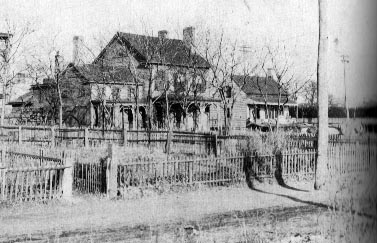
[The title photo is taken from "Images of America - Jersey
City." It shows the John A. Post and Butterwick house in the
village of Communipaw. This house was not the Wild Goose, but it is a
good example of early Dutch architecture in New Jersey and New York,
and probably resembled the aforementioned inn.]
SOURCES:
BOOKS
The Complete Tales of Washington Irving
Edited by: Charles Neider
Da Capo Press, 1998 ----
BUY THIS BOOK!
Images of America - Jersey City
By: Patrick B. Shalhoub
Arcadia Publishing, 1995 ----
BUY THIS BOOK!
Myths and Legends of Our Own Land
By: Charles M. Skinner
J.P. Lippincott Company, 1896
PERIODICALS
Proceedings of the New Jersey Historical Society
"Guests from Gibbet Island"
By: David S. Cohen
Volume 104, 1986
SPECIAL THANKS TO
The New Jersey Historical Society
Newark, NJ
The Newark Public Library
Newark, NJ
BACK TO HALLOWEEN TALES - 2001