~ Background ~
In an attempt to transfer part of the cost of colonial
administration to the American colonies, the British Parliament
had enacted the Stamp Act in 1765 and
the Townshend Acts in 1767. Colonial political
opposition and economic boycotts eventually forced repeal of
these acts, but Parliament left the import duty on tea as a symbol
of its authority.
The situation remained comparatively quiet until May
1773, when the faltering East India Company persuaded Parliament
that the company's future and the empire's prosperity depended
on the disposal of its tea surplus. Because the American
tea market had nearly been captured by tea smuggled from Holland,
Parliament gave the company a drawback (refund) of the entire
shilling-per-pound duty, enabling the company to undersell the
smugglers. It was expected that the Americans, faced with
a choice between the cheaper company tea and the higher-priced
smuggled tea, would buy the cheaper tea, despite the tax. The
company would then be saved from bankruptcy, the smugglers would
be ruined, and the principle of parliamentary taxation would
be upheld.
In September 1773 the company planned to ship 500,000
pounds (227,000 kg) of tea to groups of merchants in Boston,
New York, Philadelphia, and Charleston. The plan might
have succeeded had not the company been given what amounted to
a monopoly over tea distribution in the colonies. The threat
of other monopolies alarmed the conservative colonial mercantile
elements and united them with the more radical patriots.
Merchants agreed not to sell the tea, and the designated tea
agents in New York, Philadelphia, and Charleston canceled their
orders or resigned their commissions.
Revolutionary sentiment mounted . . .
In Boston, however, the tea consignees were friends
or relatives of Gov. Thomas Hutchinson,
who was determined to uphold the law. The opposition, led by
Samuel and John Adams, Josiah Quincy,
and John Hancock, was determined to
resist Parliamentary supremacy over colonial legislatures.
When the first ship, the Dartmouth, reached Boston
with a cargo of tea on Nov. 27, 1773, the Committee of Correspondence
and the Sons of Liberty prevented
owner Francis Rotch from unloading the tea, but they could not
force the consignees to reject it. Rotch and the captains of
two newly arrived ships, the Eleanor and the Beaver, agreed to
leave without unloading the tea, but they were denied clearance
by Governor Hutchinson.
According to the law, if the tea was not unloaded
within 20 days (by December 17), it was to be seized and sold
to pay custom duties. Convinced that this procedure would still
be payment of unconstitutional taxes, the radical patriots resolved
to break the deadlock. On December 14, Rotch was called before
a mass meeting and ordered to seek clearance again to sail from
Boston. But neither the customs collector nor the governor would
grant it.
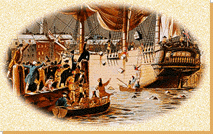
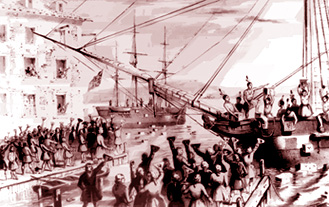
Everywhere there was opposition to landing the dutied
brew, and on December 16th, a crowd of several thousand persons
assembled in the Faneuil Hall-Old South Church area and shouted
encouragement to about 60 men disguised as Mohawk Indians, who
boarded the three ships at Griffin's wharf. With the aid
of the ships' crew, the “Indians” tossed 342 chests
of tea, valued at £18,000 into Boston Bay. The furious
royal government responded to this "Boston Tea Party"
by the so-called Intolerable Acts
of 1774, practically eliminating self-government in Massachusetts
and closing Boston's port.
The news of the destruction of the tea raised the spirit of resistance
in the colonies. On April 22, 1774, the London attempted to land
tea at New York. It was boarded by a mob, and the tea was destroyed.
Similar incidents occurred at Annapolis, Md., on October 19 and
at Greenwich, N.J., on December 22, and the tea was boycotted
throughout the colonies. |