Before the actual war of the Revolution could begin, there had to be a revolution "in the minds and hearts of the people," as John Adams put it. One of the most important factors in this change of heart was an innocent-looking document which received the assent of George III "by commission" on March 22, 1765. It was to be known as the Stamp Act. That it was also to be a piece of political dynamite was soon evident.
                                                                                 - The American Heritage History of the American Revolution


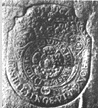
A tax stamp manufactured for the Stamp Act

The Stamp Act, sponsored by George Grenville, was the first direct tax imposed by Britain on its American colonies. To help cover the cost of maintaining troops in the colonies, Parliament levied a tax on legal and commercial documents as well as printed material such as newspapers and pamphlets, all of which had to carry a special stamp.  Benjamin Franklin and other American agents in London offered alternative measures, but conceded the need for revenue from America.

The act took effect in November 1765.  Americans, who did not elect members of Parliament, opposed the act not only because of their inability to pay the tax, but also because it violated the newly enunciated principle of "No taxation without representation."  This measure aroused the grievances of the colonists, and their concerted action in response paved the way for the American Revolution.


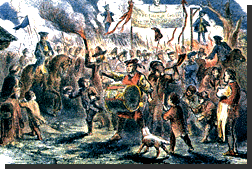
Protest against the Stamp Act
The sign in the background reads:
"The Folly of England and the Ruin of America"

Resistance to the statute took the form of petitions to the king and Parliament, a boycott of British goods, the refusal of lawyers or printers to use stamps or stamped paper, and violence sparked by the Sons Of Liberty.  In New York, rioters demolished the house of a British officer who said he "would cram the stamps down American throats at the point of his sword."

The Massachusetts legislature spearheaded the formation of the first general intercolonial conference, the Stamp Act Congress, consisting of delegates from 9 of the 13 colonies (Massachusetts, Connecticut, Rhode Island, New York, New Jersey, Pennsylvania, Delaware, Maryland, and South Carolina), that met in New York from October 7 to 25 and framed an address to King George III, petitions to Parliament, and a declaration of rights and grievances.


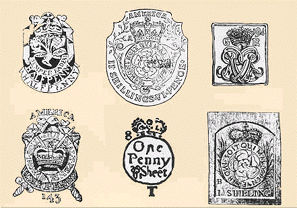
More Stamps

Parliament rescinded the statute on Mar. 18, 1766, but it coupled repeal with passage of the Declaratory Act, which asserted Britain's supremacy over America "in all cases whatsoever."

The constitutional principles and protest tactics established during the Stamp Act crisis laid the groundwork for the American Revolution.

It is more than likely that if England (Parliament) had simply given the colonies fair and equal representation, there would never have been need of a revolution, and "America," would still be a part of Great Britain today.

Strongly protested and resisted, the Stamp Act was recognized as unenforceable and was repealed on March 18, 1766. Simultaneously, however, Parliament passed the Declaratory Act, affirming its continuing authority over colonial legislatures.


(See Bibliography Below)

| Back to Timeline | or click on your browser's "back to previous page" button

    ©

Picture Credit: Library of Congress (top); The Granger Collection (bottom).
Bibliography: Morgan, Edmund S. and Helen M., "The Stamp Act Crisis: Prologue to Revolution, rev. ed." (1963); Thomas, P. D., "British Politics and the Stamp Act Crisis"(1975); Ketchem, Richard M., ed., The American Heritage History of the American Revolution (1971).

© Copyright "The American Revoulution Homepage" - Ronald W. McGranahan 1998 - 2004. All Rights Reserved.