
|
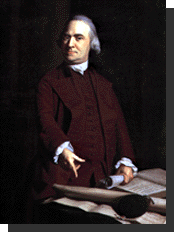
 Samuel Adams Samuel Adams
Samuel Adams was born in Boston on Sept. 17th, 1722, and died
on Oct. 2nd, 1803. He was a major leader in the American Revolution.
The son of a wealthy brewer, he inherited one-third of the family
property but lost most of it through poor management. After attending
Harvard, he became active in colonial politics and enjoyed a
popular following through his activities in the Boston political
clubs, such as the Caucus Club, which was influential in nominating
candidates for local office. |
|
|
Adams was an effective spokesman for the popular party
opposed to the entrenched circle around the royal governor. Adams
organized the protest against the Stamp Act
(1765) and was a founder of the Sons
of Liberty. Undoubtedly the most influential member of the
lower house of the Massachusetts legislature (1765-74), he drafted
most of the major protest documents, including the Circular Letter
(1768) against the Townshend Acts. He
also wrote frequently for the press in defense of colonial rights.
Adams formed close ties with John
Hancock, whose connections with the Boston merchants made
him useful in the revolutionary cause. After 1770 he was the
focal point in the creation of intercolonial committees of correspondence
to sustain the spirit of resistance. He was a principal organizer
of the Boston Tea Party (1773). Because
of the intemperate language of his essays for the press (Lt. Gov. Thomas Hutchinson called him the
greatest "incendiary" in the empire) and his early
advocacy of independence, Adams was regarded as a radical.
At the First Continental Congress
he worked closely with John Adams, his
second cousin. Their influence was crucial in the rejection of
the plan of union presented by Joseph Galloway and in the adoption
of a compulsory nonimportation agreement (in effect a boycott
of British goods). Samuel Adams remained in Congress until 1781,
participating in the drafting of the Articles of Confederation.
After the Revolution his influence in Massachusetts was never
as great, although he continued to be active in state politics,
serving as lieutenant governor (1789-93) and as governor (1794-97).
A more conservative figure in later years, he condemned
the farmers' actions during Shay's Rebellion and endorsed ratification
of the federal Constitution. |
| Back to Timeline | or
click on your browser's "back to previous page" button
 ©
©
Author: Harry Ammon.
Picture Credit: Museum of Fine Arts, Boston
Bibliography: Cushing, Harry A., ed., The Writings of
Samuel Adams, 3 vols. (1904-08; repr. 1968); Galvin, John
B., Three Men of Boston (1976); Gerson, Noel B., Grand
Incendiary: A Biography of Samuel Adams (1973); Harlow, Ralph
V., Samuel Adams, Promoter of the American Revolution (1972);
Hosmer, James, Samuel Adams (1898; repr. 1980); Maier,
Pauline, The Old Revolutionaries: Political Lives in the Age
of Samuel Adams (1982); Miller, John C., Sam Adams, Pioneer
in Propaganda (1936; repr. 1960).
© Copyright "The American Revoulution Homepage" - Ronald
W. McGranahan 1998 - 2004. All Rights Reserved