Fort Albany |
Camp Alger |
Fort Ethan Allen |
Fort Barnard |
Fort Bennett |
Fort Berry |
Fort Buffalo
Cannon Branch Fort |
Fort Cass |
Centerville Earthworks |
Chopawamsic Battery |
Cockpit Point Battery
Colonial Fort (a) |
Colonial Fort (b) |
Fort Corcoran |
Fort Craig (1) |
Fort Ellsworth |
Fort Evans |
Evansport Battery
Fort Farnsworth |
Fredericksburg Battlefield |
Freestone Point Battery |
Battery Garesche |
Fort Germanna
Fort Haggerty |
Fort Hood |
Fort Hunt |
Fort Jackson (1) |
Jones Point Battery |
Kelly's Ford Earthworks
Fort Lyon |
Fort Marcy |
Mathias Point Battery |
Mayfield Fort |
Fort McLean |
Fort McPherson |
Fort Morton (1)
Mundy's Point Battery |
Fort Munson |
Fort Myer |
Fort O'Rorke |
Fort Ramsay |
Rappahannock Station
Fort Reynolds |
Fort Richardson |
Battery Rogers |
Fort Runyon |
Fort Scott |
Camp Seldon
Shipping Point Battery |
Fort Baldy Smith |
Fort CF Smith |
Fort Strong |
Fort Taylor |
Fort Tillinghast
Fort Ward |
Fort Weed |
Fort Whipple |
White House Point Battery |
Fort Willard |
Fort Williams
Fort Woodbury |
Fort Worth
Western Virginia Forts - page 2 | Central Virginia Forts - page 3
Southeastern Virginia Forts - page 4
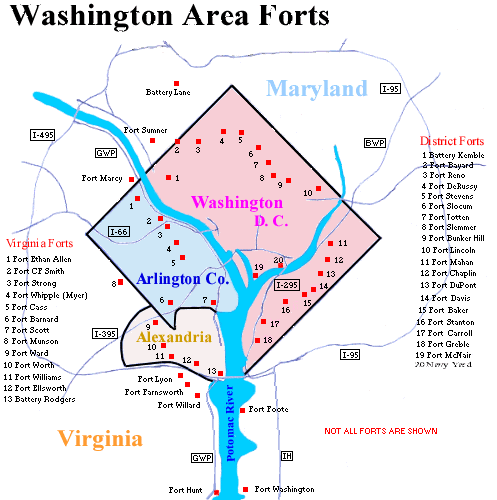
Civil War Defenses of
Washington D.C. 
(1862 - 1865), Northern Virginia
View DC map
(See also MARYLAND and DISTRICT of COLUMBIA pages.)
Alexandria: Fort Ward (1861 - 1865) (park & museum), Fort
Worth (no longer exists), Fort Williams (park) not preserved,
Fort Ellsworth (no longer exists), and Battery Rodgers (1863 - 1869) (no longer exists). Battery Rodgers served as a six-gun coastal (riverine) defense work, and was the only work (with Fort Foote in Maryland) retained after the war. It was located at the end of Jefferson Street. Condos now occupy most of the site.
About Fort Ward:
Fifth largest of the forts surrounding Washington. It had a total of 36 guns mounted in
five bastions. Construction on the star-shaped earthworks was completed one month after
the conclusion of the Civil War. One bastion has been restored, and an Officers Hut and
Headquarters Building have been reconstructed. Another website for Fort Ward.
Arlington County:
Fort Ethan Allen (park), Fort C.F. Smith (park), Fort Bennett,
Fort Strong, Fort Corcoran, Fort Morton (1), Fort Haggerty,
Fort Woodbury, Fort Whipple (part can be seen in Arlington National
Cemetery) - renamed Fort Myer
(U.S. Army Reservation) (1867 - present), Fort Cass - was also located on what is now
Fort Myer, Fort Tillinghast, Fort McPherson, Fort Craig (1), Fort
Albany, Fort Richardson, Fort Berry, Fort Barnard (park),
Fort Reynolds, Battery Garesche, Fort Jackson (1), Fort Runyon,
and Fort Scott (park).
Of interest at Fort Myer is the Old Guard Museum.
Chain Bridge, Fairfax County: Fort Marcy (park) - originally named Fort
Baldy Smith.
Baileys Crossroads, Fairfax County: Fort Taylor, Fort Buffalo,
Fort Ramsay, and Fort Munson (Munson Hill Park).
Huntington, Fairfax County: Fort Lyon, Fort Farnsworth,
Fort Weed, Fort O'Rorke, and Fort Willard (park).
Many of these are located in various parks; others were not preserved and have been
built over with houses or condos.
Fort Evans

(Ball's Bluff Regional Park)
(1861 - 1862), Leesburg
The Battle of Ball's Bluff occurred near here in 1861. Another website
Camp Alger
(1898), Dun Loring
Once located west of Falls Church, this was a training facility for troops
during the Spanish-American War.
Colonial Fort (a)

(1676), Alexandria
Built on Hunting Creek as a defense from Susquehannock Indians.
Jones Point Battery
(1795 - unknown), Alexandria
A federal fort once located on Jones Point, in ruins by 1807. Site is believed to be in Jones Point Park near the old lighthouse.
� COAST DEFENSES of the POTOMAC RIVER (partial) (see also Fort Washington, MD)
� Fort Hunt
(National Park)
(1898 - 1933, 1942 - 1946), near Mount Vernon
It was commanded by Fort Washington, located across the Potomac River in
Maryland. Endicott batteries include Battery Robinson (1901 - 1917),
Battery Sater (1904 - 1920), Battery Porter (1901 - 1917), and
Battery Mount Vernon (1898 - 1917). There is also a BC tower here.
Fort Hunt was used as a POW camp during World War II. The park is administered
by the National Park Service.
White House Point Battery
(1814), Fort Belvoir
A temporary US Naval battery with 13 guns and trenchworks, set up to harrass the British fleet sailing downriver after attacking Alexandria. Now called Whitestone Point.
Centerville Earthworks
(1861 - 1862), Centerville
Confederate fortifications and encampment. They used carved and blackened trees to resemble cannons in one of the batteries. The earthworks still exist.
Manassas Forts
(Manassas Museum)
(1862), Manassas
From the Second Battle of Manassas, Confederate Cannon Branch Fort is preserved along the railroad on the western side of town, while Union Mayfield Fort is preserved along the railroad on the eastern side of town. Administered by the museum. Admission fee.
Nearby is Manassas National Battlefield Park.
Freestone Point Battery
(Leesylvania State Park)
(1861), Woodbridge
A Confederate gun battery was located here on the shore of the Potomac River, its remains are along a walking trail. Admission fee.
Cockpit Point Battery
(1861 - 1862), Dumfries
Located halfway between Freestone Point and Quantico, it consisted of six guns (one heavy gun) in three batteries, a powder magazine, and rear rifle pits, on top of a 75-foot high cliff (Possum Nose). The earthworks and the powder magazine still remain in good shape. Some hut sites can also still be found. A field battery was located on the actual Cockpit Point, but that site was destroyed in the 1970's for a landfill project.
Quantico Batteries
(1861 - 1862), Quantico
The rebels had attempted early in the war to try to blockade the Potomac River to Federal shipping to Washington, DC. Batteries were built along the river's banks, including several around the mouths of Quantico Creek and Chopawamsic Creek. Shipping Point Battery was located at the present-day site of the Quantico Naval Hospital. Evansport Battery, located downtown (present-day Quantico), was actually two batteries on the river bank, and another 400 yards inland. Chopawamsic Battery was located at the mouth of the same named creek. All were destroyed and abandoned by the Confederates rather than surrendered. The mouth of Chopawamsic Creek has been altered due to the USMC Airfield. A CSA field battery was located where the creek now empties to the Potomac. All of these batteries no longer exist.
Fort McLean
(1861 - 1863), Brooke
Located on Aquia Creek in Stafford County. It was the first CSA fort built after hostilities broke out. It was originally named Naval Battery #1. The Confederates built it to guard the railroad terminus. The Union used it after capture to guard the depot at Aquia Landing. On a hill next to the depot was a Confederate Water Battery (1861 - 1862) which fought off one Union ship. It was abandoned after the Union took control of the depot in 1862. The actual site of the fort is on private property. The site of the depot is now a Stafford County park & beach.
To the south, in the White Oak area, was Union Camp Seldon (1863). It was once visited by President Lincoln.
Colonial Fort (b)
(1676), Fredericksburg
Built near the falls (rapids) on the Rappahannock River to protect settlers
from Indian attacks.
Fredericksburg Battlefield
(Fredericksburg-Spotsylvania National Military Park)
(1862), Fredericksburg
Extensive Confederate earthwork trench lines are located on the battlefield in various locations. Admission fee.
Fort Hood
(1862), near Fredericksburg
Located on the Rappahannock River just downriver from the city, very close
to Cosner Park. It was built to prevent Union gunboats from proceeding to
Fredericksburg. The Union captured it a month after it was built. The site
was never preserved.
Rappahannock Station
(1863), Remington
A Union stockaded encampment in Fauquier County, near where the railroad
crosses the Rappahannock River. It was named after the adjacent railroad
station that was here. To the north of here is a Fort Union Drive.
Fort Germanna
History of the Germanna Colonies
(1714 - 1720?), near Wilderness
German immigrants, mostly miners, settled here in Orange County on the banks of the Rapidan River. This was a sister fort to Fort Christanna (see Central Virginia listing). The site of the frontier stockade, located near Germanna Community College's Locust Grove Campus, is being excavated. Most of the site was built over by Governor Spotswood's manor house in the 1720's, which also no longer exists. A new visitors center was built in 2000. During the Civil War, this area was the major river crossing across the Rapidan River, between Union-controlled Northern Virginia and Confederate-controlled Central Virginia. PHOTO LINK
(info provided by Doug Sanford of Mary Washington College)
Kelly's Ford Earthworks
(1863), Kelly's Ford
Union rifle pits and trench lines still exist along the Rappahannock River in Culpepper County. This was a major crossing point.
Mathias Point Battery
(1861), Dahlgren
A partial earthwork battery that was constructed by the US Navy to prevent the Confederates from fortifying this point on the Potomac River. The Rebels drove them off before construction was complete. The site was not used thereafter by the Confederates, due to constant shelling by the Federals.
NEED MORE INFO:
NOTE:
 Books about Forts in Virginia