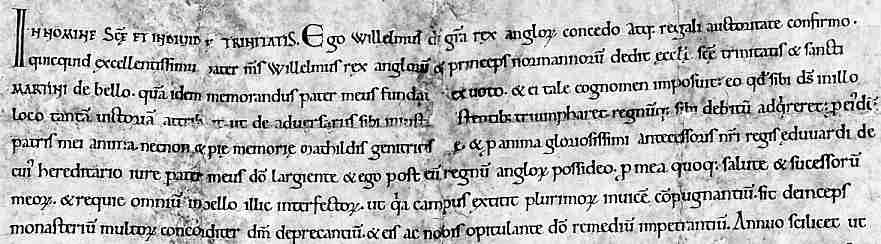
Forged charter of Battle Abbey, mid 12th century. (British Library, Egerton Charter 2211). All images by permission of the British Library.
| overview | text | alphabet | abbreviations | structure | exercises |
| transcript | translation |
Click on each of the above to walk your way through the text. The transcript will appear in a separate window so that you can use it for reference at any time. These exercises are designed to guide you through the text, not test you, so you can cheat as much as you like.

This site is created and maintained by Dr Dianne Tillotson, freelance researcher and compulsive multimedia and web author. Comments are welcome Material on this web site is copyright, but some parts more so than others. Please check here for copyright status and usage before you start making free with it.

Click on each term to indicate that section of the charter in the text.
the invocation
IN NOMINE SANCTE ET INDIUIDUE TRINITATIS
In the name of the holy and undivided Trinity
the title
Willelmus dei gratis rex anglorum
William by the grace of God king of the English
the body of the text
concedo atque regali auctoritate confirmo ........
grant and by royal authority confirm ........
The solemn invocation is a formula more usually found in Continental diplomas. This charter does not contain an address or salutation, as is generally found in English charters, nor does it contain a notification clause in one of the standard formulae. The body of the text states baldly that William is confirming what his father has granted. The text then contains a fair amount of persiflage concerning William's ancestors and the great victory of Hastings, before getting down to the details of the business in hand.

