The Bedfordshire Regiment
in the Great War

Officers who died serving in the 1st Battalion
(This roll of honour is in chronological order)
|
Captain Cecil Howard KER
Killed in action 15th September 1914, aged 30
 Cecil
was born in Madras, India on 4 November 1883, the only son of G.D.
Ker who lived at Moorland House, Whitechurch near Tavistock at the
time of his death.
After education at Cheltenham College, Cecil was commissioned into
the Bedfordshire Militia and served during the South African Wars,
moving into the Regulars after returning home (the 2nd Battalion)
in July 1903. March 1905 saw his promotion to Lieutenant and he
became a Captain in November 1912.
Captain Ker married Dorothy Hill-Climo in 1912 and they had their
only son 4/6/1914.
Landing in France with the 1st Battalion in August 1914, Captain
Ker survived the Battles of Mons, Le Cateau, the retreat to Paris
and the Marne, but was killed during heavy shelling as the battalion
were in support around Missy during the Battle
of the Aisne.
Although initially buried in Missy where he fell, Captain Ker was
moved to the Vendresse British Cemetery, 16km south of Laon. A photograph
of his gravestone can be seen here.
His service record does not appear to have survived at the National
Archives.
|
|
Captain Robert James
McCLOUGHIN (McLoughin)
Died of wounds 18th September 1914
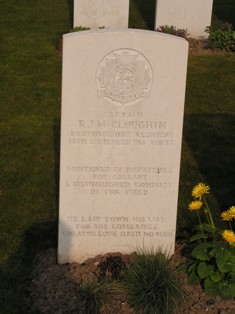 Robert
was born 9 June 1881 in Bombay, India, his father being Thomas McGloughin.
After education at the Bishop Cotton School in Bangalore, he enlisted
into the 3rd Battalion of the Kings Own Scottish Borders before
being commissioned into the Bedfordshire Regiment in 1905. Promotion
to Lieutenant followed on 5 May 1907 and between 1909 and 1911 he
was attached to the West African Frontier Force on the Gold Coast,
then as A.D.C. to the Governor of the Gold Coast and Governor of
British East Africa.
He married Flora Ellen Savage on 22 August 1912 and gained his
Captaincy on 22 January 1913. Their daughter, Flora Eileen Mary
McGloughin was born on 22 August 1914 while - unbeknown to his wife
- Captain McLoughin was in France preparing for the Battle of Mons
which would start the following day. He survived the Battles of
Mons, Le Cateau and the Marne but was fatally wounded during the
Battle
of the Aisne.
The Bond of Sacrifice records; "A wood was being attacked when
he ventured into the open to select a fresh firing position for
his men. He was hit twice and subsequently died of his wounds" adding
that he was Mentioned in Sir John French's despatch of 8 October
1914 "for gallantry under fire and soldierly qualities displayed
on every occasion since the beginning of the war"]
He died from his wounds several days later and was initially buried
in the same grave as two other officers, in a walled orchard south
of Missy, with the railway line comprising it's northern border.
After the war, his body was moved to the Vendresse British Cemetery,
16km south of Laon.
His service record is held at the National Archives under reference
WO339/6163 and a photo of his grave is here.
|
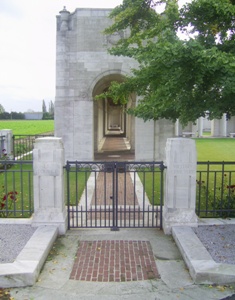
The entrance to Le Touret Memorial
to the Missing
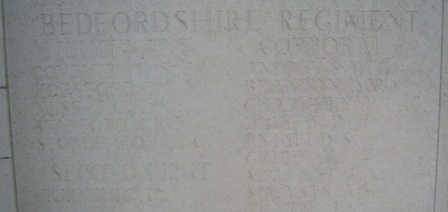
The Regiment's Officers who are remembered
on the memorial
The Battalion were engaged heavily
in the Battle of La Bassee
in October 1914, during which fighting nine of the following eleven officers
were killed:
|
Lieutenant Claude
Charles STAFFORD
Killed in action 13th October 1914, aged 23
Claude was born around 1891 and was educated at Bedford Modern
School between 1899 and 1908, where he was the Captain of the first
team Rugby squad and was a keen athelete. After school, he also
became Captain of the Bedford Rowing Cub and played as a back for
the Bedford R.U.F.C.
Lieutenant Stafford was from the Reserve of Officers and was attached
to the 1st battalion after he landed in France on 12 September 1914.
In a letter home, he remarked to his parents how the voyage across
the Bay of Biscay had made him ill and that he was not yet propery
fit despite having joined the battalion. A short time afterwards,
his parents recieved a second letter stating that he and a further
seventeen officers from the regiment "have
started on our way to - somewhere!" as replacements
for those officers already lost.
Shortly after these letters, Claude was killed during the Battle
of La Bassee.
He was the son of Mrs Florence Stafford of Bushmead Avenue in
Bedford and the late Charles Calvert Stafford. Claude has no known
grave but is remembered on Le Touret Memorial to the missing.
What little remains of his service record is held at the National
Archives under reference WO339/110.
|
|
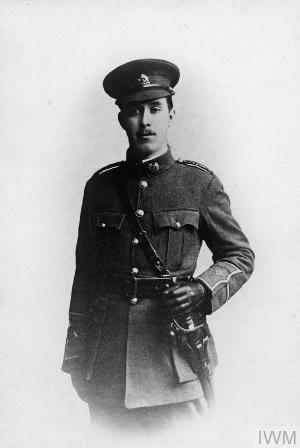
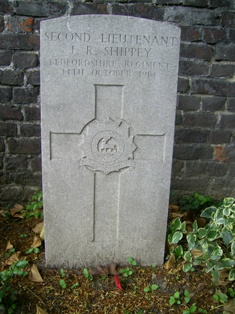
Second Lieutenant
James Reginald SHIPPEY
Died of wounds 14th October 1914, aged 23
According to the Imperial War Museum collection, item HU 126462
James was gazetted a Second Lieutenant in the Bedfordshire Regiment
in September 1911 (verified in the January 1913 Army Lists as 23
September 1911) but then 'enlisted into' the 1st Battalion, Royal
West Kent Regiment in January 1914 (although the Army List shows
him still in the 3rd Bedfordshires that month) and joined the 3rd
Bedfordshrires in August 1914. At this stage he was attached to
the 1st Battalion, arriving in France with their first reinforcement
draft on 28 August 1914 and joining them as they advanced during
the Battle of the Marne on 11 September 1914.
Surviving the Battles of the Marne and the Aisne in September 1914,
James was wounded on 12 October 1914 during the Battle
of La Bassee.
The 1st Battalion history records "Around midday, in one of
the houses in the village, Lieutenants Gledstanes and Shippey were
sitting resting, enjoying a drink of milk and quietly chatting,
when a shell caved the roof in and burst between them. Both emerged
from the ruined building staggering and covered in dust, much to
the amusement of their fellow officers, but it transpired that Shippey
was carrying internal injuries. He was moved by stretcher back to
the village school for treatment."
The barrage intensified until Brigade H.Q. gave orders to retire,
the bttalion history continuing how "The village school, serving
as the battalion's hospital, was evacuated first, the ambulances
roaring off at their best speed. Lieutenant Shippey's wagon was
hit as it retired and although he was moved back to the 15th Field
Ambulance at Bethune, carrying even more injuries, he died from
his many wounds early on 14th October."
James was the son of Frederic Shippey, of Pietermaritzburg, Natal
and his brother, Cyril
Shaw SHIPPEY fell in the 8th battalion a year later. James
lies in the Bethune Town Cemetery and his service record is held
at the National Archives under reference WO339/8457.
(Photographs courtesy of IWM collections, HU 126462)
|
|
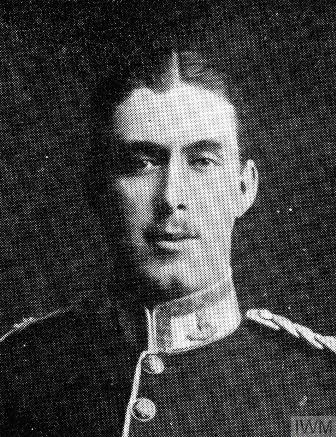
Lieutenant Villiers
Chernocke DOWNES
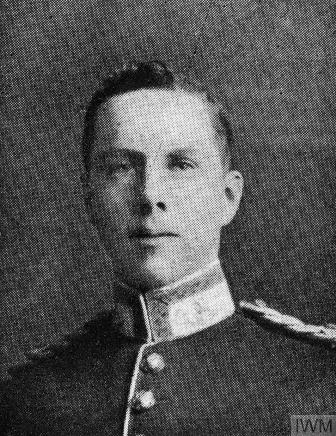 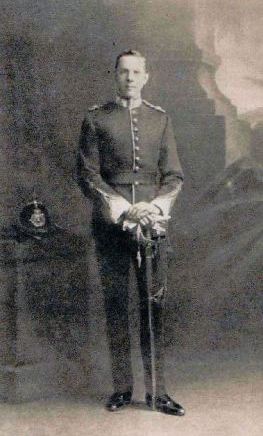 Died
of wounds 18th October 1914, aged 23
Villiers was born 5 March 1891 at Aspley Guise, Bedfordshire, the
son of Charles Villiers Summerville Downes (a retired Major of the
East Lancashire Regiment) and Catherine Elizabeth Anne Downes (formerly
Thompson). After education at Winchester and Trinity College Oxford,
he went to the Royal Agricultural College in Winchester, where he
studied farming and agriculture.
Villiers was commissioned into the 3rd (Reserve) Battalion, Bedfordshire
Regiment in September 1911, gaining promotion to Lieutenant in July
1913.
When the reserve were mobilised on the outbreak of war, Lieutenant
Downes joined the 1st battalion and went to France with the first
British Expeditionary Force, landing 16 August 1914. Survivning
the battles of Mons, Le Cateau, the Marne and the Aisne, he was
wounded on 13 October 1914, during the Battle
of La Bassee.
He died from his wounds five days later at the No.1 Clearing Hospital
at St. Omer. Lieutenant Downes is buried in Longuenesse (St. Omer)
Souvenir Cemetery; his gravestone can be seen here.
(Head and shoulders photograph above courtesy of the Imperial War
Museum, reference HU 121421)
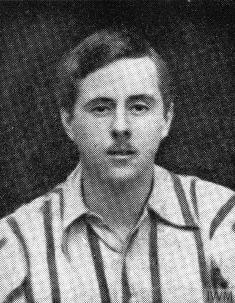 His
brother, Archer Chernocke Downes (left) also fell during the war
while an officer in the 1st Cheshires.
(Image courtesy of the Imperial War Museum, reference HU 121419)
|
|
Second Lieutenant
Leonard Wyndham RENDELL
Died of wounds 19th October 1914, aged 23
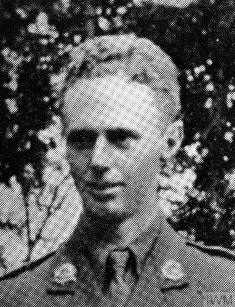 Leonard
was born 6 October 1890 the son of Wyndham Henry and Annie Dora
Rendell (formerly Kelley). Following education at Kings College
in Taunton, he was commissioned as a Second Lieutenant in the 3rd
Battalion of the Bedfordshire Regiment in September 1910, transferring
to a Regular commission in November 1912, at which time he was posted
to the 1st Battalion.
Second Lieutenant Rendell landed in France with the battalion as
part of the First British Expeditionary Force and survived the Battles
of Mons, Le Cateau, the Marne and the Aisne.
On 16 October 1914 he was scouting in advance of the battalion
when "three Uhlans concealed in a house" shot and
mortally wounded him. Although moved back to a French Hospital in
Bethuine, he died from his wounds three days later.
Second Lieutenant Rendell was Mentioned in Despatches for bravery
and he lies in the Bethune Town Cemetery. A photograph of his gravestone
can be seen here.
At the time of his death, his parents lived at Octon Lodge, Taunton,
Somerset.
What remains of his service record is held at the National Archives
under reference WO339/8363.
(Image courtesy of the Imperial War Museum, reference HU 124848)
|
|
Lieutenant William
St.John COVENTRY
Killed in action 22nd October 1914, aged 22
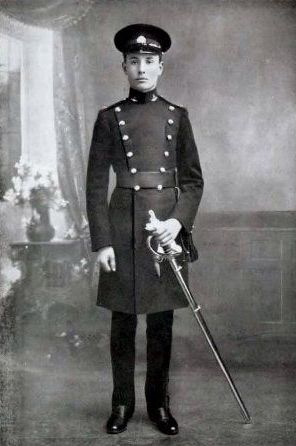 William
was born 7 February 1893, the son of John and Emily Mary Coventry
of Burgate Manor, Fordingbridge, near Salisbury. He was was gazetted
as a Second Lieutenant on 4 September 1912 and gained promotion
to Lieutenant on 21 January 1914.
Landing in France with the 1st Battalion on 16 August 1914, he
was present during all of the British Army's early engagements,
from Mons onwards but was killed during the Battle of La Bassée,
the book 1st Bedfordshires Part One; Mons to the Somme detailing
the fighting which took his life:
"At 4 a.m. on the 22nd, the company moved out quietly, to
dig a defensive supporting position north of the village, south
of a hamlet called Rue du Marais. Lieutenants Litchfield and Coventry
took a platoon each and worked on separate sections of the trench,
the other two platoons being held around the barn on the fringe
of the group of houses. In a thick mist and with visibility at a
mere 20m, some 600 Cheshires and Bedfordshires were digging trenches
in readiness for the anticipated assault. Unexpectedly, at 6 a.m.
a huge group of German infantry burst from the fog and charged the
digging men, having swept through the village with hardly a shot
being fired. They attacked from two sides and their impetus and
sheer force of numbers carried the position. The British had no
time to drop their spades and pick up rifles, so fought with their
shovels, pickaxes and fists in a brutal hand-to-hand brawl. Some
200 of the 600 men became casualties and the line was thrown back
towards Rue du Marais, where it held. Initially, the line around
Rue du Marais was a jumbled collection of Cheshires and Bedfordshires,
Royal Engineers and artillerymen, with elements from a few other
unexpected units thrown in for good measure. Establishing a firmer
line of resistance was their first priority, with folding into their
line the stragglers who appeared coming a close second. Around forty
of the company could be found, although more turned up as the day
went on. However, Lieutenant William St John Coventry, who would
be mentioned in despatches in January 1915 and Second Lieutenant
John Litchfield had both been killed leading their platoons during
the vicious brawl and almost fifty more were killed or reported
missing."
Lieutenant Coventry was Mentioned in Despatches for bravery during
the battle and was initially posted as missing in action. His death
was later presumed and his body was not identified so he has no
known grave so is remembered on Le Touret Memorial to the missing
- a photograph of his name on the memorial panel can be seen here.
His service record does not appear to have survived at the National
Archives.
[Photograph from Find
a Grave]
|
|
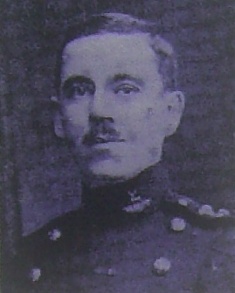
Second Lieutenant John
LITCHFIELD (LITHFIELD)
Killed in action 22nd October 1914
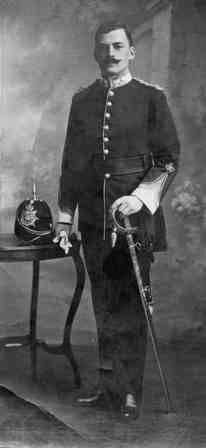
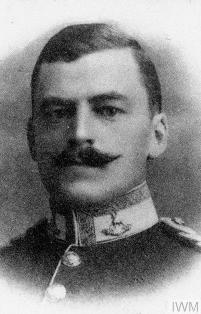 John
was born in 1882, the son of William Allin Litchfield and Elizabeth
Litchfield who lived at Noborough Lodge, Norton, Northamptonshire.
John had four older brothers and a younger sister.
The family were second generation farmers but were forced to give
up their farm in the 1890s following the decline in farming fortunes
at that time. This may be one reason why John joined the army.
On 4 May 1912 John was gazetted as a Second Lieutenant in the 4th
Battalion and was mobilised when war broke out. He was part of a
draft of reinforcements sent to the 1st Battalion in France in September
1914 and served with them for just under a month, until his death
during a skirmish which took part within the Battle of La Bassée.
The fighting which led to John's death is detailed in Lieutenant
Coventry's biography (above), both of them leading the platoons
which came under surprise attack.
Both officers were posted as missing in action, their deaths being
presumed later. As a result, John is remembered on the Ypres (Menin
Gate) Memorial to the missing and the Norton village War Memorial
in Northamptonshire
(Head and shoulders image courtesy of the Imperial War Museum,
reference HU 124197, full portrait courtesy of David Litchfield.)
|
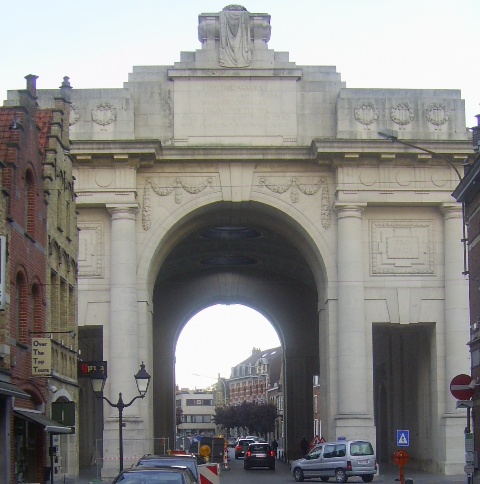
The Ypres (Menin Gate) Memorial to
the Missing
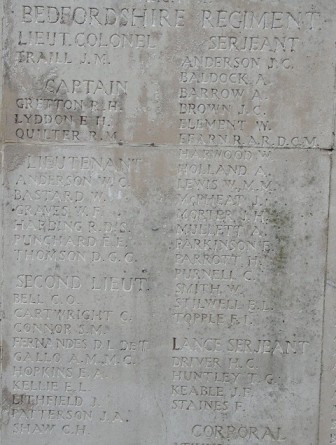
Officers of the Regiment who are remembered
on the memorial
The battalion were next engaged in
the First Battle of Ypres
and lost two of the following six officers then, with the balance dying
as a result of wounds recieved in action during the Battle of La Bassee:
|
Second Lieutenant St.
John Alan CHARLTON
Killed in action 26th October 1914, aged 25
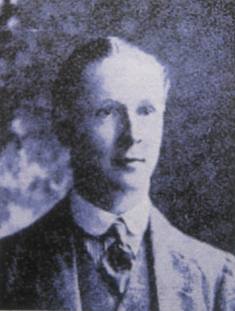 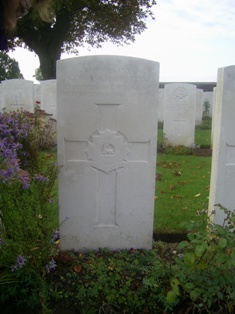 4th
attached to the 1st battalion. Second Lieutenant Charlton was the
son of St. John Charlton and Elizabeth Bronwen Charlton, of 9, Sloane
Gardens, London and lies in the Cabaret Rouge British Cemetery,
Souchez having died from wounds received at La Bassee.
His service record is held at the National Archives under reference
WO339/7923
|
|
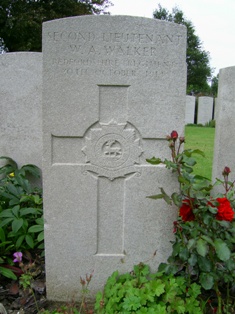
Second Lieutenant Walter
Arthur Beaumont WALKER
Died of wounds 30th October 1914, aged 22
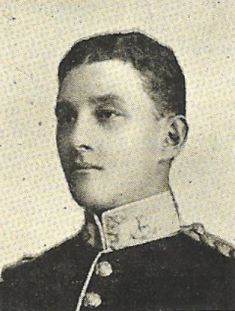  Walter
was born at Dibrugarh, Upper Assam in India on 24 March 1892, the
son of Richard Beaumont Walker. Educated at Bedford Grammar School,
he was a keen Rugby player who later went on to play for the Rosslyn
Park Football Club.
Walter has granted a commission in the Bedfordshire Regiment on
27 January 1912 and joined the 3rd (Reserve) Battalion. Becoming
a Lieutenant in May 1914, he was attached to the 1st Battalion when
war was declared and sailed to France with them, landing 16 August
1914.
Lieutenant Walker was in A Company during the Battles of Mons,
Le Cateau, the Marne and the Aisne, which he came through without
a scratch but the Battle of La Bassée was to see the end of his
life.
On the morning of 26 October 1914, a German bombardment hit the
battalion lines and Lieutenant Walker was caught by shrapnel as
he moved through his company positions, wounding him in the abdomen.
De Ruvigny's obituary records that "his
motto was 'blood and iron', which he appeared to live up to. He
was never know to grumble at hardships or pain. When he was lying
on a stretcher in a communications trench for several hours during
the fighting he constantly spoke cheerfully to the supports and
reserves who had to pass him on their way to the fire trench."
Although moved back to the Casualty Clearing Station at Gorre later
that day, he died four days later. Lieutenant Walker was buried
in No.33 CCS, which today is the Bethune Town Cemetery.
The Commonwealth War Graves Commission records he was in the 3rd
battalion, attached to the 2nd battalion; efforts are under way
to correct this.
[With thanks to Stephen Cooper for providing
a copy of the De Ruvigny's entry]
|
|
Lieutenant Walter
Francis GRAVES
Killed in action 7th November 1914
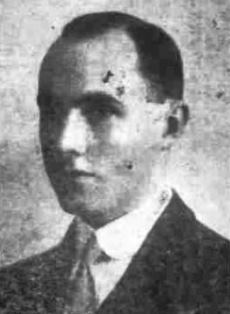 Walter
Graves was born in Islington late in 1884, the son of Walter (an
Architect) and Fanny Graves. His younger siblings - Ella and Henry
- followed 1887 and 1891 respectively.
Spending his younger years in Islington, education at Worthing
College, then Haileybury College followed. Walter spent a 3 year
apprenticeship at "a large London Engineering firm", joining
the Bedfordshire Regiment's 3rd (Volunteer) Battalion. He was attached
to the 1st DCLI until the death of his father in June 1907, at which
time he had to retire following family pressures.
In July 1908 he moved to Cardiff where he established himself as
a partner in the coal and pit wood exporter Messrs Williams, Ambrose
and Graves, based fromt eh Cardiff Docks. He had a deep interest
in social, educational and municipal matters and was asked to run
for the Roath Conservative Ward which he won in November 1912. Walter
was active in many committees including every mental health group
he could help with. By this time, Walter had develoepd a reputation
as a "Young man of great promise".
When war broke out he relinquished his seat, announcing that he
had to "rejoin the regiment" but did not wish to draw
an income and leave his constituency without full time support.
Walter was reinstated as a Second Lieutenant in the 3rd Battalion
in August 1914, his promotion to Lieutenant following on 3 September
1914.
Lieutenant Graves was in a large draft which landed in France 15
September, finally arriving with the 1st Battalion on the front
lines on 14 October, during the Battle of La Bassee. They were involved
in the heavy fighting around Givenchy until the end of the month,
being pulled from the line and rushed north to Ypres, to help hold
the line against the latest German attacks.
After going into the front line in the woods around Herentage Chateau,
east of Ypres, on 6 November, Lieutenant Graves was killed during
the heavy fighting as the British line held back the massed German
assault of 7 November 1914.
Although his official date of death is recorded as the 9th November
in some documents, eye witness sources refer to his death being
on the 7th when the battalion were heavily engaged rather then the
9th when the fighting had died down considerably.
Walter's grave was initially unknown but a year after his death,
a wounded 1st Bedfordshires' Sergeant in hospital reported that
it was "buried 600 yards south-east of the portion of ornamental
water in the Herontage (sic) Chateau grounds".
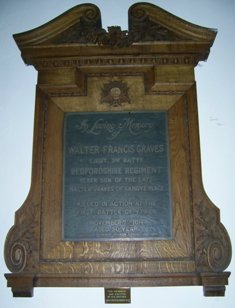
As the family had nowhere to focus their mourning, the memorial
plaque below was erected by his widowed mother (Mrs. Fanny Graves)
in the church in Sandy, Bedfordshire.
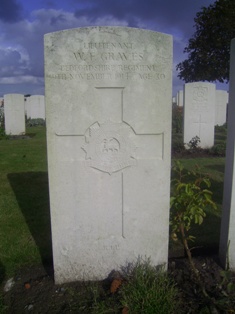
In June 1925, during the battlefield clearances, a mass grave containing
mostly unidentifiable remains was uncovered near the remains of
Herentage Chateau. Among them was an officer, later identified as
Walter Graves from the numerals on his person, being his Long Service
Number. The soldiers - mainly Bedfordshires who had fallen during
the 7th November 1914 fighting - were interred together in the same
section of Bedford House cemetery.
What remains of his service record is held at the National Archives
under reference WO339/19994
|
|
Lieutenant Robert
Dennis Stewart HARDING
Killed in action 7th November 1914, aged 28
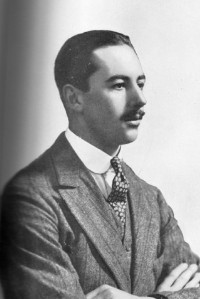 4th attached to the 1st battalion.
Robert was educated at Harrow (Rendalls's 1889-1903)
and Christchurch, and was a member of the Bath Club as well as being
a member of Lloyds of London. He joined the 4th Battalion in 1912
becoming Lieutenant in March 1913. When war broke out he offered
his services and was attached to the 1st Battalion, who he arrived
with in October 1914.
The "Harrovian War
Supplement" for December 1914 included a letter from his
Company CO, Captain Monteith. In it, he describes the events around
Robert's death:
"The enemy had broken
through the line of trenches held by the battalion on our left,
and it's break caused part of our trenches to be vacated also. Our
company was in reserve, and we formed up and brought off an entirely
successful counter attack, driving the enemy back, killing many
and capturing 25 prisoners. It was in this counterattack that Harding
fell, leading his men up a lightly wooded hill. I did not see him
fall, but missed him when we got to the ridge, and on going back
found him quite dead. Death had evidently been instantaneous. I
had formed a very high opinion of his gallantry and coolness. I
could rely on him always and he had gained the confidence of his
men, though he had only been with the company a month. He was always
bright and cheery and it was a real pleasure to have his company
on the line of march or in the trenches."
Robert Dennis Stewart Harding was killed in
action on the 7th November 1914, aged 28 south of the Ypres-Menin
road. He was the only son of (the late) Mr Stanley Greville and
Mrs Edith Harding of 15 Lowndes Square S.W. London and is remembered
on the Ypres (Menin Gate) Memorial
Although various sources state the 9th as the
date Robert was killed, the action and description above supports
the date being the 7th November.
(With thanks to John Hamblin for the "Bond of
Sacrifice" pre war bio and photo)
|
|
Second Lieutenant Edwin
Allan James EDWARDS
Died of wounds 31st December 1914, aged 19
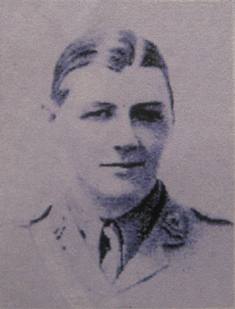 Edwin
was born in Brixton 13 March 1895, the youngest son of Mr. and Mrs.
Herbert Edwards. Educated at St. John's College, Brixton and at
Dulwich, Edwin was commissioned into the 3rd Battalion of the Bedfordshire
Regiment June 1913. He was noted as being a good left handed tennis
player and was 'fond of boating'.
Second Lieutenant Edwards joined the 1st Battalion on the Western
Front at Paris early September and fought through the Battles of
the Marne and the Aisne, before being badly wounded at Givenchy,
during the Battle of La Bassee, on the 15th October.
A bullet severed his spinal cord at the fourth dorsal vertebrae,
causing paralysis from the trunk down.
He died from his wounds some months later at Fishmonger's Hall
hospital for Officers, London Bridge, from exhaustion which ultimately
caused heart failure, and lies in the Long Ditton (St.Mary) Churchyard.
His service record is held at the National Archives under reference
WO339/9003.
|
|
Captain Basil John ORLEBAR
Killed in action 15th January 1915, aged 39
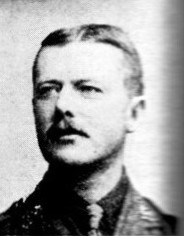 Basil
John Orlebar was born on the 8th of September 1875, the son of John
Orlebar (a Gentleman) and Julia Charlotte (formerly Pearce), from
Silsoe in Bedfordshire. The Orlebars were a well known Bedfordshire
family at the time. He was educated privately and at the Currie
Engineering Schools Folkestone and was for some years a civil engineer
in the employment of several leading firms.
Initially gazetted as a Second Lieutenant in the
5th (Territorial) Battalion, Basil applied for a transfer to the
3rd (Reserve) Battalion in July 1909; this was unusual at the time
as, at 34 years old, he was over regulation age. Lord Ampthill supported
his application which went through in September 1909.
He joined the 3rd (Reserve) Battalion of the Bedfordshire
Regiment in November 1909 becoming Lieutenant in March 1911 and
Captain in June 1912 qualifying at the Hythe School of Musketry.
On 12 September 1912 he married Barbera Florence Edwards
(herself born on Christmas Day 1878) in Kent, although whether he
lived in Kent or was temporarily associated to the county while
at the School of Musketry is unclear.
Captain Orlebar was mobilised at the outbreak of war
and joined the 1st Battalion in their first reinforcement draft
on the 4th September 1914 after the battalion's losses the previous
month. He was put in charge of a company and was present at the
battles of the Aisne, the Marne, La Bassee and the First Battle
of Ypres. However on the 15th January 1915 he was killed instantly
when a shell landed on top of his dugout as his Company held the
front line trenches at Wulverghem, just west of Messines.
Captain Orlebar is buried in the Dranoutre Churchyard
which lies a few kilometers west of where he was killed. According
to the Bond of Sacrifice, Captain Orlebar gained great credit in
the field for his soldierly qualities and died, to quote the words
of one of his men, "a soldier and a gentleman".
His service record is held at the National Archives
under reference WO339/8529
|
|
Second Lieutenant (Captain)
William Henry Fitzroy LANDON
Killed in action 15th February 1915, aged 47.
William was born 24 May 1867 in Creaton, Northamptonshire, and
served in the South African Wars as a Sergeant in the Imperial Yeomanry.
When war broke out in 1914 he was an Inspector for the Board of
Agriculture and Fisheries, and on 12 September 1914 he applied for
a commission in the 3rd Suffolks. Second Lieutenant Landon landed
in France early December 1914 and joined the 1st Battalion on the
front 28 January 1915.
William was the son of Major James Henry Landon of Creaton House,
Northampton, and Mrs. Katherine Louisa Landon (formerly Markham).
He lies in the Dranouter Churchyard, 12km south of Ypres centre
|
|
Second Lieutenant John
Hewitt Sutton MOXLY (Moxley)
Killed in action 13th March 1915, aged 23
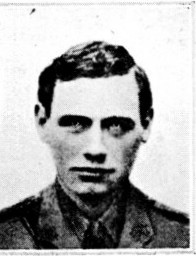 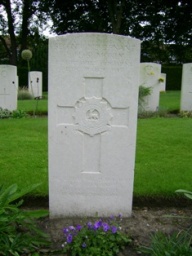 4th
(Extra Reserve) Battalion attached to the 1st Battalion
John was born on the 27th of December 1891, the second
son of the late Reverend J.H.Sutton Moxly, Principal Chaplin to
His Majesty's forces. He was educated at Victoria College, Jersey
where he took the King's Gold Medal for classics and was head of
his school. In 1910 he was elected to a King Charles I Scholarship
at Pembroke College, Oxford. There he obtained a second in Honour
Moderations, a second in Greats, and was preparing for a career
in the Civil Service when war broke out.
He applied for an Officers commission immediately
and was gazetted into the 4th (Reserve) battalion of the Bedfordshire
Regiment on the 15th of August 1914, landed in France on the 2nd
January 1915 and joined the battalion within days. John spent the
time he served in the battalion around Wulverghem and St. Eloi,
south of Ypres and endured the daily sniping and shelling duels
that typified the first winter of the war.
On the 12th March he was sent for by the O.C. to
supervise the repair of a section of trench that had been blown
in, as the Company Captain next to his post had been wounded. Whilst
lifting a wire entanglement onto the parapet he was killed instantly
by a sniper who "shot him through the heart". His commanding officer
wrote "It was the death of a brave and
devoted gentleman. He was always the same; resourceful, alert, loved
by officers and men, as good an officer as one could ever wish to
meet"
He had served just two months in the trenches before
he was killed on the 13th of March 1915 near St Eloi, aged 23. John
is buried in the Ramparts Cemetery in Ypres itself.
His service record is held at the National Archives
under reference WO339/17332
(My thanks to John Hamblin for the Roll of Honour
information and Martyn Smith who forwarded his obituary that was
shown in the St.Neots and County Times, 3rd April 1915)
|
The battalion found themselves in the line at
Hill 60 when the ferocious fighting for the small but significant mound
broke out. They lost over 500 men during their stay on and around the
hill, including the following seven Officers:
|
Second Lieutenant
Esmund Lawrence KELLIE
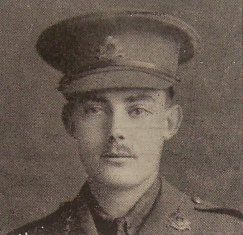 Killed
in action 19th April 1915, aged 20
Educated at Westminster School, Esmund arrived in the battalion
17th to 21st January 1915 with 2/Lt Charles KIRCH (below)
who also fell the same day. He was the son of Lawrence and Gertrude
Mary Kellie, of 191, Portsdown Rd., Maida Vale, London.
Second Lieutenant Kellie has no known grave but is remembered on
the Ypres (Menin Gate) Memorial to the missing.
His service record is held at the National Archives under reference
WO339/24529.
|
|
Second Lieutenant
Charles Sidney KIRCH [KIRSH]
Killed in action 19th April 1915
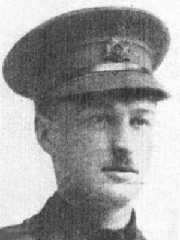
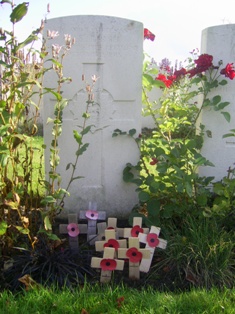
Charles was born in Hong Kong, the son of Lily Kirch
and went to Gresham School in Norfolk.
His attestation papers show he enlisted on 6th August
1914 and became Private 1604 in the Artist's Rifles. Charles stood
almost 6 feet tall, was 19 years, 5 months old and worked as an
Assistant in the Anglo-Persian [Mining?] Company, although his writing
makes it difficult to be certain!
He went abroad with the battalion on 26th October
1914 and on 31st December 1914 he was granted a Temporary commission
in the Bedfordshire regiment. At the time he was single and gave
his address 40 Princes Square, Bayswater in Middlesex with his mother
being the only next of kin, living in Hindhead and New South Wales.
He arrived with the 1st Battalion whilst they were
in billets at Bailleul and spent his tour holding the line around
Ypres. On the 11th April 1915 the Battalion were moved to opposite
Hill 60, where they provided support for the evening attack on the
German stronghold on 17th April. During days of furious attacks
and counter attacks, the Battalion lost over 400 men, including
Charles who was acting as Company Commander and declared missing
at the time.
After his death, Major Walter Allason wrote to his
mother saying "He did not know what fear
or danger was".
It was some time before he was officially declared
dead rather than missing, with his mother being officially informed
on the 21st of May. On the 28th of June she received a letter through
her bank in London that he had been buried in the grounds of Ypres
Asylum although he was later moved to the Bedford House Cemetery.
His wristwatch and strap were returned to her as was his diary.
Charles' estate passed to his mother in the sum of £90, 8s and 10d.
His service record is held at the National Archives
under WO339/24530, with his Officers' service number being 45221.
(With thanks to John Hambling for the picture from
'Bond of Sacrifice')
|
|
Lieutenant John WEBB
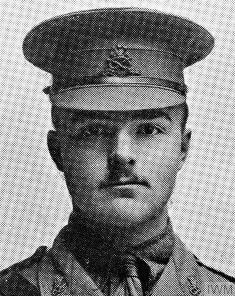 Killed
in action 21st April 1915, aged 20.
4th battalion the Prince of Wales (South Staffordshires) regiment,
attached to the 1st battalion, Bedfordshire Regiment (although CWGC
records attached to the Royal Berkshires).
Born on 8 June 1894, John's parents were Captain Charles Boyer
and Adela Dorothy Webb (of Elford House, Tamworth in 1914). After
education at Harrow, John went on to Trinity College in Cambridge.
Interrupting his education, he applied for a commission very early
in the war, on 7 August 1914, being commissioned as a Temporary
Second Lieutenant in the Special Reserve of Offices, South Staffordshire
Regiment.
Lieutenant Webb arrived with the battalion 26th March 1915 and
was killed within a month as they held the fiercely disputed Hill
60, south of Ypres.
He was interred in the Railway Dugouts Burial Ground, 2km south-east
of Ypres centre and his service record is held by the National Archives,
reference WO 339/19138.
(Image courtesy of the Imperial War Museum, reference HU127201)
|
|
Second Lieutenant
William Bernard KNIGHT
Killed in action 21st April 1915, aged 28
William was born 30 March 1887 in Westminster Road,
Hanwell, the son of Thomas Joseph Knight and Margaret (formerly
Bennett).
A solicitor from Kilburn before the war, William rejoined
the Inns of Court O.T.C. in September 1914, having served between
1906 and 1912 before. He was commissioned and posted to the 4th
(Reserve) battalion the Prince of Wales (South Staffordshires),
attached to the 1st Bedfords.
Second Lieutenant Knight arrived with the battalion
on the 25th March 1915, in the same draft as his comrade John Webb
(above) and fell on the same day as John Webb.
He has no known grave but is remembered on the Ypres
(Menin Gate) Memorial to the missing.
|
|
Second Lieutenant Ronald Marmaduke
Dawnay HARVEY
Killed in action 21st April 1915
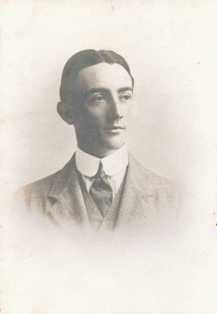 Ronald was born 16 May 1887 at Buckingham Palace Hotel in London,
son of the Reverend Frederick Mortimer Harvey (the Rector of Bolnhurst,
Bedfordshire) and Katherine Dorethea Harvey (formerly Jervis), whose
family came from Staffordshire.
After education at Haileybury College in Hertford
he went to Australia with his parents in 1905 and although intending
to take up farming, went into the theatrical profession instead.
He returned to England in 1909 to become part of the F.R. Benson
Shakespearean Company, later touring South Africa with the 'Herbert
Company'. Returning to England in 1912, he joined the Julia Nelson
and Fred Terry Company for a year before settling down to run a
garage on Somersetshire with a friend.
Just as the garage was becoming a success, war broke
out and, feeling as though he should "do his bit", on
8th August 1814 he applied for a commmission, listing himself as
a single motor mechanic.
After training, he landed in France 17 March 1915,
joining the 1st Battalion of the Bedfordshires around Hill 60 on
the 25th. Less than one month later, he was initially posted as
wounded in the confusion and heavy casualty lists but testimony
from several men of the battalion verified his fate.
Private 5618 Mart gave the following testimony from
his hospital bed at No.8 General Hospital on 10 May 1915; "Lt
Harvey was a very nice Gentleman and had not been with them long.
Informant saw him badly wounded in a communication trench on Hill
60. He gained further information on him from a man who told him
that he had bandaged Lt Harvey up. A little later the Lieut went
past a particular spot in the trench which was very dangerous; many
men had already been lost crossing that place, and the Lt was killed
there by a hand grenade. We held the ground where he lay all the
while, so that he was probably buried by the East Surreys who came
to relieve us ... Lt Harvey commanded informant's platoon, which
was the 7th, only 15 of 57 of them came out alive."
There are a few other testimonies in his service record
which do not match but Sergeant 15018 F. Courtnell's telling testimony
of 11 May does and brings more of the local conditions to light;
"He was attached from the Staffords. I believe the North Stafford,
but am not quite certain. He was a Lt. in charge of No.7 Platoon
of B Coy. (my Coy.). The night after the mining of Hill 60 we went
grenade throwing. He was on our left. I did not see him but later
Capt. Edmunds of our Coy was told by someone that Lt. Harvey was
hit and died in a communication trench while being carried down.
I do not know whether he was buried. I am afraid he is like the
remainder of them, trampled down and covered up."
Private 8301 Taylor of Cotton End, Bedford added that
he was "buried on Hill 60 April 26th".
Coincidentally, on 26th April 1927 - 12 years to the
day after his original internment - his remains were discovered
by a Wargrave commission party and he was moved to the Sanctuary
Wood Cemetery, where he lies today.
At the time of his death, his only surviving next
of kin was given as his Aunt, a Mrs G.M. Mainwaring of The Cottage,
Wiveliscombe in Somerset.
|
|
Second Lieutenant Robert
Heath FAWCETT
Killed in action 26th April 1915
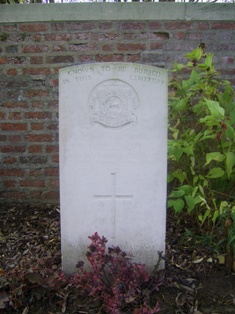 Robert was born 5 March 1893, the son of H.H. Fawcett, whose address
at the time of Robert's death was the War Office.
He was educated at Uppingham School, then Emmanuel
College, Cambridge, being an Undergraduate and living at Oaken Cottage,
Berkhampstead when he applied for a commission on 5 August 1914.
Lieutenant Fawcett was in the 4th (Special reserve)
battalion, attached to the 1st battalion and is buried in the Tuileries
British Cemetery, 3km east of Ypres centre.
|
|
Second Lieutenant Eric
Arthur HOPKINS
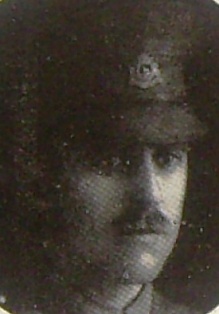 Killed
in action 5th May 1915, aged 29
Eric was born 11th September 1885 at 16 Richardson
Street in York, the son of Arthur Hopkins, an organist, and Annie
(formerly Tucker) Hopkins.
Before the war Eric gained a B.A. degree from Leeds
University and was a Schoolmaster at Elstow School in Bedford when
he applied for a commisson on 3rd August 1914.
He was commissioned into the 3rd (Reserve) Battalion
and served abroad with the 2nd Battalion from mid September 1914.
Second Lieutenant Hopkins was wounded during the First Battle of
Ypres and convalesced at the Royal Herbert Hospital, Woolwich, until
late November, after which he joined the 1st Battalion on the front.
Lieutenant Hopkins was among the long list of those
who were killed defending Hill 60 and has no known grave but is
remembered on the Ypres (Menin Gate) Memorial to the missing.
His service record is held at the National Archives
under reference WO339/12788.
|
|
Captain Sheldon
Arthur GLEDSTANES
Died of wounds 9th May 1915, aged 25
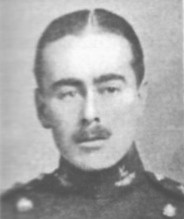 Sheldon
Arthur Gledstanes was born at Ealing on the 25th of May 1889, the
only son of Francis G. and Georgiana Sophia Gledstanes from Berry
Hill, Taplow, Buckinghamshire.
A publication called the "Bond of Sacrifice" records:
"He was educated at Eton
and joined the Bedfordshire Regiment from the special reserve in
May 1910 becoming Lieutenant in March 1912 and being promoted Captain
in March 1915. He was a member of the Conservative and other clubs
and was fond of most games, cricket, football, rackets, hockey,
golf and tennis. He was one of the original Expeditionary Force
and had nine months service at the front when he received on the
6th of May 1915, the wounds from which he died three days later
on the 9th of May.
The following particulars
of his death were given to his family by his Commanding Officer;
Captain Gledstanes was in command of a trench near Hill 60 and he
and his men had gallantly held it for two days, in spite of asphyxiating
gases, bomb attacks, and heavy artillery fire, and also in spite
of the trench being enfiladed by the Germans, having occupied a
trench on the right thus taking them, not only in the flank, but
partly in reverse. Fortunately, the good work done by Captain Gledstanes
was carried on after he was wounded and the trench was held until
the men were relieved, though many were sick from the gas, wearied
and sleepless, cut off from the rest of the line, and continually
harassed by hand grenade attacks. The authorities recognised the
achievement as one of the finest episodes of the war."
Sheldon Gledstanes landed in France with the Battalion
in August 1914 and took part in the early battles of the Great War,
around Mons, Le Cateau and Ypres. After a dreadful first winter
in the trenches, he was commanding the right sector of the lines
held by the Bedfords to the left of the famous Hill 60. At 6.30pm
on the 1st May, the Germans launched a surprise attack and smothered
the area with their new gas shells, high explosives and waves of
assaulting soldiers. Many sections were not attacked as the gas
blew back onto the German positions and during this early engagement,
Private Warner of the
1st Battalion won his Victoria Cross. A few days of relative quiet
followed as the Battalion shrunk still further from men reporting
in violently ill from the effects of this new and dreadful weapon.
On the 4th May, the lines were shortened to account
for the severe lack of men to man them, leaving the Germans to take
over the vacated portions of the British lines and their artillery
renewed its bombardment, "knocking the trenches about" severely.
The following morning, at 8am, a new gas barrage was unleashed and
the Battalion to the right were driven from their positions, leaving
the Bedfords dangerously exposed. A large attack on the left was
repelled with horrendous loss to the Germans and Captain Gledstanes'
right section was continually shelled, bombed and fired on by machine
guns and rifles. Several times that day the Germans got into their
positions, only to be bombed and bayoneted out again in one of the
most desperate brawls of the battle. Ferocious grenade skirmishes
continued all day and the Germans eventually worked around the open
right flank from which position they enfiladed the Bedfords from
the right and rear. Despite the odds and hopelessness of their situation,
the remnants stayed in their battered trenches and fought off attack
after attack. Lt Whittemore
alone claimed over 50 Germans with his rifle that day and their
small band grew even smaller.
Late that day, Captain Gledstanes was wounded but
remained at his post, encouraging his men and helping to fight off
the Germans himself. There they remained until the 7th May, when
the exhausted survivors and those who had survived from their piles
of wounded were finally reached and relieved. By that time, Captain
Gledstanes' wounds were too severe and unfortunately he died two
days later. He lies in the Bailleul Communal Cemetery, 15km south-west
of Ypres and was the son of Francis Garner Gledstanes and Georgiana
Sophia Gledstanes from Berry Hill, Taplow, in Buckinghamshire. He
is also remembered on his family's local memorial at Taplow,
Buckinghamshire.
Captain Gledstanes was mentioned in Sir John French's
dispatch of the 31st of May 1915 in recognition of his bravery during
the desperate struggle to hold the isolated position.
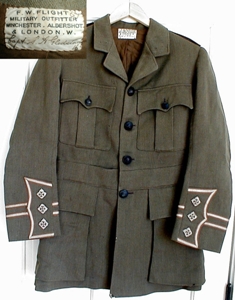 As
a fitting end to the story, in October 2007, Bill from America got
in touch. He had just become the proud owner of Captain Gledstanes'
tunic, a photograph of which is to the left. On the label inside
the collar is Captain Gledstanes' name, presumably written in his
own hand.
It is fitting to learn that, nine decades on, part
of his story still survives and is being cared for by someone who
will cherish and care for it.
(My thanks to John Hamblin for the Bond of Sacrifice
information and photograph and to Bill for the photograph of Gledstanes'
tunic)
|
|
Major John MacKENZIE, V.C.
Although Major MacKenzie served in the 1st battalion
in 1914, he moved to and was killed in the 2nd battalion. His biography
can be seen here.
|
|
Lieutenant Rupert Edwards
Gascoyne CECIL
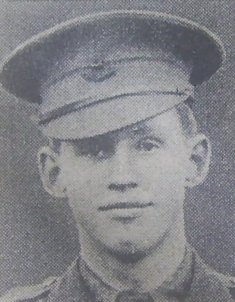 Killed
in action 11th July 1915, aged 20
Rupert was born 20th January 1895, the fourth son
of the Right Reverend Lord (Rupert Ernest) William Gascoyne Cecil
and Lady Florence Cecil and was educated at Westminster School.
At 6 feet tall, Rupert was certainly above average height for the
time and applied for a commission on 17th August 1914, giving his
occupation as an Undergraduate at Christchurch College, Oxford.
Lieutenant Cecil landed in France on 13th May 1915
and within days of joining the 1st Battalion, was wounded on 23rd
May. He returned to the battalion on 18th June once he had recovered,
only to be killed within a matter of weeks.
When the Germans blew a large mine on 11th July and
followed it up with an artillery barrage, Lieutenant Cecil was among
those killed, either from falling debris or during the barrage.
He is buried in the Railway Dugouts Burial Ground,
2km south-east of Ypres centre.
Rupert's father, the Right Reverend Lord William
Gascoyne Cecil, the Rector of Hatfield and later Bishop of Exeter
was one of history's characters. Devoted to his position in life,
he appears to have been so wrapped up in his vocation as to become
absent minded on occasion, as his entry in Wikipedia reads that
"He would feed crumpets to the rats
and throw powdered copper sulphate on the fire in order to turn
the flames green. Once, while robing in the vestry before a service,
he held a handkerchief between his teeth, but forgot to return it
to his pocket and proceeded to the altar with it still hanging from
his mouth. He was heard to complain that the Bible was 'an awkward
book', and would often ring up his wife to ask where he was."
Reverend Cecil also sheltered a Belgian family for
four years during the war and, although entitled to use the Bishop's
Palace in Exeter during his time as the Bishop of Exeter, chose
to live more modestly out of town, cycling to his parish daily and
opening the palace to the war's wounded.
Two of Rupert's three brothers, John Arthur and Randle
William, also fell during the war, making the family's loss a high
one indeed.
|
|
Second Lieutenant Charles
Adam COOK
Killed in action 11th March 1916, aged 24
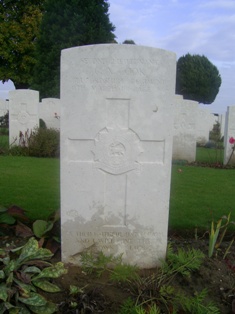 Charles
enlisted as a Private in the Hertfordshire Regiment and was commissioned
into the Bedfords, arriving with the battalion in the line October
1915.
During a 'routine' tour of the front lines, Second
Lieutenant Cook was shot by a sniper and killed instantly.
Charles was the only son of the late W. H. and Mrs.
Cook, of Hertford and lies in the Cabaret Rouge cemetery, Souchez.
|
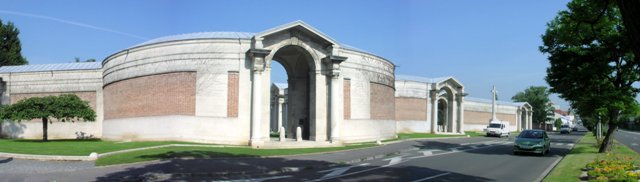
The Arras Memorial to the Missing
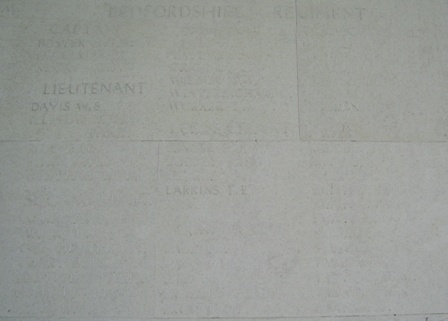
The weathered panel which shows the
names of the Regiment's officers who are remembered on the Memorial.
|
Lieutenant Frederick
John WHITTEMORE, MC
Killed in action 29th March 1916
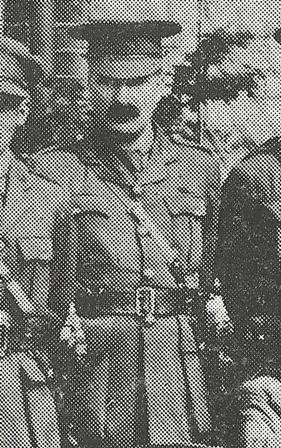 Frederick
Whittemore was born in Cotton End, Bedfordshire, the son of Henry
and Emily Whittemore.
Declaring himself as 18 years and 5 months old, the
Farm Labourer was already serving in the county Militia (3rd Battalion)
when he enlisted into the regulars of the Bedfordshire Regiment
in January 1896, becoming Private 5546 in the 2nd Battalion. He
transferred to the 1st Battalion in India in 1897 but rejoined the
2nd in February 1902, during the South African Wars. A year later
he was posted to the Depot and married Lizzie Laura Lightfoot in
April 1905 but rejoined the 2nd Battalion two years later and worked
his way up through the non commisisoned ranks until becoming a Colour
Sergeant in 1910.
Frederick remained with the 2nd Battalion throughout
their service in Gibraltar, Bermuda and South Africa, rising to
the rank of Company Sergeant Major in February 1914. When war was
declared, he returned to Europe with his battalion and landed in
France 6 October 1914. CSM Whittemore fought with the 2nd Battalion
during the First Battle of Ypres and was commissioned in the field
17 October 1914. Second Lientenant Whittemore was among the battalion's
long casualty list, being wounded during their determined stand
against a massed German assault on 29 October 1914.
After recovering from his wounds and gaining a promotion,
Lieutenant Whittemore returned to France and joined the 1st Battalion
on 2 May 1915, when he was thrown straight into the battalion's
costly defence of the infamous Hill 60, on the southern edge of
the Ypres salient. As battalion Sniping Officer, Frederick was in
the thick of things from the outset and accounted for over 50 of
the attacking German troops himself during their stand, but was
gassed and wounded in the hand on 5 May 1915.
An extract from the book 1st
Bedfordshires; Mons to the Somme reads:
'Lieutenant Whittemore shot
over fifty Germans alone during the day's fighting before being
wounded by a bayonet in the hand and suffering from gas poisoning,
a fate that he shared with Lieutenant Small. Curiously, Lieutenants
Whittemore and Small had in common many experiences during the war:
both had been NCOs in the 2nd Bedfordshires; were injured at Ypres
on 29 October 1914, and had been commissioned together, arriving
with the 1st Bedfordshires only a few days earlier. Now they were
wounded in the same trench, would be loaded onto the same hospital
train and would both recover in No. 4 General Hospital in Versailles.
Whittemore would be awarded a Military Cross for his part in the
defence and be back with the battalion at the end of the year.'
He rejoined the 1st Battalion on 1 December 1915 and
the Military Cross was gazetted in January 1916.
Following twenty years of service in the regiment
and having served through two wars, Lieutenant Whittemore, MC, was
mortally wounded during a night patrol on 29 March 1916. His comrades
tried desperately to recover his body, but despite several attempts,
were unable to reach it. As a result, Lieutenant Whittemore is remembered
on the Arras Memorial to the missing.
He can be seen here
in the 3rd battalion officers' group photograph from 1915, which
is where the his photograph to the left comes from.
|
|
Lieutenant Reginald
Cumberland GREEN
Died of wounds 18th May 1916, aged 31
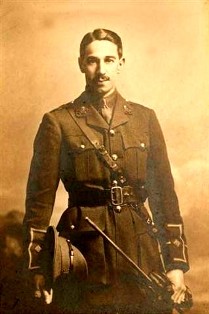 Reginald
was born 10 August 1994 at The Larches in Luton, the youngest son
of John William Green and Mary Ann Green (formerly Cumberland).
The family were behind the well known Greens Brewery in Luton.
After eduction at Bedford Grammar and Exeter College,
Oxford, Reginald studied Law in London and passed the Bar in 1912.
His intention was to run the family business but war broke out and
he applied for a commission in the Bedfordshire regiment which was
gazetted on 14 September 1914.
Landing in France on 6 October 1915, Lieutenant Green
joined the battalion in December 1915
While examining a mine at 3am on the 18th May 1916,
Lieutenant Green was shot and died from his wounds in No.15 Field
Ambulance soon afterwards. He was interred in the Faubourg D'Amiens
cemetery, Arras and a photograph of his gravestone can be seen here.
Reginald was the son of John W. and Mary A. Green,
of "The Larches," Luton.
He can also be seen here
in the 3rd battalion officers' group photograph from 1915.
|
|
Second Lieutenant Edgar
G. Butlin MILLSON
Killed in action 18th June 1916, aged 30
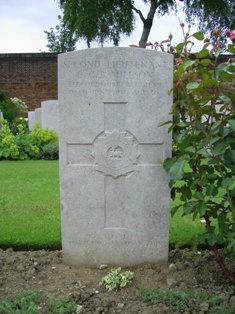 Although
some databases refer to him as being killed in the 4th battalion,
Second Lieutenant Millson was actually killed serving in the 1st
battalion.
Edgar was educated at Epsom College and was a Railway
Engineer in Columbia, South America when war broke out.
He was killed by a sniper whilst examining the enemy
lines through his looking glasses at 4am.
Edgar was the only son of George Millson, O.B.E.,
M.R.C.S., L.R.C.P., the Medical Officer of health for Southwark,
who lived at 20 Angell Rd., Brixton, London, and Mrs. Sarah Eileen
Millson.
He lies in the Faubourg D'Amiens cemetery, Arras.
|
|
Second Lieutenant Gerald
SHERRY
Died of wounds 26th July 1916, aged 25
Second Lieutenant Sherry was wounded on the 23rd
July, whilst in charge of pushing several fortified posts towards
German positions between High Wood and Delville Wood and died from
those wounds three days later. He was the son of John and Eliza
Sherry of Rusholme, Manchester, as well as the husband of Amy Nancy
Sherry of 29, Stafford St., Gillingham, Kent.
Gerald was mentioned in despatches for his bravery
and lies in the Heilly Station cemetery, Mericourt L'Abbe, 10km
south-west of Albert on the Somme.
|
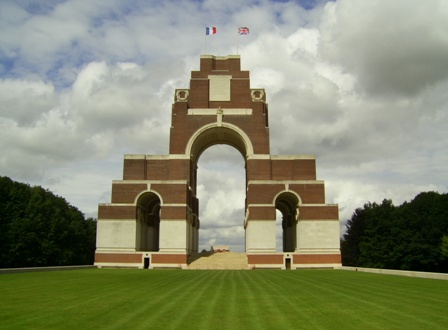
The Thiepval Memorial to the Missing
The following six officers fell during
the battalion's operations
against the heavily fortified village of Longeuval, during the Battle
of the Somme, along with around 500 other casualties over the three day
period:
|
Captain Henry Patrick
Claude BURTON
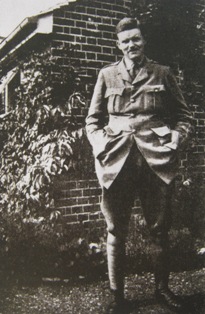 Killed
in action 27th July 1916, aged 23
Henry was born 27 May 1893, the son of Claude Edward
Cole Hamilton Burton and Katherine Grace Burton (formerly Dell)
of Berkhampstead. Henry appears to have been known as Paddy, presumably
as his father was born in Ireland.
He was educated at Repton School, then Dragon School
in Oxford (1905 to 1907), before going on to Wadham College in Oxford
and was in his second year when war broke out. His Dragon School
Memorial Book entry records "Paddy was one of those boys who make
life ceaselessly interesting to a schoolmaster. It may be said that
he was a strange compound of liberal and conservative, but what
characterized him most was his independence of judgement and pluck."
His list of achievements, including an apparently impressive wit,
were long!
Aged 21, Paddy applied for a commission on 8 August
1914 and was posted to the 4th Bedfordshires. After training he
joined the 1st Bedfordshires in France and "fought ill health" during
his time on the front.
Captain Burton was among the battalion's long list
of casualties during the assault on Longueval and like so many of
those who fell during the battle, his final resting place was lost
so he is remembered on the Thiepval Memorial to the Missing.
Paddy's bio in the Dragon School Memorial Book reported
that his Company Sergeant Major wrote "Throughout the operations
he showed wonderful courage and led us most gallantly in the attack.
His last words were to me, requesting me to carry on with the task
he had so nobly set out to do. He was loved by all the men under
his command, who were very sorry to lose so brave a leader."
His Dragon School bio also added that he was to be
married during his next spell of leave.
|
|
Second Lieutenant
Alfred Charles HAYHOE
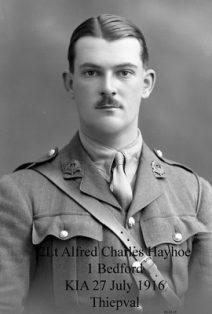 Killed
in action 27th July 1916, aged 27
Alfred was born 16 March 1889, one of nine children
born to Alfred Hayhoe (a race horse trainer in Newmarket) and Harriette
Hayhoe (formerly Rogers). After education at Felstead School he
worked as a Bank Clerk.
Aged 25 years and 6 months, Alfred enlisted into the
18th Royal Fusiliers, becoming Private 1603. Given that he enlisted
into the same battalion on the same day as Archie Holland (below)
and they were seperated by just 30 numbers, they would have presumably
come to known one another.
On 29 April 1915 he applied for a commission, which
was gazetted 15 May 1915, when he was posted to the 3rd Bedfordshires.
Like Archie (below) he arrived in France 30 January 1916 and was
posted to the 1st Bedfordshires, perhaps via the same Entrenching
Battalion Archie was, although his record does not include those
papers.
Second Lientenant Hayhoe was killed alongside his
friend Archie, during the battalion's assault on Longueval on 27
July 1916. Also like Archie, he has no known grave so is remembered
on the Thiepval memorial to the missing
|
|
Second Lieutenant
Archibald Clare HOLLAND
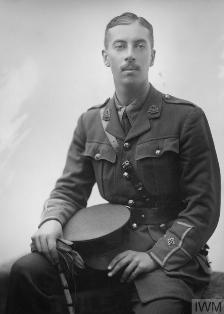 Killed
in action 27th July 1916, aged 28
Archibald - known as Archie - was born on 1 April
1888 in St. Gallen, Switzerland, the son of James Frank Holland,
M.D., and Jeanette Holland. He was educated at Harrow School, then
Merton College Oxford. His father had spent time attached to the
British Consul in St. Moritz and Archie became a Bank Clerk before
war broke out.
Enlisting on 3 September 1914, Archie initially joined
the ranks of the 18th Royal Fusiliers (Public Schools and University
Corps) as Private 1634. Given that he enlisted into the same battalion
on the same day as Alfred Hayhoe (above) and they were seperated
by just 30 numbers, they would have known one another. On 17 May
1915 he was discharged to commission and after training in the 3rd
(Reserve) Battalion he was posted to France in January 1916, presumably
in the same draft as Alfred above..
Initially serving in the 10th Entrenching Battalion,
he was atatched to the 1st Bedfordshires in the field several months
later. Taller than many of his peers at the time, Archie stood almost
6' 2" in his socks, which would have made him an ideal target
for enemy snipers.
Second Lieutenant Holland was among those killed during
the battalion's costly assault on Longueval and his grave was among
those lost in the subsequent fighting, so he is rememebred on the
Thiepval memorial to the missing.
In what appears to be an extract from a letter to
his parents after his death, one of his men wrote:
"I know how bitterly
you will feel Archive's loss. At the same time you must be proud
that he died while doing so nobly his duty. Our Commanding Officer
told me, soon after he came to us, how very proud he was to have
such a fine officer in the battalion. He was greatly liked by both
officers and men, and on works was the most painstaking officer
I have ever had."
At the time of his death, Archie's parents lived
at 6 Queen Anne's Gardens, Bedford Park, Chiswick, London
|
|
Second Lieutenant
Norman Douglas WEMYSS
Killed in action 27th July 1916, aged 20
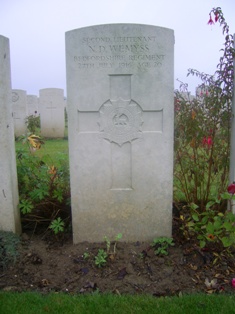 Norman was the son of Alexander and L. F. A. Wemyss, of 24, de Parys
Ave., Bedford and lies in the London Cemetery and extension, Longueval
on the Somme.
|
|
Second Lieutenant
David Newbold GAUSSEN
Killed in action 31st July 1916, aged 23
Second Lieutenant Gaussen was trained in the 9th
battalion, later being attached to the 1st. He was the son of the
Rev. Charles E. and Mary Gaussen, of Fairview Cottage, Lord's Well
Lane, Crowborough, Sussex and lies in the Dernancourt communal cemetery,
3km south of Albert.
|
|
Second Lieutenant
Arthur Norris MARSHALL
Killed in action 30th July 1916, aged 20
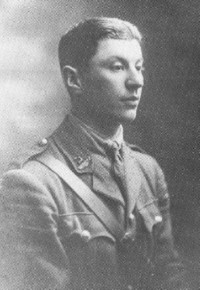 Arthur
was born at Newent, Gloucestershire on the 19th of March 1896. He
was the son eldest son of William Norris Marshall MRCS MRCP of the
Red House, Newent and Adela Frances Grace, the daughter of the Reverend
Peter Wood Rector of Newent and Canon of Middleham Yorks. Arthur
attended Dean Close School where he was a member of the Officer
Training Corps. On leaving school he took up a post as a clerk at
Lloyds Bank, Farringdon, Berkshire.
He volunteered at the outbreak of the war and was
commissioned into the 4th Battalion on the 16th of June 1915. Second
Lieutenant Marshall was transferred to the 1st Battalion from November
1915, arriving with them on the 4th December at Fricourt.
Having survived the carnage of the 27th July, when
over 300 Bedfords were killed or wounded, Arthur was killed by a
shell at Longueval on the 31st of July 1916 as the Battalion fought
in the same area and sustained almost 200 more casualties.
Arthur died aged just 20 and has no known grave.
He is commemorated on the Theipval Memorial. At the time of his
death he was a resident of Canden Lawn, Portland Street, Cheltenham.
(My thanks to John Hamblin for the pre-war bio and
his photo)
|
The following six officers were killed during the battalion's involvement
during the Battle of Guillemont,
during the Battle of the Somme:
|
Second Lieutenant James
Hirst BANYARD
Killed in action 3rd September 1916
Second Lieutenant Banyard joined the 1st battalion
from the 3rd (Reserve) battalion on the Somme 18th August 1916,
along with Vincent Sanders (below).
He has no known grave but is remembered on the Thiepval
memorial to the missing
|
|
Second Lieutenant
Vincent Stanton SANDERS
Killed in action 4th September 1916, aged 19
Vincent was born in Hornsey, London, to Henry Frederick
and Amalia Sanders (nee Stanton) on 17 Janaury 1897. After education
at Pitmans Metropolitan School he became a Bank Clerk.
Adding two years to his age, Vincent enlisted as a
Private in the Royal Fusiiers on 7 September 1914, becoming Private
222 of the 17th Battalion. In February 1915 he was discharged to
a commission and trained to become an infantry officer in the Special
Reserves, at which time his true age was revealed!
Joining the 1st Bedfordshires around Arras on 1 December
1915, he spent time in the Divisional School and by May 1916, internal
memos remarked how his education and experience had improved significantly,
especially when under severe bombardment during the battalion's
first tour on the Somme. Promotion to holding a commission in the
Regulars followed on 4 June 1916 and after a spell in hospital from
mid July to mid August, he rejoined his comrades in time for their
latest assault during the Somme campaign.
Joining C Company alongside James Banyard (above),
both officers were killed during the ferocious assault aainst the
fortified Faffemont (Falfemont) Farm, their company coming under
heavy artillery fire from both sides before attacking in support
of D Company's charge up the heavily defended slope.
Although the farm was in their hands by the time the
sun set, 17 of the 20 officers who went forward and almost half
of the 'Other Ranks' had been killed or wounded, with the rest of
their brigade also losing heavily as they were pinned on the slopes
in front of the fortified farm.
Like so many of his comrades who fell during the battle,
Vincent is remembered on the Thiepval memorial to the missing
|
|
Second Lieutenant Christopher
BLAKE
Killed in action 4th September 1916, aged 24
Second Lieutenant Blake had only been with the battalion
for three days when he was killed in action.
He was the son of William Henry Blake, M.B. and Elizabeth
Alice Blake, of Bowers House, Harpenden, Herts and is remembered
on the Thiepval memorial to the missing.
|
|
Lieutenant Addison
James HOWARD
Killed in action 4th September 1916, aged 23
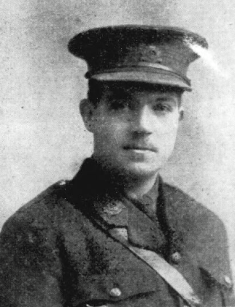 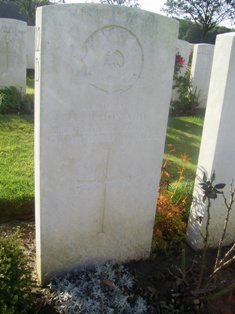 Addison
was born at home on 29 April 1893, the son of James Harold and Mary
Howard of The Grange in Kempston, Bedford.
After educaion at Bedford Grammar School and King's
College in Cambridge - at which he was a Sapper in the University's
RE Company O.T.C. - he joined his family's well know local business
'Howards' (J & F Howards) manufacturing Agricultureal implements
at the Brittania Iron Works.
On 19 January 1915 he was commissioned as a Temporary
Second Lieutenant in the Bedfordshire Regiment and posted to the
3rd Battalion for training.
From 31 August he was on sick leave courtesy of a
tonsillectomy which later heamorraged and caused his sick leave
to be extended until around February 1916.
Once his re-training had been completed and he had
been passed as fit for active service, Lieutenant Addison was sent
to France, laning on 20 May 1916. What he did for the next three
months is unclear but he arrived with the 1st Battalion in the field
on 27 August, but was killed a week later during his first battle.
According to a report in the Bedfordshire Times and
Independant, he was killed instantly by a shell explosion, during
the battalion's assault against Faffemont (Falfemont) Farm.
He lies in the Guillemont Road cemetery, Guilllemont,
12km east of Albert on the Somme.
The Addison
Howard Park in Kempston was named in his memory and BLARS
hold a collection of his cousin Douglas' papers, who was wounded
in the same battalion and on the same day as Addison.
|
|
Second Lieutenant Dion
Albert LARDNER
Killed in action 4th September 1916, aged 20
Dion was the son of Albert Edward and Mary Lardner,
of "St. Marie," Nimrod Rd., Streatham, London and is remembered
on the Thiepval memorial to the missing
|
|
Major Noel Wilfred LAWDER
Killed in action 4th September 1916, aged 30
Major Lawder had been a Regular officer before the
war and temporarily led the battalion in June and July 1916.
At the time of his death he was the battalion's Adjutant.
Noel was the son of Margaret Lawder, of 7, Blakesley Avenue, Ealing,
London, and the late Dr. E. J. Lawder.
He has no known grave but is remembered on the Thiepval
memorial to the missing
|
|
Second Lieutenant
Douglas Bowhill CANDY
Died of wounds 25th September 1916, aged 26
Douglas was the son of the late Richard E. Candy,
I.C.S., and of Mrs. E. A. Candy and is buried in the Bronfay Farm
military cemetery, Bray sur Somme.
|
|
Captain (acting Major)
John Jenkins (Jack) MOYSE
Died of wounds 7th to 9th February
1917 (dates vary according to the source), aged 32
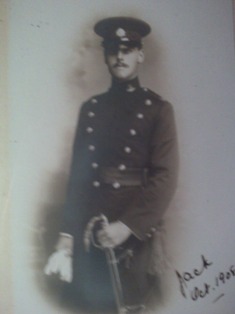 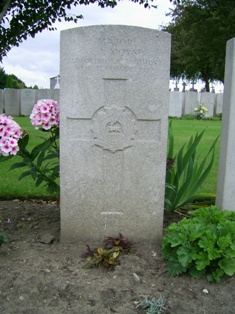 John, known as Jack, was born 3rd February 1885 in Montreal. He
was the son of Dr. Charles E. Moyse (who was to become the Dean
of the Faculty of Arts at McGill University in Montreal) and Dame
Jessie McDougall Moyse (nee Stirling).
John Moyse applied to officer training
as a Colonial Candidate and passed the 'Competitive Examination'
in October 1907, becoming a Second Lieutenant in the Bedfordshire
Regiment. The photograph opposite was taken in October 1908 and
was kindly supplied by his relative, Doug Moyse.
He became a Lieutenant from the
1st January 1910 and was promoted to Captain from the 12th February
1914, serving in the 2nd battalion before war broke out.
Captain Moyse joined the 1st battalion
on the front lines 4th January 1915, two days after landing in France
for the first time. Within six weeks he fell ill and arrived at
No.2 Stationary Hospital, Boulogne suffering from influenza on 14th
February 1915. He was returned to England to recover, arriving at
Mandeville hospital, London, on 18th February.
On recovery Captain Moyse returned
to the battalion but during the ferocious fighting for Hill 60,
he was wounded by shrapnel in the left jaw and shoulders 21st April
1915. John was admitted to 17 Park Street Hospital for Officers
in London on 25th April 1915 to recover. Once fit for basic duty
again, he was posted to the 4th battalion at Dovercourt from August
1915 until returning to the front for the third time late in 1915.
Captain Moyse was next wounded
in both legs by shell fragments on 16th April 1916 whilst reconnoitring
the front lines in readiness for the battalion taking over on the
20th and was admitted to General Hospital in Havre the following
day. He sailed from Havre to Southampton on board the 'St. David'
20th April. Once recovered, he was posted to the 3rd battalion at
Landguard, Felixstowe from the 18th June, until fit for active service
once more.
Early in October Captain Moyse
was back in the battalion on the front again and took over temporary
command of the battalion in November and again in December, being
promoted to Acting Major as he did so. On Christmas Day he was granted
a short leave and returned to the battalion a few days later.
During what was recorded as being
a 'quiet spell' in the trenches Acting Major Moyse was shot in the
head by a German sniper and badly wounded. He was admitted to 33
Casualty Clearing Station on the 7th February suffering from 'dangerous
wounds'. The documents within his service record (held at the National
Archives under reference WO339/6930) tell that he died of his wounds
on the 7th, 8th or 9th February and was buried in the Bethune Town
Cemetery where he lies today.
He was also mentioned in despatches
for bravery on the 22nd May 1917 although what this was for is not
recorded.
|
|
Second Lieutenant Walter
Thomas SMITH
Killed in action 3rd March 1917, aged 35.
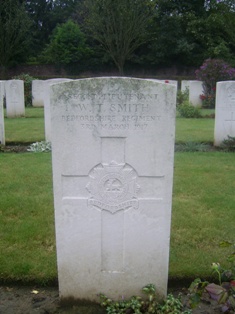 Walter
was born around July 1881 in Brierly Hill in Staffordshire, the
son of Thomas and Mary Smith. Doubtless inspired by the patriotic
fervour surrounding the South African War of the time, the 18 year
old grocer enlisted into the 3rd (Reserve) battalion of the Worcestershire
regiment on 30th November 1899, becoming Private 8642. He was 5
feet, 4 inches tall, with brown hair and grey eyes, and signed up
for 7 years with the colours and a further 5 in the Reserves.
Walter became a Lance Corporal on 16th October 1900
and Corporal from 25th October 1901, at which time he was posted
to the Regular 1st battalion and sailed with them to the South African
Wars. Initially he served in the Mounted Infantry but the 21st October
1902 saw him posted into the Regular 1st battalion and on the 2nd
April 1903 he returned home, becoming a Lance Sergeant on 21st June
1903.
On the 14th April 1904 Walter was promoted to a Sergeant
and in September 1906 elected to extend his service with the colours
to 12 years.
In January 1908 he was posted to the Regular 2nd battalion
and sailed for service in India, and in June 1911, extended his
service again to 21 years.
On the 6th March 1913 Walter returned back to England,
on 22nd September 1913 Walter became a Colour Sergeant and from
1st October 1913 was a Company Quartermaster Sergeant (CQMS).
Throughout his pre war career, he picked up several
diseases and had his share of cuts and bruises, all treated by the
army. One particularly nasty recurring personal problem lasted for
many years on and off, finally disappearing in 1913 when he returned
from India.
When war broke out in 1914, CQMS Smith sailed with
the battalion to the Western Front on 12th August and fought in
the early battles of the war as a part of the 5th Brigade, 2nd Division.
During the First Battle of Ypres, on 8th November
1914 Walter became a Company Sergeant Major (CSM) as the previous
one (CSM Williams) fell in battle.
CSM Smith received a gunshot wound (or shrapnel wound)
to the back on 12th April 1915 and returned home to recover on 26th
April, via hospitals in Versailles and Rouen.
Whilst in England he married Margaret O'Neill at the
parish church, Christchurch in London on 6th November 1915.
With his recovery under way, Walter was posted as
a C.S.M. in the 5th battalion on 16th July 1915, and moved back
to France to rejoin the 2nd battalion on 22nd February 1916. He
was appointed the Acting Regimental Sergeant Major on 7th March
and was promoted to a commissioned officer for services in the field
from 30th April 1916, having served over 16 years in the Worcesters
by then and with his character being recorded as 'Exemplary'.
Walter was posted to the 8th battalion of the Bedfordshire
regiment and was wounded in the face during the battalion's assault
on the Quadrilateral redoubt on 16th September 1916, for which he
was mentioned in dispatches in January 1917. He was sent to the
2nd Red Cross hospital at Rouen and then onto a British hospital,
from where he recovered.
Although at the time of writing the Commonwealth War Graves Commission
(CWGC) record him as being killed in the 8th battalion, he actually
returned to the front lines and was moved into the 1st battalion
on 16th February 1917. In addition, a telegram sent to his wife
informing her of his death specifically records him as being in
the 1st battalion, as does the army form recording his death in
the field. On the day Walter fell, the 1st battalion sent all its
officers to Cambrin to reconnoitre new positions they were to take
over. Walter was killed during the reconnaissance and is buried
in the Cambrin Military Cemetery, 8km east of Bethune.
In September 1916 his wife lived at Molesworth Terrace, Millbrook
in Cornwall. At the time of his death, his wife lived at 68 Margaret
Street, Great Portland Street, S.W. London and by 1920 lived at
4 St. George's Road, Regent's Park in N.W. London.
His service record, which makes fascinating reading, is held by
the National Archives under reference WO339/61677, with his officer's
number being 135546.
|
|
Second Lieutenant Douglas
Edward HOOD
Killed in action 14th April 1917, aged 21
Douglas was the son of Thomas M. and Ellen Hood,
of Pernambuco, Brazil and is burtied in the Zoave valley cemetery,
Souchez.
|
The 1st battalion assaulted German positions at
La Coulotte (now a suburb of Avion), as a part of the Battle
of Arras on 23rd April 1917.
They got into the German lines but, isolated and
short of absolutely everything, were ordered to retire late that day.
Of almost 350 casualties lost by the battalion
that day, the following six were the officers who were killed:
|
Second Lieutenant Thomas
Noel ACKROYD
Killed in action 23rd April 1917
He has no known grave but is remembered on the Arras
memorial to the missing.
|
|
Second Lieutenant Vernon
Edward CURRY
Killed in action 23rd April 1917
Vernon was the brother of Miss N. A. Curry, of 15
Cross St. in Manchester. He has no known grave but is remembered
on the Arras memorial to the missing.
|
|
Second Lieutenant
Thomas Murray Kilpin FLETCHER
Killed in action 23rd April 1917, aged 27
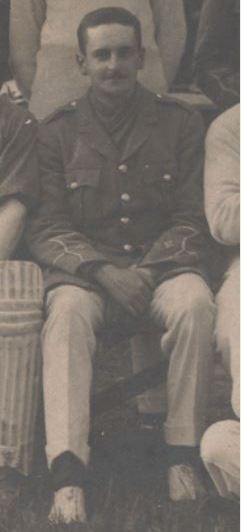 Thomas
was born in Workington on 6 May 1899, the son of Duncan Kilpin Fletcher,
who was a Missionary.
After education at Bedford School, Thomas worked in
the offices of the Pyghtle Works in Bedford before venturing to
Shanghai to work for a cotton firm. While in Shanghai, he served
in the British Shanghai Volunteer Corps for four years before returning
to England when war broke out.
Living at his father's house - St Fillans, Bunyan
Road in Kempston - on his return, Thomas enlisted into the Bedfordshire
Regiment as a Private before applying for a commission on 25 November
1915. His application was granted on 6 January 1916, when he became
a Temporary Second Lieutenant and was posted to the Bedfordshire
Training Depot at Ampthill Park.
Once officer training was complete, Second Lieutenant
Fletcher was sent to France and posted to the 1st Battalion, joining
them in the field 18 September 1916, as a replacement for their
losses on the Somme.
Page 19 of the book 1st
Bedfordshires. Part Two; Arras to the Armistice records:
Between the intense, never ending fatigue duties,
the men took the opportunity to write home, many proving to be fateful
last letters, including one penned by Second Lieutenant Thomas Fletcher.
A popular officer who was well liked among his peers and the men
alike, Thomas had returned from working in Shanghai, China when
war had broken out, joining the 1st Bedfordshires in September 1916
while they fought on the Somme battlefields. A notable cheerful,
upbeat and almost carefree man, Thomas's tone must have been a surprise
to his parents as they read his letter a few days later.
'Since I last wrote I have
had the most strenuous period since coming to the front. It has
been a matter of working at high pressure during every minute of
darkness and often during daytime as well, and no chance for sleep.
Have not had my clothes off for a fortnight. The country where we
are is part of the Hindenburg Line. More I cannot tell you. I thought
I had seen the limit of destruction in the matter of shell fire
on the Somme, but this has been the most terrific bombardment since
the commencement of the war, as so sudden had been our push that
a wounded man told me that the Germans were absolutely panic stricken
when our men went over the top. The next few days will be a dangerous
time for me, and I shall not be able to write you again. These few
lines will only be sent to you in case it is my last opportunity.
Well, dear mother and father, my heart is too full to write more.
You will always have the consolation that I am quite ready to give
my all for the cause I came home to fight for. If it is God's will
to call me, I shall meet you all by and by in the land where all
is peace and happiness.'
During the 15th Brigade's assault on the German positions
in and around La Coulotte, Second Lieutenant Fletcher was among
the long list of officers and men killed. Page 26 of the 1st
Bedfordshires. Part Two; Arras to the Armistice completes
his story:
Second Lieutenant Thomas Murray Kilpin Fletcher was
wounded during D Company's attack and his servant, Private 3/7448
Robert Brown of Baldock, was killed trying to bring his wounded
officer in. Private Brown has already been wounded three times in
the war and Lieutenant John Kingdon of their company wrote to Brown's
widow, remarking how Private Brown and his officer were like two
good friends and that his self sacrifice had not gone unnoticed.
Despite his servant's best efforts, Second Lieutenant Fletcher was
also killed soon afterwards. Days later, soon after receiving a
letter penned by Thomas just before the battle, his parents received
two letters in the same delivery by a cruel twist of fate, one of
which was an official letter from the War Office, so demanded their
immediate attention. It contained notification of their son's death
in action, which must have been made even worse by the fact that
the second letter was an untidily written note from their son. In
communications with the war office who requested a copy of the letter
to establish his will , his father wrote 'It
was simply a short note. A farewell message, as he felt sure it
was his last. He knew our men were in a position that meant this
and we knew he would never surrender. I don't like the idea of sending
away his last letter.' The note had been removed from Thomas'
tunic and sent onto the addressee, having been written whilst he
was wounded and hopelessly pinned down.
Thomas' body was not identified and as a result he
as no known grave but is remembered on the Arras memorial to the
missing.
(With thanks to Ceinwen
Hughes, whose 1916 group photo from Ampthill Camp included Thomas
Fletcher, as seen above)
|
|
Lieutenant
Frederick Donald Roberts ILLINGWORTH
Killed in action 23rd April 1917, aged 21
Frederick was born 27 June 1895, the son of Leonard
and Frances Elizabeth Illingworth from Liverpool. After education
he worked as a Shipping Clerk and joined the 1st/6th (Territorial)
Battalion of the King's Liverpool Regiment on 5 April 1913, becoming
Private 1397.
The part-time Territorial Force started training when
war broke out and his battalion were mobilised for service on the
Western Front from 24 February 1915. In the fighting around Ypres
on 20 April, Private Illingworth was wounded and returned to England
a week later. Once recovered, he was shipped back to France on 1
August 1915 but returned to England at the end of August, having
been accepted into the Officer Training programme. Joining the 9th
Battalion of the Bedfordshire Regiment at Colchester, he was attached
to the Ipswich School for instruction.
Joining the 1st Bedfordshires in the field in the
summer of 1916, he was among the long casualty list from their assault
on Longueval 27 July 1916 but returned once he had recovered
from his wounds.
On his return, Lieutenant Illingworth was killed in
action during the battalion's assault on La Coulotte. Initially
reported as missing, his remains were found in June and he was reported
as being buried 1,000 yards south-west of Avion. In the continuing
fighting, his final resting place was later lost and he is rememebred
on the Arras Memorial to the Missing
|
|
Lieutenant Percival
Frank HART
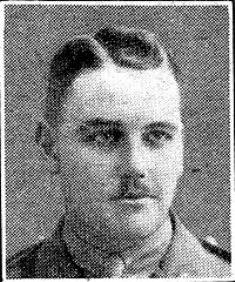 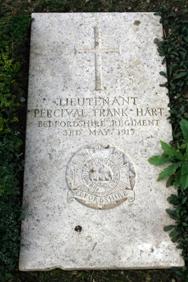 Died
of wounds 3rd May 1917
Percival Hart had been wounded during 1915 and returned
to the battalion just ten days before their assault against La Coulotte.
He was wounded on the 23rd April but was recovered
by Sergeant 3/7373 Edward Illingworth, who was awarded a Military
Medal for his bravery. Although he was moved back to the General
Hospitals along the coast, Percival died from his wounds over a
week later.
Lieutenant Hart lies in the Wimereux communal cemetery,
5km north of Boulogne.
|
|
Major Charles Alan Smith
MORRIS
Died of wounds in German hands 7th May 1917, aged
21
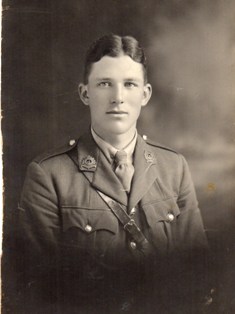 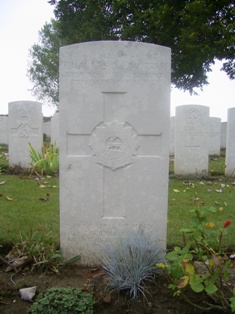 Charles
was born on 15 May 1895 and was taking his degree at Pembroke College
in Cambridge when war broke out in 1914.
Giving his parent's address of Porthcawl in Wales,
Charles attested as an officer cadet and joined the 3rd Battalion
once his basic officer training was complete.
When he was passed for active service, Second Lieutenant
Morris shipped off to France, landing on 5 March 1915. On 11 March
he joined the 2nd Battalion who were in the line facing Neuve Chapelle
and about to attack the German front line. The following day, on
12 March, the 2nd Bedfordshires were engaged in the Battle of Neuve
Chapelle and Charles was wounded y shrapnel in his right knee.
Returning to England, he was fit again by the end
of May and was posted in a large draft of over 1,500 recovered Bedfordshire
officers and men to Salonika.
Landing on Salonika 18 November 1915, he was attached
to the 5th Royal Irish Fusiliers who were being rebuilt after heavy
losses on Gallipoli. The survivors numbered just 280 so with the
addition of 350 Bedfords swelling their ranks, the men were spread
into each company, with at least one Bedford officer per company.
As part of the restructuring, the twenty years old Second Lieutenant
Morris found himself in command of a company despite having only
seen around 24 hours of service on a front line by that time.
28 November saw them move on to the bitterly cold
front line to hold "a very exposed and
windswept salient known as Rocky Peak (816 metres) to relieve the
6th Inniskillings, who were suffering badly from frost bite, and
were practically demoralised with the cold. Their C.O. was bowled
out by it, and two officers were literally crying with cold when
we got there."
"On the evening of Dec.
7th Morris and his company took over the hill and were quite comfortable
untl the next morning, when signs of a thaw set in, and at once
the Bulgar got to work on Rocky Peak, with high explosives at about
2700 yards range. In the evening Morris reported 27 men hit and
an officer, leaving him only one more, so the C.O. told me to go
up … [I] found Morris busy with a bomb attack on a forward sangar
that he had been shelled out of during the day. Morris personally
led this and regained the sangar."
An attack was launched at the British line as the
fog came down, quickly developing into a series of close quarters
bombing duels. The British were flanked in the dark "…
then the line began to wobble. The machine gun stopped work, Morris
was hit and vanished in the fog."
His servant managed to get his wounded officer back
down the hill as the fighting raged around them and Charles was
shipped back home for treatment once more. [Extracts taken from
a letter from Sidney Greene to Lord Ampthill, dated 6 April 1916]
He had been shot in the right shoulder and after his
second bout of treatment, returned to the French front lines in
September 1916.
Joining the 1st Bedfordshires who had just completed
their costly tour on the Somme, Captain Morris was given the command
of a raiding party just two days after arriving.
"The raiding party under
Captain Morris was let loose with the implicit instructions of killing
as many of their counterparts as possible, bombing as many dugouts
as they could identify and damaging as much of the German trench
system as was feasible given the time." During their preparation,
"Faces were blacked out with burnt cork,
equipment was dulled with soot and oil, with each man being issued
with two bombs and the novel idea of electric torches being secured
to the rifle stock was tried. A report on the operation remarked
how 'it caused much hilarity and certainly raised morale'"
[Extracts taken from '1st Bedfordshires. Part Two; Arras to the
Armistice']
Following months of trench routines Charles' battalion
were engaged in the Battle of Arras, the division being given the
all but impossible task of assaulting German positions at La Coulotte
on 23 April 1917. Against the odds, small groups of Bedfordshires
and Norfolks made it into the German trenches, bombing and bayoneting
their way deep into their lines. Eventually held up by heavy casualties
and a stiffening resistance, "Captain
Charles Morris, in command of B Company, was killed whilst he rallied
his men and led another attack from the front against the machine
guns dominating the second trench line." [Extract taken from
'1st Bedfordshires. Part Two; Arras to the Armistice']
Acting Major Morris was initially reported as having
been killed on 23 April, but some months later his personal effects
were among five cases returned to England via the Red Cross, along
with confirmation that he had died as a prisoner at Malmaison on
7 May, aged 21.
Charles was the only son of Charles Smith Morris and
Maud Marv Morris, of Llandaff House, Llandaff, Cardiff and today
lies in the Pont de Jour military cemetery, Athies, north-east of
Arras centre.
His service record is held by the National Archives.
[Charles'
photograph and Sidney Greene's letter are courtesy of Charles' descendant,
Julian Walker]
|
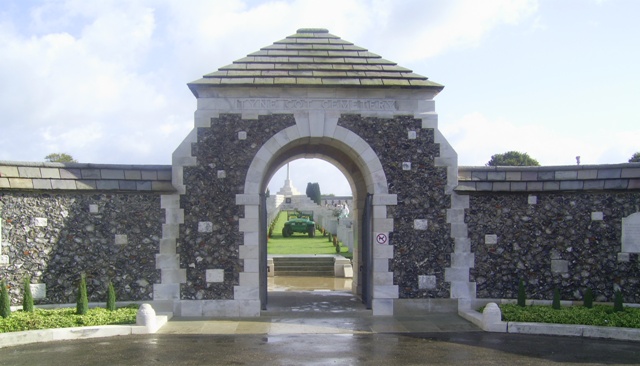
The entrance to the huge Tyne Cot
cemetery and Memorial to the missing
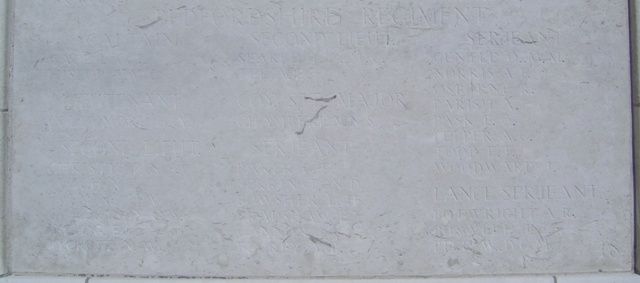
The panel showing the Regiment's officers
who are remembered on the memorial
The battalion's next major offensive action was during the Third
Battle of Ypres in the autumn of 1917.
The following five officers were lost during the battle
|
Second Lieutenant
Harold Henry REYNOLDS
Killed in action 4th October 1917, aged 20
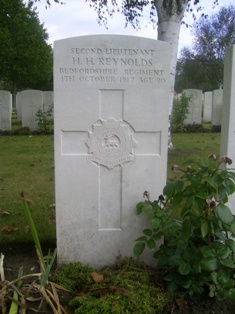 Second
Lieutenant Reynolds had initially been Sergeant 22105 in the 4th
battalion of the Wiltshire Regiment, before being commissioned as
an Officer in the Bedfords. He arrived with the 1st battalion 28th
April 1917 and served there until his death during the Battles of
Ypres 1917.
He was the son of Frank and Martha Reynolds, of 21,
Ladyfield Rd., Chippenham, Wilts and a native of Winterslow in Salisbury.
Second Lieutenant Reynolds lies in the Hooge Crater Cemetery, on
the Menin Road, east of Ypres.
|
|
Second Lieutenant
Harold Winning FLEMING
 Killed
in action (5th on SDGW, 6th on CWGC and Regimental Medal Rolls)
October 1917, aged 19
Harold was the son of Mrs. L. H. Fleming, of 147,
Finchley Rd., Hampstead, London, and the late Alex. J. Fleming,
M.D. and is remembered on the Tyne Cot memorial to the missing.
|
|
Second Lieutenant Paul Norman
Jones CHRISTIE
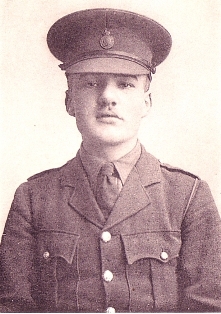 Killed
in action 9th October 1917
A full biography, along with Paul Christie's personal
diaries, can be seen here.
|
|
Second Lieutenant Joseph
COTCHIN
Killed in action 9th October 1917, aged 31
Joseph was the son of Joseph and Emma Cotchin, of
79, Station Rd., Ridgmont Beds and is remembered on the Tyne Cot
memorial to the missing.
|
|
Second Lieutenant
Alexander Edward CROOCKEWIT
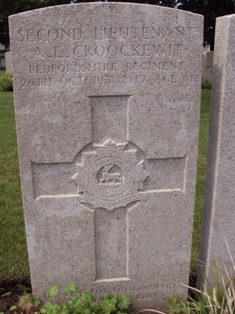 Died
of wounds 26th October 1917, aged 31
Alexander was educated at Bedford School and was
trained in the 3rd battalion, but attached to the 1st when he fell.
He was the son of John Henry and Fanny M. Croockewit, of "Menin,"
32, Leyburn Rd., Dover and is buried in the Lijssenthoek military
cemetery, 12km north-east of Ypres centre.
|
|
Lieutenant William
Francis George PERHAM
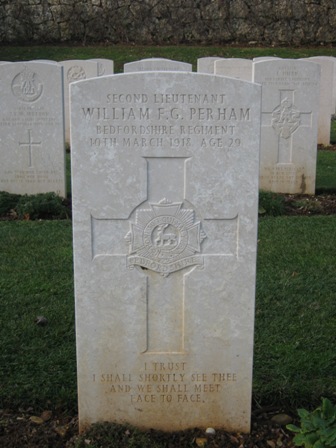 Died
of wounds 10th March 1918, aged 29
Lieutenant Perham was from the 3rd (Reserve) battalion,
attached to the 1st when he was severely wounded during a heavy
bombardment on 9 March.
He died the following day, being the only officer
in the battalion to be killed during their tour in Italy.
William was the son of William and Emily Martha Perham,
of 110, Mantle Street, Wellington, Somerset and lies in the Giavera
British Cemetery, Arcade, Treviso province, Italy.
|
|
Second Lieutenant
Ambrose Ethelstone PEEL
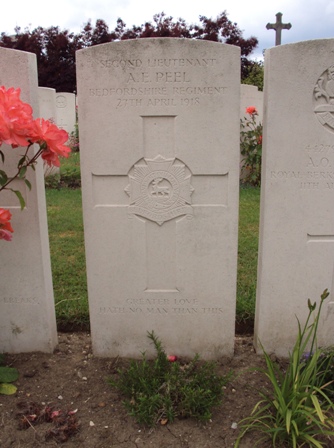 Killed
in action 27th April 1918, aged 20
Ambrose Peel was born in Bedford on 29 January 1898,
his father being a journalist, then Stockbroker. As a student, Ambrose
was part of the Bedford Grammar OTC, and in September 1916 passed
entrance exam into RMC Sandhurst.
On his death, he was originally interred in the Halte
cemetery, south-east of Hazebrouck, but later moved into a concentration
cemetery after the war.
Ambrose was the son of the late Edward Lennox Peel
and of Amy Peel, of 51, Mount Avenue, Ealing, London. He now lies
in the Merville communal cemetery, 15km north of Bethune.
|
|
Second Lieutenant Frederick
Lee RAY
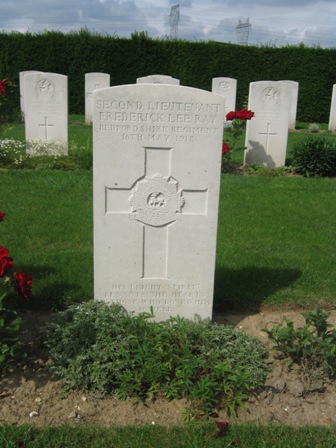 Killed
in action 16th May 1918, aged 24
Frederick was the son of Frederick and Alice Ray,
of Bedford and lies in the Tannay British cemetery, Thiennes, between
Bethune and St.Omer.
|
|
Second Lieutenant
Herbert Walter CORNELIUS
Killed in action 20th July 1918
Herbert was born 20 December 1890 and before enlisting
worked as a Civil Servant in the National Health Insurance Commission.
A married resident of West Ealing, Herbert enlisted during the Derby
Scheme, on 6 December 1915 aged 24.
He was called up in January 1917 and posted to the
2nd Artists Rifles O.T.C. The following monnth he applied for a
commission, which was granted 31 July 1917. After a short spell
on home service, he went to France and joined the 1st Battalion
27 Septemebr 1917.
Second Lieutenant Cornelius was killed during a night
time raid which saw heavy fighting but his body was not recovered.
He has no known grave but is remembered on the Ploegsteert memorial
to the missing.
|
|
Captain (Major)
Geoffrey De Carteret MILLAIS
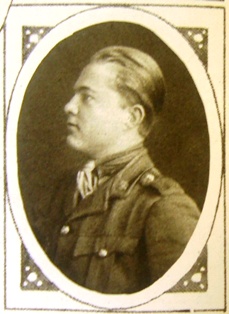 Died
of wounds 21st August 1918, aged 21
Geoffrey was the son of John Guille Millais and Fanny
Margaret Millais, of Comptons Brow, Horsham, Sussex and lies in
the Sailly-au-Bois Military cemetery, between Arras and Amiens.
|
|
Captain Herbert John WEST,
M.C.
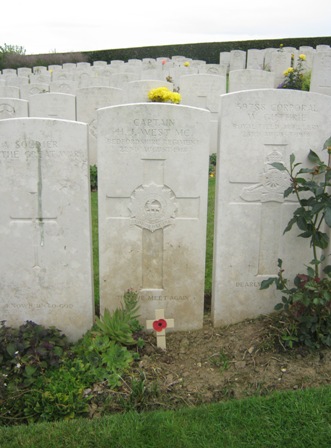 Died
of wounds 22nd August 1918, aged 29
Captain West had been wounded during the Battle of
the Somme in 1916 and had recovered in the 4th battalion, but was
again attached to the 1st when he fell.
He was the son of William F. and Emma West, of 15,
Ellesmere Rd., Chiswick, London and lies in the Bagneux British
cemetery, Gezaincourt, 2km south-west of Doullens
|
|
Second Lieutenant Harry MAW
Killed in action 22 August 1918
Harry was born at Crowle on 9 February 1893, the
only son of Richard Cornelius and Rebecca Maw (nee Chafor) and was
christened in St Oswald's Church in March the same year. His father
Richard was also from Crowle and his mother was from North Kelsey.
Richard was a farmer and in 1901 the family lived at Easingwold
Farm but had moved to Mount Pleasant Farm near Swinefleet by 1911.
Harry was a farmer's boy helping his father on the farm according
to the census.
Sometime before 1913 they moved again to Stowmarket
in Suffolk, where in 1914 Harry married Dora Cowling, of Reedness.
The couple had one daughter Mytle Irene, born 20 April 1915. His
wife had moved back to Reedness by the time of Harry's death and
lived at Wheelgate House.
Harry was embodied into the Territorial Force's Suffolk
Yeomanry (Duke of York's Own Loyal Hussars) on 12 March 1913 and
would have been mobilised on the outbreak of war in August 1914,
when his unit became the 1/1st Suffolk Yeomanry. Following almost
a year of training and providing Home Defence in and around Suffolk,
his regiment were finally shipped to Gallipoli as dismounted cavalry,
landing at Anzac Cove on 10 October 1915.
Private Maw was among the high proportion of troops
on the peninsular to be struck down with dysentery. Reporting to
the East Anglian Field Ambulance on 1 November, he was moved to
Mudros four days later, then on to Alexandria for continued treatment.
A trip back to England followed later that month but once recovered
he returned to Egypt (on 1 June 1916) and reported to the Yeomanry
Base Unit on 14 June.
Other than another short bout of diarrhoea in September,
he rejoined his unit who spent a quiet period guarding the Suez
Canal. On 5 January the Yeomanry were converted into an infantry
unit, becoming the 15th (Suffolk Yeomanry) Battalion, Suffolk Regiment
and Harry was renumbered to 32048.
In December 1916 Harry had applied for a commission
and on 31 January 1917 he found himself on a ship home to take up
a post as an Officer Candidate.
On 31 July 1917 he was commissioned as a Temporary
Second Lieutenant in the Bedfordshire Regiment. Landing in France
after a short furlough before reporting for duty, Harry was posted
to the 7th Battalion,
joining them on 7 October 1917.
Nothing concrete exists to account for his movements
as an officer from this point onwards but the 7th Battalion were
engaged in the Third Battle of Ypres in 1917, as well as being very
heavily engaged in the German
Spring Offensives in March and April 1918. Statistically,
it is likely that Harry was wounded during this phase of his service
but if he came through those actions unscathed, he was possibly
transferred into the 1st Battalion when the 7th were disbanded in
May 1918. Alternatively (and more likely based on the 'flow' of
others around him at the time), he may have been wounded or taken
ill, sent home for treatment, and once he was able to resume his
duties, was posted to the 1st Battalion given that the 7th had ceased
to exist by his return.
Once what would become the final Allied offensives
started in August 1918, the battalion found themselves in the thick
of the advance but met with relatively little resistance in the
opening stage. Part two of the
1st Battalion history records "The
Bedfordshires remained in their support line under heavy gas and
shell fire throughout 22 August, consolidating the position and
preparing for the next advance. Second Lieutenant Harry Maw was
killed during the day's shelling, having joined the battalion over
the summer. Harry had served in the ranks on Gallipoli and in Egypt
before being commissioned into the Bedfordshires a year earlier
and spending time in the 7th Bedfordshires. The 25 years old farmer
from Lincolnshire was buried alongside his comrades in a makeshift
cemetery 200 metres east of Achiet-le-petit, being moved to the
Adanac military cemetery in Miraumont after the war."
Harry is also remembered on Crowle War Memorial, the
Whitgift War Memorial, and possibly on the Stowmarket War Memorial.
His service record is held at the National Archives
under reference WO339/86993.
[With thanks to Paul Connell for the background and
pre war information]
|
The battalion assaulted German positions around
Achiet le Petit on 23rd
August 1918, losing heavily from machine gun fire. The following eight
officers, including the battalion's Commanding Officer, were all killed
during their determined assault:
|
Lieutenant Colonel Hugh
COURTENAY, D.S.O., M.C.
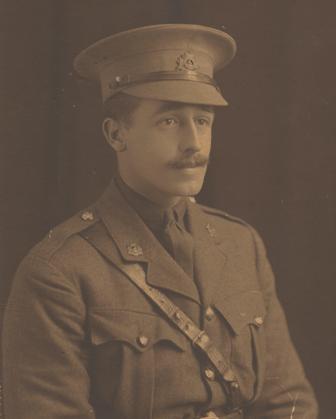 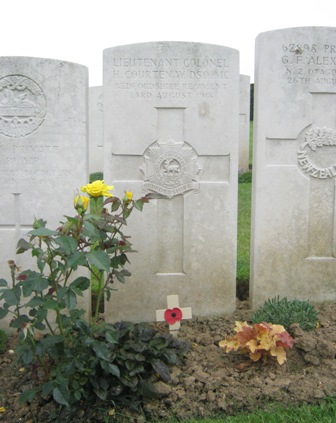 Died
of wounds 23rd August 1918, aged 30
Lieutenant-Colonel Courtney had served in the battalion
from before the war and landed with them in the first wave of the
British Expeditionary Force in August 1914. Hugh was woudned in
the temple during the Battle of the Aisne, the resulting injury
leaving hism partially blind in one eye.
He was engaged in a Staff posting in Italy until Lieutenant
Colonel Worrall invited him to spend Christmas Day 1917 with his
old battalion. After a thoroughly enjoyable day catching up with
those from his old friends who remained, he requested to return
as Worrall's second in command, despite having a 'comfortable billet'
at the time. Although his request was initially refused, he re-applied
and was eventuall granted his wish during the summer of 1918.
Having survived the entire war and risen to the rank
of Lieutenant Colonel, Hugh led his battalion during their assault
against Achiet le Grand, leading and inspiring them from
the front after they had been pinned down by a large number of machine
guns along the ridge line they were attacking. Although the gunners
missed him while he stood tall on the battlefield as he rallied
his men, Lieutenant Colonel Courtenay was mortally wounded just
as the position fell to his determined battalion's bayonet charge.
He was given instant first aid and rushed back into
the medical system but his wounds were too severe and he died later
that day at the Casualty Clearing Station in Gezaincourt.
Hugh was the son of Charles C. and Constance H. Courtenay,
of Manor Farm House, East Horsley, Surrey and lies in the Bagneux
British cemetery, Gezaincourt, 2km south-west of Doullens.
[With thanks to Penny Maitland-Stuart, descendant
of Hugh Courtenay, who provided the photograph and letters sent
to Hugh's widow]
|
|
Lieutenant Alexander
Robert Charles EATON
Killed in action 23rd August 1918, aged 29
Alexander was the son of Charles E. and Emma Margaret
Eaton, of 203, Neville Rd., Forest Gate, London and is buried in
the Adanac military cemetery, Miraumont, on the Somme.
|
|
Lieutenant George ABBOTT
Killed in action 23rd August 1918, aged 35.
Lieutenant Abbott was attached to the 1st battalion
from the 1st Herts. George was the son of Thomas Abbott, of "Oaklands",
Stevenage, Herts and lies in the Gommecourt British cemetery No.2,
Hebuterne.
|
|
Lieutenant Robert
Henry Preuss ARNHOLTZ
Killed in action 23rd August 1918, aged 20.
Lieutenant Arnholtz was another officer from the 1st
Herts who was attached to 1st Beds. He was the son of Henry P. and
Amelia J. Arnholz, of 62, Fairhazel Gardens, South Hampstead, London
and lies in the Adanac military cemetery, Miraumont.
|
|
Lieutenant Edgar Ivan
Fitzroy NAILER
Killed in action 23rd August 1918, aged 27
Edgar was the son of Mrs. Laura Nailer, of 37, St.
Michael's Rd., Bedford, and the late Lt. Col. Nailer and lies in
the Adanac military cemetery, Miraumont, on the Somme.
|
|
Lieutenant Henry James
Arthur WATSON
Killed in action 23rd August 1918, aged 23
Lieutenant Watson was in the 5th battalion, attached
to the 1st Battalion. He was the son of Mary (May) Ellen Watson,
of 59, Goldington Rd., Bedford and is buried in the Adanac military
cemetery, Miraumont, on the Somme.
|
|
Second Lieutenant Frank
Herbert FOX
Killed in action 23rd August 1918, aged 20
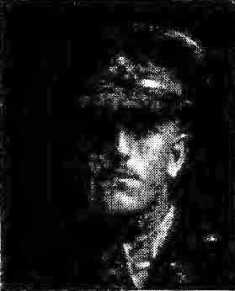  Frank Fox was born 17 March 1898, the second son of Frederick Isaac
and Kate Fox who lived at Cavendish Place, Beeston, Nottingham during
Frank's service. His father was the Deputy City Treasurer for Nottingham
After education privately at the Elm Bank School in
Nottingham Frank became a Bank Clerk and joined the Nottingham University
OTC in April 1916
Unmarried, Frank enlisted into the ranks of the Notts
and Derby Regiment as Private 80492 in September 1916 but was not
called up until March 1917, when he became 19 years of age. The
following day he was posted to No.4 Officer Cadet Battalion in Oxford,
being commissioned as a Second Lieutenant and posted to the Bedfordshire
Regiment on 1 August 1917
Joining the 7th Battalion on 28 September 1917 he
seems to have been wounded very soon afterwards and left the battalion.
On 14 January 1918, Second Lieutenant Fox joined the
1st Battalion with a draft of 14 men, who were stationed in northern
Italy at the time. March 1918 saw the 5th Division rushed back to
France following the German Spring Offensives and Frank spent the
summer in and around Nieppe Forest, with his battalion.
Once the '100 Days' allied offensives started in August
1918, Second Lieutenant Fox found himself in the attacking front
waves as his battalion assaulted a well defended and sited 'glacis-like'
slope near Achiet le Petit. The British captured the position but
at great cost, Second Lieutenant Fox being among the long list of
casualties the 1st Bedfordshires lost on 23 August 1918
Frank died at the Achiet le Petit Casualty Clearing
Station and today lies in the Achiet le Petit communal cemetery
(The image comes from De Ruvigny's Roll of Honour,
so I am unable to improve on the quality)
|
|
Second Lieutenant William
Thomas PAINE
Killed in action 23rd August 1918, aged 35
 William was the son of William and Elizabeth Paine, of Manchester;
husband of Kate Paine, of 30, Osborne Rd., Broadstairs, Kent and
is buried in the Achiet-le-Grand Communal cemetery.
|
|
Second Lieutenant
Reginald John CROPLEY
Died of wounds 22nd September 1918, aged 21
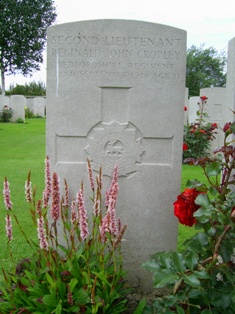 Reginald was the son of Mrs. V. C. Cropley, of 24, Birchfield Rd.,
Handsworth, Birmingham, and stepson of Arthur Cropley. He is buried
in the Grevillers British cemetery, 3km west of Bapaume.
|
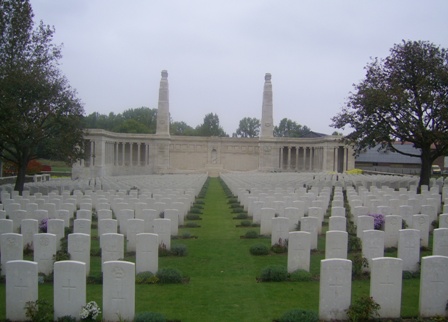
The Vis en Artois Memorial to the
Missing, East of Arras.
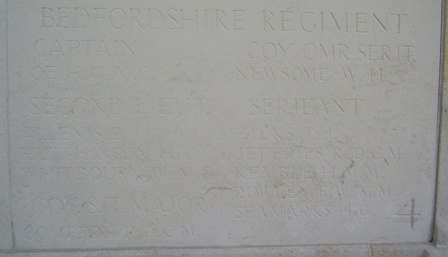
The officers of the Regiment who are
listed on the Memorial.
The battalion were engaged in the Battle
of the Canal du Nord that led directly to what would become the final
advance in Flanders that ended the war. They lost around 140 casualties
during the assault, including the following three officers:
|
Second Lieutenant Herbert
HUTCHINSON
Killed in action 27th September 1918
Lieutenant Hutchinson was from the 3rd (Reserve)
battalion, attached to the 1st when he died and is remembered on
the Vis en Artois memorial to the missing.
|
|
Captain Harold Charles
LOE, M.C.
Killed in action 27th September 1918, aged 27
Harold was the son of Abraham and Esther Jane Loe,
of Elm Rd., Hook, Surbiton, Surrey; husband of Eva Loe (formerly
Woods) and is remembered on the Vis en Artois memorial to the missing.
|
|
Second Lieutenant
Joseph Thornton LAUGHTON
Died of wounds 29th September 1918, aged 22
Joseph was the son of Thomas and Beechie Laughton,
of 16, Lansdowne Rd., Bedford and lies in the St. Sever cemetery,
Rouen.
|
The 1st battalion's final offensive action of
the war saw them engaged in the Battle
of the Selle, during the final advance in Picardy. The few Old Contemptibles
who were left in their ranks would doubtless remark on how they were not
far away over four years earlier, when they were to be 'sacrificed' during
the Battle of Le Cateau in August 1914. A further 150 casualties were
lost in their assault, including the next two officers:
|
Second Lieutenant
William Henry Thomas COTHILL
Killed in action 23rd October 1918, aged 23
Lieutenant Cothill had only joined the battalion
on the 1st October 1918 and this would prove to be his first and
only battle. He was the son of Thomas Henry and Elizabeth Cothill,
of 13, Peter's Square, Hammersmith, London. William was born at
Keston in Kent and lies in the Amerval cemetery, Solesmes, 5km north
of Le Cateau.
|
|
Second Lieutenant Claude
Oliver FOWLER
Killed in action 23rd October 1918
Claude was commissioned into the 5th Battalion but
joined the 1st Battalion in France on the 7th October 1918. He was
also killed in action during his first battle as the battalion assaulted
the village of Beaurain on the 23rd October 1918, two weeks before
the war in Europe ended. Second Lieutenant Fowler is buried in the
Amerval Communal Cemetery Extension in Solesmes, France.
|
Site
built by Steven Fuller, 2003 to 2023