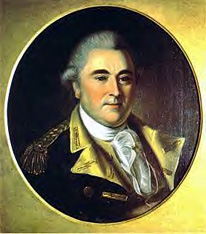
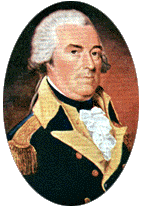
General "Mad" Anthony Wayne 

The American Revolutionary War Brigadier General Anthony Wayne, was born in Chester County, Pennsylvania, near Paoli, Pa., Jan. 1, 1745, and died Dec. 15, 1796. Privately educated in Philadelphia, General Wayne won major recognition in the American Revolution and in Indian warfare.


A dashing, brave soldier, known as "Mad Anthony," Wayne served in Canada in 1776 and at Brandywine and Germantown in 1777; he encamped at Valley Forge during the winter of 1777-78. At the end of 1778 he was given command of a corps of light infantry. His most successful action was a surprise attack on the British at Stony Point on the Hudson River in July 1779; he continued to see action throughout the war.

In 1776, after the outbreak of the American Revolution, he entered military service as a commander of a Pennsylvania regiment assigned to cover the retreat of American forces from Québec. In 1777, after being promoted to Brigadier General, he was posted to Morristown, New Jersey. The Pennsylvania regiments participated in the maneuvering near New Brunswick during June. After a brief stay at Ramapo in July, Wayne's men marched to defend Philadelphia. At the Battle of Brandywine, Wayne's division was at Chadd's Ford. For three hours Wayne fought to repulse Hessian advances over the river as the American left wing deteriorated. In the retreat to Chester, Wayne inspired his men by his bravery.

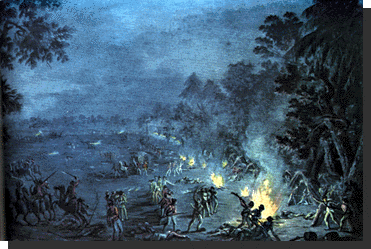
As the British converged on Philadelphia, Wayne's 1,500 troops attempted to harass the enemy. Assuming that the American presence was undetected, Wayne camped close to the British lines. What became famous as the "Paoli Massacre" ensued. On September 20-21, in a skillful night attack led by Major General Sir Charles Grey, the British bayonted patriot soldiers. With 300 casualties, Wayne was inevitably subject to criticism. An offical inquiry by five ranking officers held that Wayne was not guilty of misconduct but that he had erred in tactics. Enraged, the tempestuous Wayne demanded a full court-martial. On November 1, a board of 13 ranking officers declared that Wayne had acted with honor. Yet Paoli remained a stigma on his record for the rest of his career.


British troops using only their bayonets inflicted over 300 casualties at Paoli


 Wayne participated in the battles of Brandywine and Germantown and in 1778 distinguished himself in the Battle of Monmouth. His greatest achievement was a brilliant victory at Stony Point in 1779. In 1781 he contributed to the British defeat at Yorktown.
Wayne retired to civilian life in 1783. After the Revolution, Arthur St. Clair's defeat by the Indians in 1791--the culmination of a series of American defeats in the Old Northwest--caused Wayne to be given (1792) command of the Northwest army.

After spending more than 2 years training his troops, he led an American army north from the Ohio River and, on Aug. 10, 1794, won a decisive victory at the Battle of Fallen Timbers on the Maumee River near the site of present-day Toledo, Ohio, and the following year he negotiated the Treaty of Greenville with them, opening the Northwest Territory to American settlers. Noted for his bravery and quick temper, Wayne was popularly known as "Mad Anthony." Under provisions of the ensuing Treaty of Greenville (1795), Wayne obtained a large cession from the Indians. After the British had agreed in Jay's Treaty to vacate their posts in the Old Northwest, Wayne led the American force that took possession of the forts in 1796. 


(See Bibliography below)

| Back to Timeline | or click on your browser's "back to previous page" button

    ©

Picture Credits: Charles W. Peale, 1783 (top); Wayne: Edward Savage (bottom); Battle of Paoli: Xavier Delta Gatta, 1782 (middle).
Author: Reginald Horsman; Richard L. Blanco; Ronald W. McGranahan, contributing.
Bibliography: Blanco, Richard L., The American Revolution, 1775-1783 (1993); Pleasants, Henry J., "The Battle of Paoli," Pennsylvania Magazine of History and Biography, 72 (1948): 44-53; Tucker, Glenn, Mad Anthony Wayne and the New Nation: The Story of Washington's Front-Line General (1973); Wilder, H. E., Anthony Wayne: Trouble Shooter of the American Revolution (1944).

© Copyright "The American Revoulution Home Page" - Ronald W. McGranahan 1998 - 2004 All Rights Reserved.