|
Paris, the capital of France, has been the site
of many important treaty negotiations. The Seven Year's War was
concluded by the Treaty of Paris of Feb. 10, 1763, signed by
Britain, France, and Spain. France lost to Britain all of its
North American possessions (except Louisiana, which it had ceded
to Spain); the treaty excluded French troops from Bengal, effectively
ending the French imperial drive in India; and, in Africa, France
yielded Senegal to the British. The only colonies retained by
France were Saint Pierre and Miquelon (in the Gulf of Saint Lawrence);
Saint Lucia, Haiti, Guadeloupe, and Martinique (in the West Indies);
and Pondichery and Chandernagor (in India). Spain recovered Cuba
and the Philippines but ceded Florida to Britain.
If the 1763 treaty was a landmark in the growth of
the British Empire, another Treaty of Paris (Sept. 3, 1783) marked
Britain's first major colonial loss. By that treaty, which ended
the American Revolution, Britain recognized the independence
of the United States. The treaty also made navigation of the
Mississippi free to all signatories (which included France, Spain,
and Holland), restored Florida to Spain and Senegal to France,
and gave the United States fishing rights off Newfoundland. |



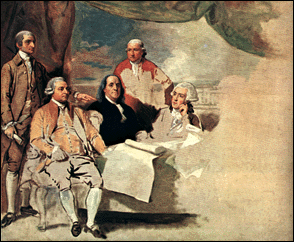

 Signing the
Peace Treaty
Signing the
Peace Treaty