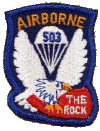
Around the middle of 1992, there was a good deal of talk in the World War II veteran circles about plans for the 50th anniversary of the big events of World War II in Europe, such as the Allied landing at Normandy. The 50th Anniversary of Pearl Harbor had already come and passed.
As usual, the Southwest Pacific received only passing attention.
True, there was talk of a celebration of the 50th anniversary of the landing on Leyte in October 1995 but not much was being done to commemorate other significant events. The 503rd Parachute Regimental Combat Team had participated in at least eight major campaigns in the Pacific, including three Combat Parachute jumps. But it did not appear anyone was making plans to commemorate the events we’d been involved with. |
I’d had never considered organizing a tour before and had no experiences along that line. Tours I’d seen which had been organized by professionals some times were not really doing what the travelers would prefer. I felt I knew what our people should do and see in order to really commemorate the historic events we’d known 50 years ago. As a starter, I drafted up preliminary itineraries and plans for the commemoration of our three combat jumps. The Annual Reunion of the 503rd took place in Rapid City in July 1992. I took these plans to the Board of Directors for their consideration and possible approval. Since it would not cost the Association any money and the Board would not have to do any of the work, the ideas were enthusiastically received. Our Commanding Officer, Retired Brigadier General George M. Jones was present. His health had gone down hill, steadily, since that time and he was unable to travel with us. The General liked the proposals, particularly, those dealing with a return to the Philippines. He was, especially, insistent that we should be in contact with Fidel Ramos, the President of the Philippines with whom he had a special connection. |
Fidel V. (Edie) Ramos had just been installed as President the previous month. Earlier he had been a four star General and Chairman of the Joint Chiefs of Staff of the Philippine Armed Forces. I had met General Ramos in 1987 while he held that post under the then President Corizon Aquino. Information about the proposed trips was included in several of the quarterly newsletters sent out by the Association to the members. The suggestion we travel back to Nadzab, our first combat jump, and Noemfoor, our second combat jump, was abandoned, after virtually no one expressed any interest. In the case of Nadzab it as probably just as well because I’d been warned crime conditions in New Guinea were very bad. It is just as well there was little interest in Noemfoor because there did not appear to be any facilities for tourists on the Island. The proposed return to the Philippines which would include Manila, Corregidor, our third combat jump, and Negros received considerable interest. Over the remaining two plus years, many people expressed serious interest with as many as 55 people at one time, definitely, planning on going. When the final count came and everyone had come up with their money, 43 people made the trip. Another seven 503rd people, fearing we would not have room in our group traveled with another group and participated in some of the events with us. In April 1993 I made another return trip to the Philippines – my fifth. This time, I took special notice of things which would need to be reflected in our detailed planning. During all my previous trips I’d stayed with native families on Corregidor. I’d been in the Hotel on Corregidor but this time I looked it over with the thought we would be staying there. Then I made my first return trip to the Island of Negros where we had been fighting when the War ended in August 1945. That side trip was to contact Alfredo Montelibino, the Mayor of Bacolod, Negros. This is the largest city on the Island and has a population of about four hundred thousand people. I also wanted to see Raphael Coscolluela, the Governor of Negros Occidental. I got along very well with the Mayor and the Governor. The latter named Tina Lapres an assistant on his staff, to be my contact. Upon my return to the States I chose a Philippine tour company. It was Rajah Tours International. Fortunately, they have an office in San Francisco so communications were much easier than dealing with Manila, their headquarters. They took care of all transportation arrangements, luggage handling and hotel accommodations for us. Now I’d like to tell you about some of the HIGH POINTS of the trip and how they came about.
29 of our 43 travellers at Intramuros The first order of business was to make contact with President Ramos to set up a meeting of our group with him. This turned put to be a difficult task. Can you imagine trying to make personal contact with President Bill Clinton? There are so many layers of bureaucracies surrounding high public officials, it is a miracle when someone breaks through and makes contact. I was lucky. General Jones graduated from West Point in the class of 1935. President Ramos was an oddity: although a Philippine citizen, he graduated from West Point in 1950. That meant that Jones and Ramos were both "ring knockers" as we called them. All West Point graduates wear heavy class rings which make them members of an elite group. In 1960 Captain Ramos and three other Philippine officers attended the Special Warfare and Airborne schools at Fort Brag, North Carolina. General Jones was the Commanding Officer. Among the instructors was one I knew very well: Colonel Robert (Cracker) Atkins. A classmate of Ramos at West Point, Laurence Jackley attended the same Special Warfare class. Jackley was well known to Jones and Atkins. Now a retired Colonel, Jackley maintained a close relationship with Ramos and another Filipino officer who had attended the class, now retired Major General Joe Magno. Cracker Atkins, who travelled with us, introduced me to Jackley. Colonel Jackley was able to make contact wit both President Ramos and General Magno and pave the way for us. The upshot was that President Ramos appointed General Magno to be the contact between him and me. We were in! The only potential problem could be affairs of State which would make it impossible for him to take the time to meet with us. Just the day before we left the States for the Philippines General Magno informed me by fax that we had a date to meet the President in the Malacanang Palace on our second night in the Philippines or February 13th. This turned out to be quite an affair.
The Malacanang Palace is actually a group of buildings both old and new which house the head of Government as does the White House in the United States. The old building is the one in which the Marcos family lived. Now it is a museum through which we were guided. To pass time until President Ramos could see us, General Magno lined up a group of present and retired Generals of the Airborne and Special Forces branches of the Philippine Army. Each was given a few minutes to speak. President Ramos entered the room and spent, perhaps, an hour with us in an informal atmosphere. He seemed relaxed and to be having a good time. I could hardly believe my ears when he proceeded to tell an old airborne clinker I think I first heard when I was in parachute training in 1941
During our meeting with him the president spent a bit of time getting himself up to date on plans for the 50th Anniversary commemoration of our jump on Corregidor on February 16th. These had just been drafted and were still in the process of being finalized. In order to save time the President made a ceremonial presentation of the Philippine Liberation Medal to two of our people. Medals for all others were given to me for presentation to them. The President ended by inviting all the group for a "photo opportunity". So ended the first of the HIGH POINTS. From Manila our group went to Corregidor, checked into the hotel and began an extended tour of the buildings and batteries. In addition to the affairs of our people, I became involved in polishing the program for the 16th, working with an American and Philippine committee.
The actual program for the 16th was truly impressive. Normal crowds of tourists on Corregidor probably do not exceed a couple of hundred people. February 16th brought several thousands. The Philippine Navy, for example, used there LST’s to shuttle people, busses and equipment back and forth from the mainland. The people involved were also truly impressive. From the Philippines the crowd began with President Ramos, Secretary of National Defense Renato DeVilla, Chief of Staff of the Philippines, General Arturo Enrile, General Magno and other Cabinet members. The United States contingency began with Secretary of the Negroponte and Four Star Genearl Wayne Downing, Commander in Chief of the U.S Operations Command. Many other important individuals were also present.
General Downing impressed our people were favorably. He was friendly and low key. He was willing to talk with anyone and shook hands with and had his picture taken with a lot of people. Kodak will probably raise its dividends. I like to tell this little story: Since my name tag had a large "DON" on it, Downing called me by my name several times. I took a hint from that and called him by his first name: "GENERAL". Four starts have always impressed me.
The ceremonies began with the laying of wreaths at the Pacific War Memorial, followed by a reenactment of the 1945 jump, including Philippine and U.S. Special Forces and Philippine Airborne troops. These jumps gladdened our hearts. We have always been a bit ashamed of the fact we put people over the cliff, and into trees and buildings. Of course we were jumping under battle conditions. This time the jumpers had practiced the day before, had a weather station on the ground and, most important, no one shooting at them. I never did get a count of the number of people who jumped this time but there must have been at least a hundred. Probably thirty of them went into trees or buildings. We, probably, didn’t have many more than that out of about 2,000 jumpers.
Following the reenactment there was a series of special activities including one I thought was impressive and meaningful. It began with me passing an American Flag to General Downing, who in turn passed it on to three members of the current generation of the 503rd who had come from Korea where they are now stationed. They, with the help of two of our veterans, raised the flag while a U.S Navy band played "To the Colors" and or National Anthem. Them our flag was lowered while Taps (with echo) were played. The Philippine National flag was then raised and the Philippine National Anthem played by a Philippine Navy Band. A number of speeches were made including the featured one by President Ramos. As mentioned earlier, Ramos was trained an airborne jumper. When I met him in 1987 he wore Master Parachute Wings which means he had a substantial number of jumps. At that time I asked him how many and he responded that he did not remember exactly, but that the last time he had looked he had about 740. In his speech the President vividly recalled his training: Get Ready! Stand Up! Hook Up! Check Equipment! Sound Off For Equipment! Check! Stand In The Door! Go! One Thousand Tow Thousand! Wham! The President placed great emphasis on the importance of recapture of Corregidor by the503rd. It does not hurt one’s ego to be praised as heroes by someone with the stature of President Ramos. He also stressed the friendship which has and does exist between the Philippine and American people. The ceremony on Corregidor was the "HIGHEST OF HIGH POINTS".
From the time we first arrived in Manila officers from JUSMAG (Joint Military Advisory Group) in the US Embassy had been working on me to change our itinerary to do some things they had included in their plans but failed to tell us about. One was a memorial service at the American Cemetery outside of manila on the 17th. I was adamant that we could not change our itinerary to the extent it would mean canceling hotel reservations on Corregidor and making new ones in Manila. Somewhat facetiously I said "Of course if you could find a couple of helicopters to fly us over and back in the same afternoon I might be able to find some takers." To my surprise I was contacted by the Commodore of a US Navy flotilla which was visiting Manila. He had scheduled two Navy H46 helicopters from one of the ships to handle the transportation for us. Thirty of our group took the opportunity and participated in a wreath laying ceremony. Ambassador Negroponte was the featured speaker. That was another "HIGH POINT".
Following our stays in Manila and on Corregidor we caught a Philippine Air Lines domestic jet to Bacolod, Negros. The stay on Negros was a series of "High Points". The Bacolod airport is somewhat equivalent to the one here in Santa Rosa – there are no jet-ways, only stairs which are rolled out to the plane. As we went down the stairs we could see this was going to be something to remember! The Mayor of Bacolod was the first person to greet each of our people. Then at the foot of the stairs we walked, literally onto a red carpet which had been rolled out for us. A few feet awat a High School Band played enthusiastically, In front of the band a Corp of drum majorettes twirled their batons. On each side of the ramp leading into the airport building Cadets from the Philippine Marine Academy were waiting with crossed sabers for us to pass under. Once inside many local people who remembered individual veterans and who had stayed in contact, were waiting to meet us. For example, I had received a letter from a woman representing a large family with a Hacienda near the North end of the Island asking me if I knew some men they had known. I knew several and as it happened, one of the men she mentioned was with us. He is retired from the FBI and the legislature in Connecticut. When I mentioned the family to him he was very excited because he remembered the people well. My contact met us and I was able to reintroduce these people. This example is only illustrative of several such connections after 50 years had passed. As our stay on Negros continued we found our program more or less followed a pattern. We would travel by bus to a town where we would be met by the mayor and a group of local people which included veterans, politicians and local people of importance as well as just plain people who remembered us. Schools would be let out so the children could come to see the Americans they had heard about all their lives. The children would sing songs or perform dances for us. The Mayor would make a speech, there would be a response and we would retire to a luncheon table where every delicacy was possible would be waiting to tempt us. Each end of the table would hold a whole roasted pig, head and all. On our first night on Negros we were entertained for dinner at the home of the Mayor. On our second night on Negros we had dinner in the home of a woman who treated us royally. Her husband had been the head of the local guerilla intelligence. I had met him but had mainly dealt with his operatives. He died a number of years ago. His wife had a story worth telling: About the time the 503rd had landed on Negros she had twins – a boy and a girl. The boy died of malnutrition and the girl near death. Our of our men gave her powdered milk which she believed all these years saved her daughter’s life. Incidentally, the daughter traveled from her present home in Manila to see the Americans who had provided the milk. Our group spent one afternoon at Hacienda Rosalia, the Gaston ancestral home with members of the Gaston family. They credit the 503rd with saving the home from being burned by the Japanese in 1945 and are not ashamed to tell about the circumstances. We were told the family has annual reunions when as many as five hundred Gastons return. One day we helped the Governor Coscolluela celebrate his 48th birthday in the capital building in Bacolod. The old one still stands and I found rooms in it I’d known in 1945. The last evening in Bacolod the governor hosted a dinner in our honor. Again, there were many speeches by both sides. We were just about to leave for our hotel when someone came up to me and said there was someone I should meet. The man was about our age, fairly tall and did not look like a Filipino. He said with a big grin " I Japanese. I up in Mountains". One of our men came up to him, pointed his finger at the Japanese and said "We missed you". He laughed very heartily and to show there were no hard feelings was at the airport the next day to see us off for our return to Manila. Unfortunately, he spoke little English. I’d have liked to have heard about his experiences in the mountains.
Before we left Manila for Negros I received a letter from Brigadier General Victor Mayo, Commanding General of the Philippine Special Forces Airborne Regiment. He invited us to attend an informal "Gathering of Eagles" as he put it, at Fort Bonifacio in Manila upon our return from Negros. Again there were many speeches on both sides but they led to having General Mayo pin Philippine jump wings on each of our men. In addition they gave each of us Crystal beer mugs inscribed with their Special Forces insignia. This was the last but not the least of our "HIGH POINTS". Filipinos are a curious lot. They wondered what we were doing in the Philippines, particularly on Negors where they don’t see many Americans these days. We were continually asked why we were there. When we told them we were coming back to commemorate the times we had fought there 50 years ago they understood and almost invariably remarked "Oh, a Sentimental Journey!" and were satisfied. They nod their understanding. It really was a "Sentimental Journey!".
|