| |
US 101 Photo GalleryCity of San Diego (1940 - 1958) |
| US 101 was modified considerably during and after World War II. During the war, San Diego was an important location due to the naval presence and the concentration of war manufacturing. Even after the war was over, San Diego continued its incredible growth. Fortunately it was realized that an extensive road network was required and during the late 1940s and 1950s portions of US 101 became some of the first sections of highway to be brought up to full freeway standards in the county. Two major upgrades, ocurring in 1942 and 1958, demonstrate the evolution of the road. |
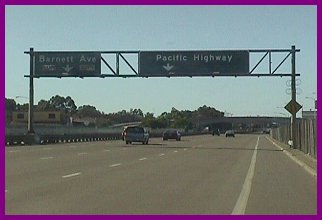
| By 1942, Pacific Highway between Barnett Ave and Rosecrans Ave had been
upgraded to partial freeway standards. While this was a much needed improvement, it was
not until 1958 that the limited access portion was extended south of Barnett Ave. In this
case it was short: it only went for about a mile south, with the major improvement being
the grade separation over Washington St. This portion saw service as US 101 for seven
years until it was superseded by I-5 in 1965. Unlike many other abandoned freeways in
California, this one still has the bulk of its original signage and offers an interesting
look at what signs looked like at the time
|
 |
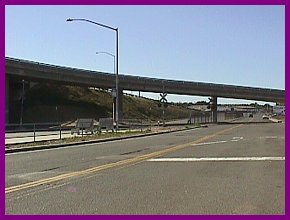 |
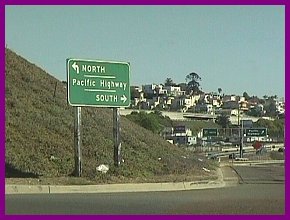
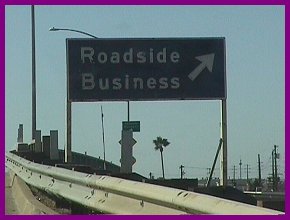
Above:
Original entrance to Pacific Highway. The sign is obviously new, but the poles are
original. Left: Flyover ramp to roadside businesses. Below left: Original sign indicating roadside businesses - sign is white on black. Below: Old overhead sign for approach to Barnett Ave. Unlike modern signs, this does not use button copy. The sign on the right used to say "101 Los Angeles" with two arrows indicating the lanes for through traffic. |
 |
 |
As mentioned above, in 1942-43, Pacific Highway north of Washington St. was upgraded
to partial freeway status as part of the war effort. During the second World War, San
Diego played a major role in supplying war materials and a good network of highways was
essential. At the same time, it was also critical that war materials be conserved, which
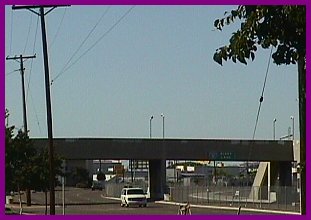
led to the minimalistic design of the interchange structures.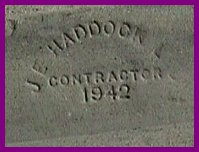 Right: Pedestrian overcrossing built in 1942 to facilitate access for workers at the nearby Convair plant. Left: Contractor's date stamp. |
 |
 |
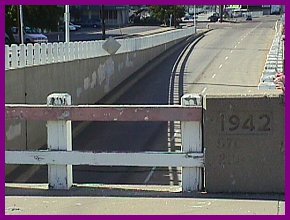 |
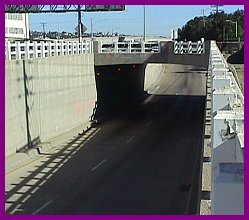
| Above: The Barnett Ave. underpass, built in 1942. This was built to conserve materials for the war effort, which is why it has the wood guardrails. It is almost identical to the bridges pictured below. | |
The picture below accompanied an article in the November/December 1943 volume of California Highways and Public Works titled "Modern Design Features Mark New Highway Construction in San Diego."
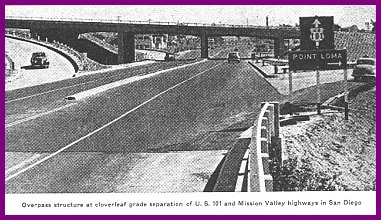 "Overpass structure at cloverleaf grade separation of U.S. 101 and Mission Valley highways in San Diego." (Caltrans) |
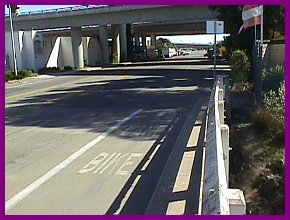 Same location, 1997 |
The pictures below show the evolution of the US 101 / US 80 interchange. This was built at a time when building materials were at a premium. This is reflected in the design of the cloverleaf where one of the circle ramps was smaller so that the ramp carrying traffic heading from north 101 to the east highway could join with the mainline bridge over the railroad. At the time there was actually a lot of value in the materials saved by not building the extra bridge soley for the exit ramp. 1961 the interchange was essentially unchanged since its construction in 1942. As the picture above on the right shows, this was entirely removed in 1968-69 to accomodate the newer I-5 / I-8 interchange. The picture to the right is especially interesting since it shows the old interchange in relation to the more recent one. By the time this interchange was under construction, I-5 was already completely eight lanes between National City and San Clemente; this was the last portion of old highway. This is visible in the picture with the completed eight lane I-5 visible at the bottom of the picture and again just beyond the San Diego River crossing.
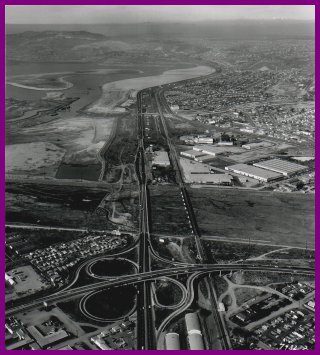 |
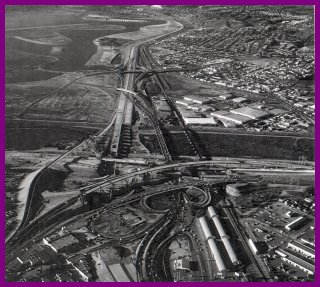 Above: I-5 / I-8 under construction, early 1969. Note the continued use of the older interchange. Left: The US 80 / US 101 interchange in 1961, before they became Interstate highways. (Caltrans) |

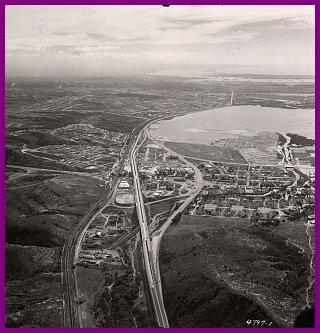 |
The Mission Bay Freeway was a short four lane full freeway bypass built
in 1954 to help alleviate traffic at the crowded interchange with Balboa Ave / Garnet Ave.
It also afforded a savings in travel time by continuing in a straight line rather than
swinging out as the older (1930s) alignment had. In 1969 the original pavement was removed
and the freeway was realigned to accomodate the new eight lane freeway. However, all of
the original bridges still exist, though they were widened. In fact, the one over Rose
Canyon Creek still has the original curbing in the middle, complete with the reflectorized
divots. Left: Mission Bay Freeway, 1961. The freeway bypass is to the left while Mission Bay Drive (Old US 101) swings out to the right. (Caltrans). |
 |
US 101 Page Continue north:
Go south: Southern San Diego |
Go to the Historic California US Highways Main Page
http://www.gbcnet.com/ushighways/101pics2b.html