|
|


 |
|
"Mail Pouch" 100+ Years
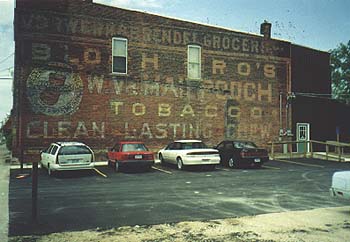
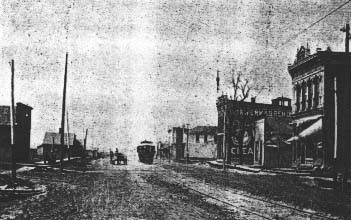
My son and I own a commercial building in Fort Madison, IA on which there is a Mail Pouch ad painted which I am relatively sure dates to 1891 or perhaps as early as 1889. It measures about 20 x 50 ft. and is for the most part legible. I have a current photo (top left) and a copy of a photo (left) from Fort Madison History, which was published in 1896. The building is located near what was at that time called "Shopton." The Santa Fe Railroad shops are about three blocks south. The actual address of the building is 2621 Avenue L, which is the same as US Highway 61. "VORWERK AND BRENDEL GROCERS" as the wall reads, built the building and occupied it from 1889-1891 as indicated by Fort Madison directories. Below this copy is a frame and a yellow line about 6 in. wide with 3-in. in diameter black dots on 1-ft. centers. These are most visible below the letters "OCE" in "GROCERS." The black dots were used to calculate the square footage that was the basis by which the walldog was paid. The next line "BLO H RO'S" was originally "BLOCH BRO'S," the founders of the Mail Pouch Company. The windows were installed after the wall was painted. There is a black line across the sign that is the former roofline of an adjoining building built after 1896 and since removed. I have searched the web and not found any information about "W Va MAIL POUCH." To the left is the company trademark that is about 6-ft. in diameter. I thought it unique, but in talking with Harley Warwick, the man responsible for painting the Mail Pouch walls for so many years, there are a few which have been repainted. The frame continues around "TOBACCO" and "CLEAN LASTING CHEW" and can be seen between the cars; the black dots are visible in portions of the lower frame as well. The sign is virtually untouched since painted with the exception of the windows. The masonry has never been tuck-pointed since being built; the upper left and right dark areas have not yet been washed or tuck-pointed. Some brick damage is evident in the lower left-the result of a construction projection where building materials were stored prior to our ownership. I have the following questions about this sign, and would appreciate any feedback offered: 1) I know that the Highway Beautification Act enacted during the administration of President Johnson exempted the Mail Pouch walls, and that legislation was in fact passed that protected them as national landmarks. Does anyone have more specific information about this? Is the sign exempt from recent legislation banning tobacco billboards? I was very excited when I heard about the virtual American Sign Museum and thought visitors would be interested in hearing about the historic sign. If anyone has possible recommendations about how to preserve the sign, I'd sure like to hear. By the way, I'd also like to mention that Harley Warwick referred me to Signs of the Times, for which I am thankful. Thomas J. Kitchen Editor's Note: We've already started a discussion on this topic in the General section of Talk. If you can answer some of these questions or have questions or comments of your own, please speak up! |
Home | News | Exhibits | Events | Links | Talk | FAQ | Contact Us