|
|


 |
Welcome to Philadelphia
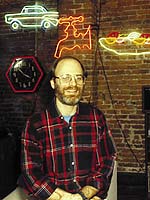
Len Davidson offers a personal guided tour
|
|
Between the 1930s and '60s, Philadelphia was a major industrial center--with a significant neon history to match. Sadly, industry and population have waned in the last fifty years, and most of the luminous neon extravaganzas that promoted city businesses are long gone.
What characterized both spectaculars and more modest signs was an emphasis on pictorial images. With scores of mom-and-pop sign shops competing for work, the neon artisan who included a figural image in his proposal was often the one who made the sale.
This figural tradition is examined in depth in my recently released book, Vintage Neon (available online from ST Publications). Included are over 350 photos and accompanying stories on pictorial signs from across North America. I've also focused on figural signs in my own Neon Museum of Philadelphia collection.
The following photo tour only scratches the surface of Philadelphia's wondrous neon tradition.
Exterior Signs & Spectaculars - Philadelphia Companies
Giles & Ransome's double-sided sign was restored in June, 1999. Made in the late 1940s for the company's Hunting Park Avenue headquarters, it features a complex animation sequence in which the operator shifts gears, causing treads to rotate. The sign now entertains Pennsylvania Turnpike travelers from the rooftop of the company's suburban Bensalem, Pennsylvania facility.
Like the tractor, the best signs had intricate, porcelain-backed graphics. Thirty-nine tubes were used to detail the magnificent porcelain and neon crown that proclaimed Pat's "Pioneer & Originator" of that working-man's delicacy, the steak sandwich. In 1994, Philadelphia Licenses and Inspections condemned the abandoned masterpiece as imminently dangerous. I was able to retrieve the city icon, but it still awaits restoration. It was built about 1950 by Ajax Signs, a small firm known for elaborate designs.
Other 1950s animated marvels yet to be restored include Kunda Sign's double-sided Swartz Camera in which a multi-colored neon aperture opened and closed. The Subway Bar's animated subway cars increased in size as they moved down the track. These signs will also be restored by the museum pending time, money and space.
One of the many that got away was the Twist Bar's dancer who appeared to be gyrating a la Chubby Checker, a Philadelphia native son. Like the "Twist" and "Subway," many huge figural signs were located on Broad Street. One that survives (as a giant cowboy boot with inoperable neon) is the Boot & Saddle Bar.
Termini Bakery's beautifully preserved 1940 sign features the bullnose curves and scroll work accents popular at the time. The business also boasts a stainless steel and neon entry alcove and time-warped interior . . . not to mention the baked goods that are a civic treasure.
Also lit is the 1950s Levis Hot Dog, though the beloved lunch counter restaurant that originated in 1895 went out of business in 1992. Levis' 13-ft. wiener was salvaged from an architectural antiques warehouse and restored atop the North Star Bar. The L and I commissioner, a longtime Levis lover, instituted a "historic sign" loophole which permitted the sign's resurrection. The mayor flipped the switch at a "99th Anniversary Relighting" ceremony.
When a section of downtown was cleared for redevelopment, the venerable Kosmin's Camera was endangered. Neon lover Neil Benson broke into the shuttered building and rescued the figural tubes that covered the top part of the sign. After the wrecking ball destroyed the building, Neil pulled one side of the camera's porcelain backing panel out of the rubble.
Smaller exterior signs also featured pictorial elements, as seen in the animal logos use by Vahle's Pet Store and Harold's Men's Shop. These projection signs, like hundreds of their ilk, are lost forever.
Exterior Signs & Spectaculars - National Companies
National businesses either had signs made at one location and shipped to stores around the country, or commissioned local signshops in many cities to produce their logos. The winking eye Buster Brown Shoes sign was produced by Kirn Signs in St. Louis and shipped to Weinstein Shoes on Philadelphia's South Street in the 1950s. When the no longer functioning logo was replaced by a plastic sign in 1982, I obtained the porcelain can for my museum and restored the neon.
Other national signs preserved by the museum include a 1930s Sherwin-Williams Paints "Cover the Earth" logo that was rescued from a defunct North Philadelphia hardware store, and a 1950s Pontiac Indian with multicolored feathers. The Indian was displayed at the stainless steel Silk City Diner, a popular hangout for the city's Generation Xers.
The museum's most complex porcelain and neon renovations are three Howard Johnson logos--all built in the 1950s. The 8 x 7-ft. Lamplighter was originally erected in North Carolina. It now lights an atrium dining area at the North Star Bar. The 10 x 6-ft. Simple Simon & the Pieman (#1) was obtained in 1987 from a Jacksonville, IL restaurant that no longer operated as part of the Hojo chain. One side will be displayed at the National Building Museum in Washington D.C. through 2002 before returning to the City of Brotherly Love. The other side is displayed at the Henry Ford Museum in Dearborn, MI. The life-size Simple Simon & the Pieman (#2) came from Uniontown, PA. One side was purchased from an antique dealer and restored, while the second sign awaits a buyer and restoration. The sign is noteworthy because it includes a lamp and circus graphics--elements not usually seen on Simple Simon logos.
Mobil Pegasus logos varied in size and style, with shield and cut-out models, as well as stationary and animated versions. This 5-ft. shield was exhibited by the museum at a Philadelphia diner until 1998 when the business was sold and the sign taken back.
Other signs that were made outside Philadelphia, but restored and put on exhibit by the museum include a 1930s Bellows Camera and a double-sided metal and neon Bakery Rolling Pin. The 4-ft. tall free-standing camera was discovered at a New York City architectural antiques business. The rolling pin was found in South Dakota. It was made by Rosenbaum Signs and originally hung under the arcade of a 1950s shopping plaza in Rapid City.
Window Signs
The figural tradition was very evident in windows. Meat markets portrayed a butcher wielding an Animated Cleaver, or used cows and pigs to denote their businesses. Cappuccio's is one of several old shops in the Italian Market (made famous by the movie "Rocky") that continue to use such advertising. Before the advent of burglar bars, a night-time trip through the market was an excursion through a 1950s neon gallery. Another cow is illustrated in the Fresh Meats sign, noteworthy for the solid cane glass used to weld neon sections together. This risky technique (too much heat and the tube will crack) has not been used by area benders for over 40 years.
The Scissors and Beauty Salon Silhouette were used in Passyunk Avenue storefronts, a busy shopping corridor that intersects the Italian Market. Between the 1930s and '60s, hundreds of beauty salons used similar profiles to advertise their shops. The words "Permanent Waxing" frequently hung above the silhouette.
Hats Blocked dates to the 1940s before men's headwear went out of style. It was found in a defunct Center City storefront.
Before the 1960s, hundreds of local companies made and distributed soda and seltzer in small neighborhood factories. Rowhouse garages and cellars often provided start-up space for such businesses. The Seltzer sign was found in the window of a rowhouse where it is believed seltzer was produced.
The 1950s Records sign uses the time-tested graphic device of substituting an image for a letter.
Colosmo's signs also date to the '50s and include a third window in which a neon deer is portrayed--appealing to the hunters.
Promotional window signs were made in multiples and given away or sold cheaply to outlets that carried a firm's products. Today this activity is mostly limited to beer signs, but in 1950s Philadelphia it was commonly done by all types of manufacturers: paint, cold cuts, nylon stocking and ice cream--to name a few. Coca-Cola gave away so many of their script logos that several Philadelphia tubebenders specialized in their work. The illustrated signs advertise cold cuts (Samuel Sandler); paints (Carroll and Xtra Glo); and windshield wiper blades (Trico). The Xtra Glo logo is particularly inventive with a paint can doubling as sign frame and "X" doubling as overalls.
Though most of the classic pictorial images are gone, figural neon continues to flourish on South Street, one of the city's busiest entertainment districts. Hip venues like Rocketships and Accessories (a space toys store which closed in the 1980s), and Zipperhead (a punk clothing emporium in which a man is depicted with a neon zipper in his head) commissioned some of the street's most unusual signs. Retired benders Nick Mancuso and Carol Falone crafted these and many other interesting South Street signs back in the 1970s and '80s, though their greatest work was probably seen in the 1950s spectaculars and movie marquees.
Entryways, Borders and Clocks
Neon was frequently mounted directly on store facades as seen in the 1960s Chadmoore Formal Wear sign. Built by Oscar Sorgentoni, the tuxedoed man continues to shine on South Broad Street.
Corner bars mounted neon over entry alcoves and often accented the doorway with neon behind wavy glass or glass block. The best remaining example is Club Bali's 1950s nude-in-a-cocktail glass. The sensuous figure also holds a tiny glass in one hand. In 1986, Davidson Neon restored this landmark without charge.
Hendzels was a 1930s blue collar tavern that had a bold entryway and border treatment. In 1996, new owners reopened the restaurant as the Vega Grill. The period neon flavor was maintained and the façade complimented with stainless steel--an element commonly used on Philadelphia bar exteriors between the 1930s and '50s.
Neon borders were also frequently used to trim store windows. Unlike today's typically straight border designs, vintage borders had corner geometric accents bent in contrasting colors, as seen at Sal's Shoe Repair.
Jim's Steaks, though built in the '60s, evokes Philadelphia restaurant design from the 1930s. Hundreds of neighborhood shops and taverns used exterior tile and hung neon borders behind glass block.
Neon clocks were seen throughout the city. The 6-ft. diameter Bulova Watch Time model is one of four that were erected at city watch dealers after exhibition at the 1939 New York World's Fair . The only remaining example can be seen at Mohamed's Oasis, a North Broad Street storefront that was formerly a watch shop. The clock is no longer operational.
Most Philadelphia clocks were made by the Electric Neon Clock Company of Cleveland and sold by their regional salesman, John Welsh. ENCC pieces were mounted on interior walls, in windows, and on building exteriors. Some were even integrated into exterior signs as seen in this 1950s Andrew's Jewelers sign.