|
|


 |
|
Happy Birthday,
Neon!
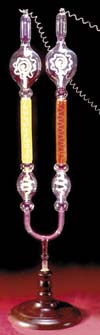
This month, in honor and memory of Georges Claude and many other contributors, I'll focus on the early years of neon. On Nov. 9, 1911, the U.S. patent office received a document which read: "Be it known that I, Georges Claude, a citizen of the republic of France, have invented a certain new and useful improvement in systems of illuminating by luminescent tubes, of which the following is a specification." At that time, no one ever thought that such an invention would still be part of daily life after 90 years -- especially because the neon tube was born as a waste product. It's a long story; let's start from the beginning. First experiments In the 17th Century, many scientists experimented with atmospheric air, including Italian physicist Evangelista Torricelli, who, in 1644, constructed the first recorded mercury column barometer in which he observed that, when shaken, it would emit a bluish light in the dark. Furthermore, when such scientists as Henry Cavendish and Benjamin Franklin investigated "electrified atmospheres," they discovered that the resulting light's color is also dependent on the chemical composition of gas and pressure. They didn't have much success "diluting" the gases because the vacuum technique was very primitive.
At the turn of the century, many scientists experimented with electrical lighting and vacuum electrics. American scientist D. McFarland Moore discovered that early tubes had a short lifetime because the gas inside was consumed quickly, thus leaving none to conduct electricity. But Moore's most famous invention was an automatic refilling valve, which, when pressure dropped, refilled a tube during operation with gas from a reservoir. Although bending and processing big (up to 60 ft. in length and almost 3 in. in diameter) tubes was a challenge, the first luminous advertising sign using Moore light tubes was installed in a Newark, NJ-based hardware store in 1904. Claude's recycling project In 1895, German engineer Carl von Linde found a way to liquify air and, in 1902, he discovered how to separate its main compounds (oxygen and nitrogen) by low-temperature distillation. During the air separation process, such inert gases as argon, neon, krypton and xenon were leftover as surplus waste products. Linde's concurrent, Frenchman Georges Claude, was seeking a commercial use for such "waste" gases. In addition to his knowledge about the Moore tube, Claude knew that a chemical reaction between the gas and electrode material caused a drop in gas pressure. Thus, by experimenting with different gasses and electrode materials, he discovered that the gas should be chemically inert, and that the electrical load for a given electrode surface must remain below a level of 4.5mA/cm2 (29mA per sq. in.). Claude also found neon to have the best light output vs. electrical-resistance ratio. Consequently, the neon-lighting tube was developed and became patented on Jan. 19th, 1915, as U.S. Patent 1,125,476. Claude's patent for the purification process included the process of "electrical bombarding," which has been unique to the neon industry. My research references didn't include information about where the "heating and purification of discharge tubes by electrical overload" was used first. 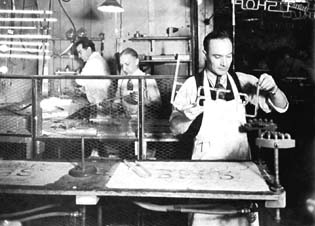
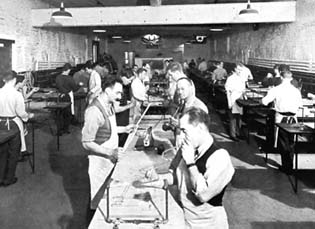
Class at the Egani Institute
(New York City) Claude's monopole Claude fully exploited his patent commercially. He alone made and sold the signs in Paris and quickly spread out to other big cities. In 1922, Claude sold the first two identical signs to the Los Angeles-based Packard dealership of Earle C. Anthony for $1,250 apiece. The demand for neon signs increased to such an extent that Claude couldn't fulfill all the requests he received. Thus, he finally decided to sell franchise licenses outside of France for $100,000, plus royalties for each one. The popularity of neon continued to rise, and "Claude Neon" became so popular that many thought "Neon" was the last name of the inventor. However, because so many people wanted a piece of this breakthrough technology's success, fierce commercial strife began to emerge. In the patent war that took place from the 1920s up to 1932, the courts declared numerous claims made by the Claude organization invalid, but the fundamental claim on electrode size was declared valid. The Claude organization kept all knowledge strictly confidential. Former Claude employees were the first to start their own neon businesses and tried to get around Claude's patents. The Cortese brothers (their family is still active as owners of Berkley Heights, NJ-based EGL) and Ben Kresge (1915-1999) worked to develop an electrode that could withstand a higher current on a smaller surface than that claimed by Claude. Thus, the new or "activated" electrode was developed and adopted the principle of coating the cathode surface with earth alkali oxides (discovered by Arthur Wehnelt in 1907), causing a much higher quantity of electrons to be released into the gas at a reduced voltage drop. The new electrode was quite different in processing compared to Claude's uncoated electrodes, and therefore, only a few neon shops could successfully use them. 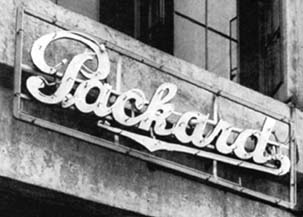
The first neon sign in the
United States Because advertising always directly relates to the economy, the 1929 business collapse impacted the neon business. After Claude's patent expired on Jan. 19, 1932, the neon business began to surge as secrets of the electrode -- and the activated electrode -- became widely available. But, as expected, such conditions led to cutthroat competition at its worst. Also during this time, techniques from radio-tube and incandescent manufacturing were adapted to neon. Further, Ben Kresge developed the machine-made tubulated electrode and introduced it to the market in the late 1930s. At the same time, filament hot-cathodes for gas-discharge lamps were introduced, leading to the low-voltage, T-12 lamps widely used for lighting today. Because these lamps could be filled with argon/krypton plus mercury only to operate on low voltage, fluorescent materials were needed to convert the ultraviolet light into visible, preferably white, light. Unfortunately, such classical fluorescent materials as willemite, calcium silicate and calcium tungstate didn't perform well under the environmental conditions of a heavy-current gas discharge. Only a few colors, including green, blue and pinkish-white, were available at first. In addition, glass tubing made from colored glass was used in the neon field. This glass was obtained from plate-glass manufacturers for stained-glass windows, which use sodalime glass as a base. Although lead glass was used for neon tubing due to its ease of workability, the colored tubes were fabricated from hard sodalime glass up to a few years ago when a Venetian glass master started to make a soft, lead-free, colored glass. Beyond neon's first decade Technically, little changed in neon's first decade. But after World War II, government programs were established to help re-educate soldiers. The Egani Institute (New York City) was one of few schools in the country that taught neon-trade secrets. The American streamlined design from the 1950s would be unimaginable without the use of neon. Also in the early 1950s, neon profited from the "waste" of an invention in a completely different field -- the color TV. The RCA laboratories in Princeton, NJ, were commissioned to develop the color-TV picture tube, and they needed very intense fluorescent materials of deep color, especially red. 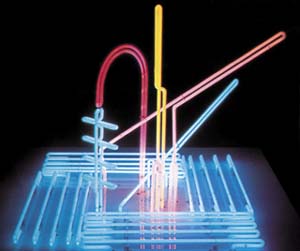
Marie's Fist Neon by
Stephen Antonakos (1965) Here, for the first time, systematic scientific research was carried out in the field of fluorescent materials. Plus, the first rare-earth phosphor -- yttrium-vanadate activated with europium -- was found. Today, this phosphor, which is still used to create "coral pink" in neon, is also used in almost every computer monitor and TV screen. The availability of more than 24 colors contributed to the neon boom in the 1960s, and the technology's rapid expansion continued until the plastic-box type sign, backlit with fluorescents, was promoted as "the new look." Neon suffered a recession when price, rather than design, became a determining factor in signage sales. Although the 1970s were rough years for neon professionals, some artists discovered that light could be used as a medium to express the art philosophy of the late '60s and early '70s. Such artists as Bruce Nauman, Stephen Antonakos, John David Mooney and others helped neon become an elaborate art form, rather than an expression of cheap advertising. In the early 1980s, an energy crisis lead to a push in low-consumption lightsources, triggering new research on new luminous materials. Highly efficient fluorescent materials were introduced to the neon world from the lighting business, and the range of available colors increased to nearly 100. Rudi Stern helped revive American neon in the '80s and advocated the technology up to the mid-'90s. In his '96 introduction to The New Let There Be Neon, he says, "I believe that we need to remind ourselves that neon is still at the beginning, and its potential has still not really fully been explored." Today, we can see the truth in Stern's observation. The demand for the use of neon and cold cathode in architectural applications is growing, and the introduction of new techniques -- like fiberoptics and LED -- into the sign market have strengthened, rather than replaced, neon technology. The evolution of the "waste" product neon tube remains incomplete 90 years after the patent was filed. According to Stern, "The need for this wonderful kinetic light can only grow." May the next 90 years bring even more breakthrough developments in neon technology than the first. Happy birthday, Neon!
Photo credits: The New Let There Be Neon, by Rudi Stern, The Light Artist's Anthology, by Christian Schiess
|