Aberdeen Proving Ground |
Fort Armistead |
Fort Babcock |
Baltimore's Civil War Forts |
Fort Carroll
Concord Point Battery |
Fort Covington |
Camp Cross |
Fort Defiance |
Fort Dix |
Fort Federal Hill |
Fells Point Battery
Ferry Point Redoubt |
Fredericktown Fort |
Frenchtown Battery |
The Garrison Fort |
Camp Hoffman |
Fort Hollingsworth
Fort Horn |
Fort Howard |
Fort Hoyle |
Kent Island |
Lazaretto Battery |
Fort Lincoln (1) |
Camp Look-Out
Fort Madison |
Fort Marshall |
Fort McHenry |
Naval Camp |
Fort Nonsense |
Patapsco Battery
Fort Patterson |
Pikesville Arsenal |
Potato Battery |
Port Deposit Battery |
Principio Furnace Battery
Rogers' Bastion |
Fort Rosehill |
Sailor's Battery |
St. Ignatius Fort |
St. Leonard's Fort |
St. Mary's Fort
St. Michaels Battery |
Fort Severn |
Fort Smallwood |
Fort at Soller's Point |
Spring Garden Battery |
Fort Whetstone
Fort Wood |
Fort Worthington
Western Maryland - page 2
Fort Lincoln (1)

(Point Lookout State Park)
(1864 - 1865), Point Lookout
Built by Confederate POW labor when Washington was threatened by Confederate General Early's raid, and a prison break was feared. It is the only surviving fortification of three that guarded Camp Hoffman, the stockaded POW camp established in 1863. It is a small four-sided earthen fort with four reconstructed buildings, and the remains of a powder magazine. It is located on the Potomac River side of the peninsula. The war ended before construction was complete. The site of the other two works, Redoubts #2 and #3 were located on the Chesapeake Bay side above the prison camp stockade. They were smaller circular earthen works with a moat, armed with four guns each, and a wooden observation tower in the center. Both have eroded away. A marker locates one of the redoubts offshore. Camp Cross, one of the the cantonments for the Union garrison, was located outside the prison stockade to the north. 50,000 Confederate POWs were here at one time or another. The state fishing pier is at the site of the prison camp. There are some remains of the prison camp's ditch, as well as a reconstructed portion of the stockade wall. Most of the site has eroded away. Hammond General Hospital was built in 1862, located at the point near the lighthouse. The lightouse was built in 1830, remodled in 1883. It is off limits to the public at the present time. A museum is at the park's visitor center. Admission fee.
St. Mary's Fort

(Historic
St. Mary's City)
(1634 - 1637), St. Mary's City
A palisaded fort was once located here but became neglected and abandoned.
This is a reconstruction of one of the first English settlements in the
state. Located here is a replica of the Dove which brought
those settlers. Admission fee. The first settlement was located at
St.
Clement's Island.
St. Ignatius Fort
(1638 ?), St. Ignatius (?)
A fort was erected here after the St. Mary's fort fell into disrepair. It did not last long itself. (Probably located at Fort Point on the St. Mary's River in St. Inigoes, located at NAS Patuxent River-Webster Field Annex. A Third System fort was proposed for this location, but never built.)
Fort at St. Leonard's Creek
(Patterson State Park)
(1813), Wallville
A federal naval battery secretly built to attack the British ships in the Patuxent River in order for the American gunboats to break out of the British trap. It was armed with five heavy guns and three field guns, with a hot-shot furnace. This was considered the Second Battle of St. Leonard's Creek on June 26, 1813.
Fort Severn

(U.S. Naval Academy)
(1808 - 1909), Annapolis
An 11-gun circular masonry fort. Garrisoned in 1814 on the threat of a British attack that never came. Transferred to the Navy in 1845 and became known as the Naval School at
Fort Severn. In 1850, it changed its name to the United States Naval Academy. The Army took control again in 1861 - 65 while the Naval Academy transferred to Newport, Rhode Island. The old
fort was demolished in 1909. A plaque is on Bancroft Hall.
A Patriot fort was built on Windmill Point in 1776.
Fort Madison
(1812 - unknown), Annapolis
A 13-gun fort located across the Severn River at the present-day Naval Surface Warfare Center - Annapolis
Detachment (Naval Ship Research and Development Center). This fort was rebuilt in the early 1850's. It was transferred to the Navy in 1873. A Naval Experimental Battery was built in the 1870's at the tip of Carr Point.
Fort Nonsense was built in 1810 a half-mile north of here. Patriot forts were built in 1776 at Greenbury Point and on Biemans Hill near here.
Fort Horn
(1776, 1813 - 1815), Annapolis
A local militia fort. Located on Horn Point near the yacht club. A work from 1794 was not completed.
Fort McHenry
(National Monument & Historic Shrine)
(The Friends of Fort McHenry)
(1798 - 1923), Baltimore 
Fort Whetstone, a five-pointed star-shaped earthwork fort (13 guns), was first here in 1776 - 1783, replacing an Upper and Lower Battery (18 guns) from 1776. Along with Fell's Point Battery (1776 - 83), they were Baltimore's only defenses during the American Revolution. Fort McHenry is the site of the major British bombardment in 1814 that
inspired Francis Scott Key to write "The Star-Spangled Banner" national anthem. The fort was rebuilt in 1829 - 36 to the present layout. Rodman cannon were installed in 1866, and all the other old cannon were removed by 1895. The Rodmans were last fired in 1903.
The fort was abandoned in 1912, but the military used it as a hospital from 1917 - 23. All the hospital buildings were removed. Some buildings still exist as part of the Naval Supply base adjacent to the fort. From 1942 - 45 a Coast Guard Training Station was outside the fort.
These buildings also no longer exist. Became a National Park in 1925 administered by the Army until 1933. Admission fee.
Another website
Other War of 1812 Forts of Baltimore
(1813 - 1815), Baltimore
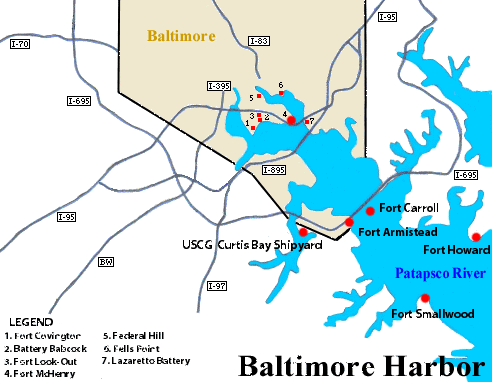
Additional forts that defended Baltimore Harbor were Battery (or Fort) Babcock (1813 - 1815), a six-gun earthwork semi-circular redoubt with a rear powder magazine, also known as the Sailor's Battery. A granite monument marks the site one and one-half miles west of Fort McHenry on Gould Street.
Fort Covington (1813 - 1832), a V-shaped ten-gun brick fort with barracks, guardhouse, and magazine located one-half mile west of Fort Babcock. It was originally called Patapsco Battery. Site now occupied by the Baltimore Sun newspaper headquarters.
Camp (or Fort) Look-Out (1813 - 1819), a circular earthwork battery with a central magazine that protected the landward approach to Forts Babcock and Covington. It was renamed Fort Wood in 1814. The ruins still existed as late as 1853, the site is now Riverside City Park.
Lazaretto Battery (1813 - 1815), a three-gun redoubt across the channel from Fort McHenry, built adjacent to the Lazaretto Quarantine Station (1801 - 1959). The site is now a concrete factory. A lighthouse once stood on Lazaretto Point from 1831 to 1926. A replica (1956) stands there now.
Rogers' Bastion (1814 - 1815), aka Naval Camp, it was one mile of fortified earthworks with seven artillery redoubts, located east of Fell's Point on Hampstead Hill and in Patterson Park.
Spring Garden Battery (1813 - 1815), a small battery located north of Fort Covington at the head of the Middle Branch in the Camden Yards section of the city. I-395 now runs through the site.
Ferry Point Redoubt (1813 - 1815), a small work located at Ferry Point, probably located at present-day Ferry Bar Park. It protected a log boom across the Middle (Ferry) Branch.
Civil
War Forts of Baltimore
(1861 - 1865), Baltimore area
During the Civil War, Baltimore had 44 forts, batteries, redoubts, and armed camps, and about
20 unarmed camps (hospitals, POW, etc.) as the first southern city occupied by the Union Army. In addition to Forts McHenry and Carroll, these included:
Fort #1/2 (1864) at West Baltimore and Smallwood Streets.
Fort #1 (1863 - 64) at West Baltimore and Smallwood Streets.
Fort #1 1/2 (1861 - 64) aka Camp Andrew, Camp Reynolds, Camp Creager, Camp Wool, Camp Simpson at Baltimore Street and Fulton Ave., now present-day Bon Secours Hospital. A military hospital was built adjacent in 1862.
Fort #2 (1864) at Franklin Street and Kirby's Lane.
Fort #3 (1864) at Gilmor and Townsend Streets (or Franklin Street and Kirby's Lane?).
Fort #4 (1864) at Gilmor Street and Winsor Mill Road (or Townsend Street and Kirby's Lane?).
Fort #4 1/2 (1864) at Gilmor and Baker Streets.
Fort #5 (1861 - 64) aka Camp Druid Hill Park at Druid Hill Park on Madison Ave.
Fort #6 (1864) at Druid Hill Park.
Fort #7 (1864) near Mount Royal Resevoir by the railroad (North and Madison Aves?).
Fort #7 1/2 (1864) opposite Camp Bradford at North Charles Street.
Fort #8 (1861 - 64) aka Camp McKim south of Greenmount Cemetery at Preston, Chase, Homewood, and Valley Streets. The barracks became a military hospital in 1862 - 1865.
Fort #9 (1864) at Harford Rd. and North Ave.
Fort #9 1/2 (1864) at Caroline Street in Fell's Point.
Fort #10 (1864) at Caroline St. in Fell's Point.
Fort #11 (1864) aka Fort Rosehill at East Monument Street near the present-day Johns Hopkins Hospital (or Chester and Elderry Streets?).
Fort #12 (1861 - 62) aka Camp Washburn, Camp Patterson, Fort Patterson at Patterson Park. Became a military hospital in 1863 - 65.
Fort #13 (1864) aka Fort Worthington at Kenwood and Preston Streets, south of Baltimore Cemetery.
Fort #14 (1861 - 64) aka Fort Marshall on Murray's Hill in Highlandtown section. Now site of Sacred Heart Catholic Church.
Fort #15 (1861 - 64) aka Fort Federal Hill on Federal Hill. It was
the first temporary fort built at start of the war because of riots in April of 1861. All guns faced downtown to suppress anti-federal riots and pro-southern sympathies.
Fort Dix (1861 - 65) at Thomas Viaduct Bridge in present-day Patapsco State Park.
Battery A (1864) at Monroe and Ramsey Streets.
Camp Belger (1862 - 64) aka Camp Birney at Madison and North Aves.
Camp Bradford (1861 - 64) aka Camp Cattlegrounds, Camp Tyler at Charles and 26th Streets. It became a military hospital in 1864 - 65.
Camp Cadwalader (1861) adjacent to Fort McHenry.
Camp Carroll (1861 - 64) aka Camp Chesebrough at Carroll Park.
Camp Chapin (1862) in Druid Hill Park.
Camp Emory (1862) adjacent to Camp Millington.
Camp Essex (1861 - 65) at Thomas Viaduct Bridge in present-day Patapsco State Park.
Camp Glory (1861 - 62) at Long Bridge on the Ferry Branch of the Patapsco River.
Camp Hoffman (1861 - 64) at Lafayette Square.
Camp Meade (1863) at North Charles Street.
Camp Melvale (1861 - 62) aka Camp Small at Cold Spring Lane and Jones Falls in the Cross Keys area.
Camp Millington (1862) east of Gwynn's Falls at Brunswick Street and Millington Ave., adjacent to Camp Emory.
Camp Morgan (1861 - 65) at Thomas Viaduct Bridge in present-day Patapsco State Park.
Camp Mount Clare (1861) at West Fayette St, Fulton Ave., West Baltimore and Smallwood Streets, adjacent to Camp Andrew. Became a military hospital in 1862 - 65.
Camp Cram (1862) at Liberty Road near Powhattan Dam in Baltimore County.
Camp Hay (1861 - 62) aka Camp Beaver at York and Sherwood Roads in Cockeysville.
Camp Stansbury (1861) at the Back River railroad bridge in Rosedale.
Camp Seward (1861 - 62) on York Road at the Little Falls railroad bridge in Parkton.
Camp Donaldson (1863) unknown location.
Camp Newport unknown date and location.
Information on Baltimore's Civil War defenses collected from Scott Sheads' Baltimore During the Civil War, Toomey Press, 1997.
� COAST DEFENSES of
BALTIMORE
View Baltimore Map
� Fort Carroll
(Fort Carroll Lighthouse)
(1847 - 1921), Dundalk
Located on a man-made island in the Patapsco River adjacent to the Francis
Scott Key Bridge. The construction was once supervised by Robert E. Lee. It is
hexagonal and includes three modern coastal batteries. They are Battery Towson (1900 - 1918), Battery Heart (1900 - 1917), and Battery Augustin (1900 - 1920). The single story fort was originally intended to have four tiers. The casemates became flooded in 1864, with all powder and ammunition transferred to Fort McHenry. The fort was a subpost of Fort McHenry from 1908 to 1911, and then was a subpost of Fort Howard until 1914. Several guns were removed in 1917, and the fort was abandoned in 1921. The Army used the fort in WWII as a small-arms range, and the Coast Guard also briefly used the fort in 1955 for the same purpose. A lighthouse was added in 1854 and rebuilt in 1898. The lighthouse was automated in 1920, but is now abandoned. The fort was originally known as Fort at Soller's Point until 1850. During the Civil War, Fort Carroll had only five gun platforms ready in April 1861, and only two were armed with guns, out of a planned 225 gun emplacements. Privately owned since 1959, and with no public access, it is overgrown and deteriorating. The best views are from Fort Armistead.
Another website
� Fort Armistead (park)
(1896 - 1928), Baltimore
Located at Hawkins Point next to the Key bridge. Batteries here are Battery
Winchester (1900 - 1918), Battery McFarland (1900 - 1917),
Battery Irons (1900 - 1913), and Battery Mudge (1901 - 1920),
which is partially destroyed. A mine casemate is located behind Battery Mudge.
� Fort Howard (park)
(1896 - 1940, - 1960's), Fort Howard
Located on North Point at the Patapsco River entrance. Batteries here are
Battery Key (1900 - 1927), Battery Stricker (1899 - 1918),
Battery Nicholson (1900 - 1927), Battery Harris (1900 - 1917),
Battery Clagett (1901 - 1920), and Battery Lazear (1900 - 1920),
which was destroyed. This was the chief defense and harbor headquarters for Baltimore. Two mine towers still remain, and two fire-control towers still existed until 1980. A Veterans Affairs hospital has occupied the post garrison area of the fort since 1940. The battery area of the fort remained under military control until the Vietnam War era, used for intelligence operations training.
� Fort Smallwood (park)
(1890 - 1928), Venice on the Bay
Located on Rock Point at the Patapsco River entrance opposite from Fort
Howard. Batteries here were Battery Hartshorne (1900 - 1927), and
Battery Sykes (1905 - 1927), which is destroyed.
� ALSO: Additional fire-control towers associated with these defenses were once located at Gibson Island, Black Marsh, Bodkins Neck, 65-foot Hill, and Stony Creek (Riviera Beach).
The Garrison Fort (Park) 
(1693 - unknown), Stevenson
Located just north of Baltimore, now in the midst of a residential neighborhood. This two-story stone structure is the oldest standing fort in the state. It was built as a frontier defense for the early settlements of Baltimore and Annapolis.
Pikesville Arsenal
(1813 - 1888), Pikesville
Located just north of Baltimore. It became a home for Confederate veterans after it was closed until 1932. Now used by the Maryland State Police.
Fort Hoyle
(unknown dates), near Chase
The site eventually became part of the Army's Aberdeen Proving Grounds. Probably located at Battery Point on the Gunpowder River.
Aberdeen Proving Ground
(U.S. Army Ordnance Museum)
(1918 - present), Aberdeen
Located north of Baltimore. Relocated from Fort Hancock, New Jersey. There are several World War II observation towers on
Pooles Island and other parts of the Proving Grounds.
Havre de Grace Batteries
(1813 - 1815), Havre de Grace
Local militia works to defend against the British. The main work was Concord Point Battery with three guns. The secondary work was Potato Battery, also with three guns, located where the lighthouse now stands. Attacked and destroyed by the British in 1813. The lighthouse on Concord Point was built in 1827. One of the original guns is on display.
Port Deposit Battery
(1813 - 1815), Port Deposit
A local defense to protect Creswell's Ferry. It was not attacked by the British in the 1813 raid.
Principio Furnace Battery
(1813 - 1815), Principio Furnace
A five-gun battery protecting the iron works located here, which was a major supplier to the federal government. It was attacked by the British in 1813.
Fort Defiance
(1813 - 1815), near Elkton
Located just south of Elkton on the western shore of the river. The British attacked in 1813 but were turned back by the local militia manning the fort.
Frenchtown Battery
(1813 - 1815), near Elkton
A local militia three-gun fort across the river from Fort Defiance. It was attacked and destroyed by the British in 1813.
Fort Hollingsworth
(1813 - 1815), Elkton
A local militia fort that was not attacked during the 1813 British raid.
Fredericktown Fort
(1813), Fredericktown
A local defense that was destroyed by the British in the 1813 raid.
Kent Island
(1631 - unknown), Kent Island
Located in the Chesapeake Bay near Annapolis. This was one of the first
settlements in the state. A Virginia trading post was established here in 1631. Maryland took possession in 1638.
St. Michaels Battery
(1813 - 1815), St. Michaels
Located on Navy Point, it was bombarded by the British fleet in 1814.
NEED MORE INFO:
Towns: Garrison north of Baltimore.
 Books about Forts in Maryland