


 previous pageCategories
of Works
If you are looking at this page without frames, there is more information about medieval writing to be found by going to the home page (framed) or the site map (no frames).

|
|||
| Personal Devotion (2) | |||
| There are some very famous and lavish books of hours, illustrated by the most celebrated artists of the day, and glossy publications often focus on these. There were also vast numbers produced commercially, for sale to the aspiring middle classes who couldn't afford a private contract with the Limbourg brothers. The artwork of these may look awkward, even naive, but they had fancy initials treated with gold leaf, elaborate floral and foliate borders and a program of miniatures which was not unvarying, but followed certain patterns with plenty of room for special requests by the patrons or buyers. So what are these and what are they for? (See Wieck 1988 also Backhouse c.1982 also de Hamel 1986) | |||
| Books of hours are well represented on the web. Glen Gunhouse gives the complete text in Latin and English translation of one variant in his Hypertext Book of Hours. The University of Pittsburgh Book of Hours gives the structure and information on each section, with beautiful illustrations of the miniatures. A Few Minutes on the Book of Hours provides an essay on the structure of the book of hours, with some illustrations. Horae Beatae Mariae ad usum Romanum is a demo for a CD-ROM,and you can see a small selection of pages on the web site. The Très Riches Heures du Duc de Berry represents the most exquisite and lavish end of the spectrum. The Hours of Jeanne d'Evreux examines a book of hours in the Metroploitan Museum of Art. Some miniatures are shown on this Book of Hours site. The Bodleian Library shows a lavishly decorated leaf from a 15th century English book of hours (Bodleian LIbrary, MS lat. liturg. f.21, fol.68v) and a 14th century Flemish book of hours (Bodleian Library, MS lat. liturg. f.3, f.51r). There are lots more. | |||
| The heart of the book of hours was the Hours of the Virgin, a very brief version of the divine office which may have been used by busy preaching clergy instead of the extended and intricate version used by monastic communities. Its dedication to the Virgin appealed to the laity with whom the cult of the Virgin was hugely popular. The idea was that the ordinary lay person took out a few minutes at the times of each office to say the appropriate prayers. If they were as snappy with this as the Catholic schoolgirls of my youth were at rattling off their Hail Marys this would not disrupt their day too much, but the aim was to encourage a little spiritual contemplation. The text of each office was preceded by a miniature which represented some aspect of the life of the Virgin, mostly a Nativity cycle, but in some cases it was a Passion cycle, representing the sorrows of the Virgin. | |
||
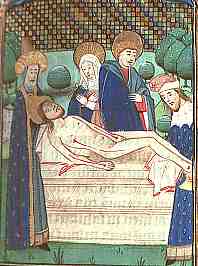
| A miniature of the entombment of Christ, with the Virgin standing at the back, precedes the text for compline in the Hours of the Virgin in a 15th century book of hours (National Library of Australia MS 1097/9, f. 50r), by permission of the National Library of Australia. | |||
|
The Hours of the Virgin were the centrepiece of the book of hours, but there were numerous other components which, in total, were greater in length. The volume customarily began with a calendar of the saints. | ||
| A calendar page from a book of hours (National Library of Australia MS 1097/9, f. 1r), by permission of the National Library of Australia. | |||
|
There were prayers to the Virgin, and to a number of saints, many at the choosing of the owner or patron. There were psalms, prayers for the souls of the dead and a litany. There were texts of contemplation and devotion. The texts were not absolutely fixed and could be varied to suit the owner. The saints included, for example, might reflect the popular saints in a particular region or even those of special significance to the owner. | ||
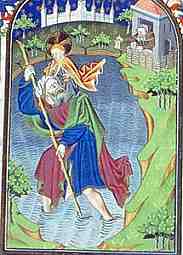
| St Christopher was one of the more popular saints, shown here in a miniature from a 15th century book of hours from northern France (Vatican Library, Cod. Vat. Lat. 14935). From a facsimile. | |||
| The images of the saints were true icons, containing some spiritual power attributable to them. Saints were a bit tricky in the medieval church, as they could not under any circumstances be regarded as deities. However they were directly accessible to the laity without the intervention of clergy and were believed capable of acting equally directly in response to prayer. The images in the book of hours were a conduit to the saints and certain images were used to invoke them in times of specific need. Faces in the miniatures may be smudged as a result of having been kissed repeatedly, and the image of St Margaret, if present, is likely to have suffered the worst. She was the patron saint of childbirth and was likely to have been clutched in sweaty hands and pressed to damp lips at such times in the private histories of many households. | |||
| The ownership of books of hours is associated with the increasing literacy of the laity in the later middle ages, but the majority of them were in Latin. One presumes that their Latin literacy comprised a very large percentage of rote learning of these often repeated texts. It is possible to understand the significance of such texts without being able to transfer the knowledge of the language to other texts or to be fully literate in the language. Some books of hours were produced in the vernacular. In English these were known as the prymer, a term used later for the first reading books used in school. The book of hours, present in so many households, was often the basic text used for learning the written word. | |||
|
|||
| Segment from a Prymer, or English language book of hours, from the early 15th century (British Library, add. ms. 36683, f.23b). (From New Palaeographical Society 1906) | |||
| The book of hours may have been the most beautiful and prestigious object that some households owned. Even the shopwork variety, produced not to an exclusive contract with the buyer but turned out in batches for a generic market, was carefully lettered, coloured and gilded and filled with images, sometimes more lavish and colourful than elegant. It was an aid to private devotion which gave a direct link for matters of the soul to the highest spiritual authorities. A famous miniature in the Hours of Mary of Burgundy (Vienna, Österreichische National Bibliothek, Cod. 1857, f.14v) is sometimes described as the owner sitting in some kind of private box in a church. (You know the one - she has a tall pointy hat.) I prefer to think she is sitting in her own home, having conjured up the church and the vision of the Virgin through the medium of the book she is reading, which is the book that contains the miniature ...... a sort of visual spiritual riddle. It was also an introduction to a culture here on earth, the ever developing world of written words. | |||
| A reproduction of this miniature can be found on the Univerity of Notre Dame's Medieval Manuscripts in Facsimile website. I knew I would find one if I looked long enough! | |||
|
previous page |
|||
|
Categories
of Works |
|||
|
If you are looking at this page without frames, there is more information about medieval writing to be found by going to the home page (framed) or the site map (no frames). |
|||
|
|
|
|