
Petition to Henry VI of 1441. (London, Public Record Office, E28/G8/18). All images by permission of the Public Record Office.
| overview | recto text | verso text | recto alphabet | verso alphabet |
| recto abbreviations | verso abbreviations | exercises |
| recto transcript | recto translation | verso transcript | verso translation |
Click on each of the above to walk your way through the text. The transcripts will appear in a separate window so that you can use them for reference at any time. These exercises are designed to guide you through the text, not test you, so you can cheat as much as you like.
This site is created and maintained by Dr Dianne Tillotson, freelance researcher and compulsive multimedia and web author. Comments are welcome Material on this web site is copyright, but some parts more so than others. Please check here for copyright status and usage before you start making free with it.
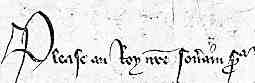 OK, let's just start at the top and work through. To whom is the petition
addressed? Expand abbreviations. Enter your answer in the box below then check
it against that given.
 What characteristics of the king are they appealing to?
 What are they asking him to do?
 Who are the petitioners?
 Where is the abbey?
 What exactly do they want?
 Where is the substance of their petition explained?
 What are they trying to avoid?
 And who do they invoke at the end?
And that's it. If you are still a bit bamboozled by it, just work through the text page with the transcript window open. The same can be done with the endorsement on the verso, which is much more difficult to read unless you are familiar with the standard formulae used in these situations.
