|
This
site is hosted and supported by the School
of Journalism and Mass Communication, College of Liberal Arts,
University of Minnesota.
|
|
Copyright © 1996, The Media History Project,
Inc. |



Promoting the study of media history
from petroglyphs to pixels

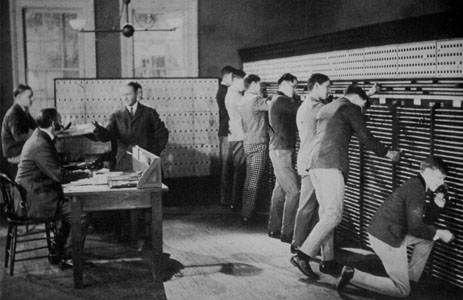
The first telephone operators, in a carryover from the the telegraph system, were teenage boys. However, after complaints of rowdiness crackled over the lines, New Englnd Bell and the New York Telephone Company managers got the idea of employing young ladies.
There was still some questions about whether it was decent for a young woman to take employment outside the home, because it jeopardized her chances for marriage, but the chance to escape the family each day and to earn money of her own to spend as she pleased was a much greater lure, even though the pay packet was light and the early headsets weighed more than six pounds.
A wake-up service for customers requesting it was among the duties of the hello girls, whose indeterminate social status approximated that of domestic servants.
(A History of Mass Communication: Six Information Revolutions by Irving Fang)
To be an operator, a woman had to be unmarried, between the ages of seventeen and twenty-six. She had to look prim and proper, and have arms long enough to reach the top of the tall telephone switchboard. Much like many other American businesses at the turn of the century, telephone companies unfairly discriminated against people from certain ethnic groups and races. African American and Jewish women were not allowed to become operators.
Because women were generally discriminated against, operators' wages
were low. And operators seldom got the respect they deserved. The typical
operator earned about $7 per week -- a small salary even in 1900. She
worked ten or eleven hours a day, six days a week. If
necessary, she also worked nights and holidays. An operator who got married
was forced to leave her job. To many early telephone users -- most of
whom were wealthy -- the telephone operator was just another household
servant.

(The American Experience online: http://www.pbs.org/wgbh/amex/kids/tech1900/phone02.html)