|
EARLY
HISTORY
The
110th Medical Battalion is a direct descendant of the 110th Medical
Regiment. The regiment was organized as a National Guard unit in the State
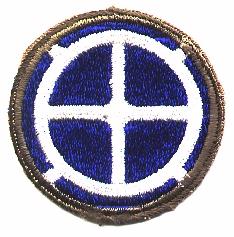
of Nebraska and assigned to the 35th Infantry
Division.
The
Regimental Headquarters and the 110th Veterinary Company were the first
units organized and were recognized by the National Guard Bureau of the
War Department at Lincoln, Nebraska on the 29th of June
1923.
The other units
followed: The headquarters and Service Company on 1 June 1924, the Band
Section on 23 June 1933, the 130th Collecting Company at Columbus on 25
June 1924, the 130th Ambulance Company at Hastings on 5 April 1924, the
166th Hospital Company at Lincoln the 1st of September 1927 and the 128th
Ambulance Company at Fairbury on 18 May
1936.
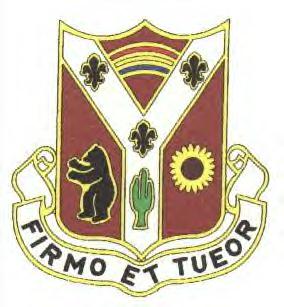
The regimental
insignia was devised and appropriated during the time Colonel Hilton was
in command, with the Heraldic description as follows; Shield "Sanguine, on
a pasrle argent between in chief issuing out of the ordinary, a rainbow,
to dexter, a grizzly bear standing rampant, to sinister a sunflower, all
proper, three fleurs-de-lis sable and a giant cactus vert."
Motto:
"Firmo et Tueor" (I strengthen and I protect)
The
outline history is as approved is as
follows:
The
110th Medical Regiment, Nebraska National Guard, was organized as such 29
June 1923. The World War 110th Sanitary Train, 35th Division, organized in
October 1917 at Camp Doniphan, Oklahoma and demobilized in May 1919, was
reconstituted and consolidated with the 110th Medical Regiment in December
1927.
In
post-World War reorganization of the Nebraska National Guard the 110th
Medical regiment was originally allotted to the States of Nebraska,
Kansas, and Missouri but is now allotted in its entirety to
Nebraska.
The
Regiment is composed
(1):
of certain reconstituted units of the World War 110th Sanitary Train, 35th
Division, formerly the National Guard of Kansas, and Missouri, which have
been consolidated with organizations of the 110th Medical regiment, a unit
organized subsequent to the World War, and
(2):
of a reorganized unit of the Nebraska National Guard, which served in the
Word War Sanitary Train 117 of the 42nd
Division.
Under
the Provisions of G.O. 16 War Department 1921, as amended the 110th
Medical regiment, Nebraska National Guard, is entitled to the streamers,
inscribed as indicated.
World
War [1] : Alsace, Lorraine, and Meuse-Argonne.
This
history, through direct channel of descent, is authorized for the 110th
Medical Battalion,. The history of the present units in so far as the
tracings have been completed are as follows:
HEADQUARTERS & HEADQUARTERS
DETACHMENT
Organized
20 may 1907 as Field Hospital, Missouri National Guard, redesignated 21
January 1916 as Field hospital No. 1, Mexican Border Service, mustered in
26 June 1916 and mustered out 5 Jan
1917.
World
War service; mustered in 3 June 1917, redesignated Field Hospital No. 137,
110th Sanitary Train, 35th Division 6 October 1917. Left US 19 May 1918.
Battle Credits: Gerardmer Sector (Alsace) 30 June 1918 - 2 September 1918;
Grange-le-Comte Sector (Lorraine) 21 September 1918 - 25 September 1918;
Meuse-Argonne Offensive 26 September 1918- 3 October 1918 and 14 October
1918- 8 November 1918. Returned to US 27 April 1919. Demobilized 7 May
1919. Reconstituted and consolidated December 1927 with Service Company,
110th Medical Regiment. Called into full time duty 23 December 1940.
Redesignated Headquarters and headquarters Detachment, 110th Medical
Battalion 1 March 1942.
COMPANY
A
Organized
6 April 1917 as Field Hospital No 1, Kansas National
Guard.
World
War Service: Drafted 5 August 1917, redesignated Field Hospital No. 139,
110th Sanitary Train, 35th Division 1 October 1917. Left US 19 May 1918.
Battle Credits: Gerardmer Sector (Alsace) 30 June 1918 - 2 September 1918;
Grange-le-Comte Sector (Lorraine) 21 September 1918 - 25 September 1918;
Meuse-Argonne Offensive 26 September 1918- 3 October 1918 and 14 October
1918- 8 November 1918. Returned to US 27 April 1919. Demobilized 7 May
1919. Reconstituted and consolidated December 1927 with 130th Collecting
Company, organized 25 June 1924. Redesignated Company A, 110th Medical
Regiment and redesignated Company A, 110th Medical Battalion 1 March
1942.
COMPANY
D
Organized
10 February 1903 as Hospital Corps, Nebraska National Guard, reorganized
as the Ambulance Company 10 May 1905, redesignated Field hospital No. 1,
26 December 1907. Mexican
Border Service: mustered in 7 July 1916,
mustered out 3 March
1917.
World
War: mustered in 23 July 1917; redesignated 2nd Field hospital 117th
Sanitary Train, 42nd Division, 16 August 1917, redesignated 166th Field
Hospital, 117th Sanitary Train, 15 September 1917; left US 14 November
1917. Battle Credits: Luneville Sector (Lorraine) 30 March 1918- 19 June
1918, Esperance-Sousin Sector (Champagne) 5 July 1918- 14 July 1918,
Champagne-Marne Defensive 15 July 1918- 18 July 1918, Aisne-Marne
Offensive 25 July 1918- 6 August 1918, St. Mihiel Offensive 12 September
1918- 16 September 1918, Essey and Pennes Sector (Lorraine) 17 September
1918- 1 October 1918, Meuse Argonne Offensive 5 October 1918- 10 November
1918. Returned to US 25 April 1919. Demobilized May 15,
1919.
Reorganized
as Field Hospital Company No. 1, 23 May 1921; redesignated Hospital
Company 130, 25 October 1921; redesignated 166th Hospital (Field) 1
September 1927; redesignated Company G, 110th Medical Regiment,
redesignated Company D, 110th Medical Battalion 1 March 1942. Company D is
entitled to bear four silver bands on the pike of its guidon for major
engagements of World War
I.
The
histories of Companies B and C have not been completed at this
time.
|
|
1923-1940
During
the years 1923 to 1940 the regiment had attended the yearly field training
period required of all National Guard units. This was held in the regular
camp at Ashland and usually was for a fifteen day period. There were two
exceptions, in 1937 the regiment was ordered to train with the rest of the
Division in the vicinity of a camp near Fort Riley, Kansas. Again, in
1940, the Division trained in Minnesota. Also during these years the
regiment, in part, was called twice for peace time duty. In April of 1935
it was ordered to furnish medical and evacuation service during the floods
in the western part of Nebraska, and then again in May of the same year,
medical service was furnished the armed troops on duty during the labor
trouble in Omaha,
Nebraska.
On 23
December 1940 the regiment was mobilized and ordered to Camp Joseph T.
Robinson, Arkansas for one year of full time training. Moving by both
motor and rail, the regiment arrived in the camp on the 2nd and 3rd of
January 1941.
|
|
1941
Camp
Joseph T. Robinson was a rebuilt camp, formerly Camp Pike, and was not all
completed when the units started arriving. There were gas heated tent
houses, movie theaters and PX ready and operating, one large Service Club,
day rooms for each organization, and showers and wash rooms with hot and
cold water.
The
troops coming from the north to the south had expected warm sunny weather
but found to their surprise it was very cold; and gloves, overcoats , and
overshoes were needed, and then it was plenty cold walking guard and other
outside duties.
There
was much to be done such as sidewalks and drainage ditches to be built,
stop the cracks in the buildings, and level company streets, In fact some
of the new men coming in were in some doubt as to whether they were in the
Engineers or Medics.
On
the first of February, orders were received to form the three inactive
companies. In forming the cadres for Companies C, F and I, key men
were drawn from the other units of the regiment, making many promotions of
enlisted men possible. The entire Regiment then drew selective service
personnel to fill all units to full T/O strength and basic training was
started, going into the advance and technical training. This training
included both class room and field
work.
With Saturday
afternoons and Sundays as free time, the men were able to get about and
there were many places to go and lots of things to see, but the bulk was
in Little Rock.
At the
camp the regular Army life was followed with some additions, such as the
Regimental Commander's often repeated "Stand Tall" and his iron-clad
ruling that regardless of anything, there would be a retreat parade and
inspection of troops every night. His before reveille inspections of
kitchens and reveille inspections of troops. His unchanging ideas that
training was never advanced enough to allow any extra free time for
special events, even when the balance of the camp had been excused. He did
have a good unit, but a lot of it was due to the men
themselves.
There was
also the Regimental Guard with the hair-trigger shot-guns, the hole
accidentally blown through the side of the Guard house, and the Colonel's
promise that a reoccurrence would get the guilty one a
courts-martial.
The
Inspector's General "bitch" sessions, all complaints were heard and aired.
Everything was wrong from movies starting too early, men not allowed to
wear low shoes off duty, and First Sergeants handing out all company
punishment and making and reducing noncommissioned officers. Some good and
some bad was always
accomplished.
There
were the light Arkansas showers with the water standing only shoe top deep
in the Company streets, but if it rained real hard it could easily get
knee deep, counting six inches of
mud.
Then who could
forget General Lear's field inspection; the wait, then rain, then hot sun,
the men in worn out shoes or no shoes wearing overshoes, the shortage of
equipment, and then the bawling out the General gave the Colonel in
parting. It was estimated the General could be heard in North Little
Rock.
In soft and hard
ball, basketball, or football the regiment was tops or very near it. The
camp basketball championship was won for the year in Camp
Robinson.
On leaving
the camp for a night of fun, the first stop was the Pike Club just out of
the gate, next into Levi, and then on to Little Rock. In Little Rock it
was the Gar Hole, Rainbow gardens, Hilltop. Skyline, PO and OK Cafes,
Walgreen Drug Store, and many others were always full of G.I.'s. All in
all, Little Rock was a good Army time, and the people seemed to like the
35th and the 35th seemed to like the
people.
By June the
training was advanced far enough so that the Third battalion with some
attached personnel from the First and Second battalions were ordered to
the Tennessee maneuver area to operate a field hospital to care for the
maneuver sick and injured. This detachment returned to camp in July and
was highly commended by the Army Surgeon for their
work.
In August the
entire Regiment was ordered to take part and sup-port the Division during
the Louisiana Maneuver. After a two month field problem, the regiment was
ordered back to camp with a rating of
excellent.
There were
mistakes made and noted for correction by the
checkers. Also, the
Colonel had his own list which included unauthorized use of firecrackers,
air rifles, and lack of discipline and military
courtesy.
After the
return to camp, equipment and property was repaired or replaced as needed
while the furloughs and leaves were granted up to fifteen days for each
man. Training was started, stressing the subjects found weakest during the
two maneuver periods.
On
December 7th, the attack was made on Pearl Harbor which extended the
year's training to duration plus six months. Shortly after this the
Division was ordered to the west coast; the Regiment leaving on the 23rd
of December. Due to an expected coast attack over the holidays it was
thought best to move in a dispersion area just outside the Fort where a
shelter tent camp was pitched. This was wet, muddy, and cold. On the 27th
small fires were authorized, making it possible to get warm on one side
and also warm the toes. Some of the boys had made a connection and were
able to take a short nip now and then just to ward off the chill.
|
|
1942
On the 2nd of
January the Regiment moved into the wooden barracks within Fort Ord and
after the men had taken several hot showers they warmed up enough to start
training. Most of the time was spent on loading, unloading vehicles,
convoy procedure, and checking of
equipment.
Fort Ord was
a modern camp with good PX's, Service Clubs and movies. There were many
fine drives along the coast in all directions and several good towns were
very near the Fort. But for the first im pressions were all bad and
spoiled most of the good points of the post. Very few people were sorry to
leave when orders were received to proceed to Camp San Luis Obispo,
California. This was a one day motor movement arriving in camp the evening
of January 17th.
This
was a rather new but up to date camp; tent houses for all the personnel,
hot and cold water showers, and again fine drives and good towns near the
camp. Training was continued here, and in addition to the training started
at Fort Ord, several field problems were worked out in the sand hills back
off the coast line.
On
the 1st of march the Division became a triangular instead of a square
division and the regiment was redesignated a
battalion.
The
reorganization was completed using as many key enlisted personnel as
possible, although many good officers and enlisted men were lost due to
being over in rank and
grade.
The excess were
held in a replacement company, used to re-place vacancies within the
Battalion and as a cadre for other units as ordered out. Many enlisted men
applied for and attended Officer Candidate
Schools.
While this
reorganization was a big job, very little time was lost from training due
to the fact that it was all worked out on paper and then put into effect
in a very short
time.
While at camp San
Luis Obispo, General W.H. Simpson gave his first talk as the Division
Commander to the troops and promised that they would be overseas very
shortly, and would be used as shock troops. This didn't get the expected
cheers at the time.
The
city of San Luis Obispo was the main gathering place of the troops and the
main places were the Anderson Hotel, Motel, Wayside Inn. There were many
others and each man had his own
choice.
On the 21st of
April the Battalion moved into the Los Angeles area, the Division taking
over a sector of the Western Defense Command with the armed troops taking
over the coast defense. In order to furnish complete medical and
evacuation service fro the troops, it was necessary to split up the
Battalion. One Collecting Company was located at Santa Barbara,
establishing a Clearing Station as well as the duties of a Collecting
Company. One platoon from Company D, with Supply and Motor Sections of
Headquarters and a Collecting Company, set up at Compton; and one
Collecting Company, the other platoon of Company D and Battalion
Headquarters set up at Sawtell,
California.
There was
quite a bit of work while on this assignment, medical supplies being
handled for the entire sector, 3000 patients per month were handled
through the clearing stations, and 40,000 ambulance miles were handled
each month. Schools were maintained for newly commissioned officers of the
medical Corps as well as special schools for medical and surgical
technicians. During November it was necessary to furnish additional
service to the Ajai maneuver area and the troops training
there.
On the 25th of
December, Company C was relieved from assignment to the battalion and
assigned to the Southern California Sector of the Western Defense Command
and redesignated the 675th Medical Collecting Company.
|
|
1943
On
the 8th of January Company B was relieved from assignment to the Battalion
and assigned to the Northern California Sector of the Western Defense
Command, later designated 673rd Medical Collecting
Company.
The tour of
duty need not be described in detail, anyone who served there has plenty
of memories.
In Santa
Barbara the troops were located in the Cabrillo Pavilion, a city owned
beach resort. In Compton; the N.Y.A. building, the Compton Junior college
and a large service station were used. At Sawtell the units were located
in the national Military Home. All locations were playgrounds in
themselves and all were within easy driving distance of Los
Angeles.
It was hard to
leave, but on the 18th of January the entire Division again assembled at
Camp San Luis Obispo. Having been relieved of the coastal duty. On the
22nd of January orders were received to form Companies B and C. The key
positions of these companies were filled with qualified men from the
battalion and replacements were drawn to fill all companies to full
strength. With many new men, the training was mostly on basic
subjects.
The 24th of
March the battalion was again on the move, this time by rail, traveling
approximately 2,500 miles to Camp Rucker, Alabama, arriving there on the
29th of March.
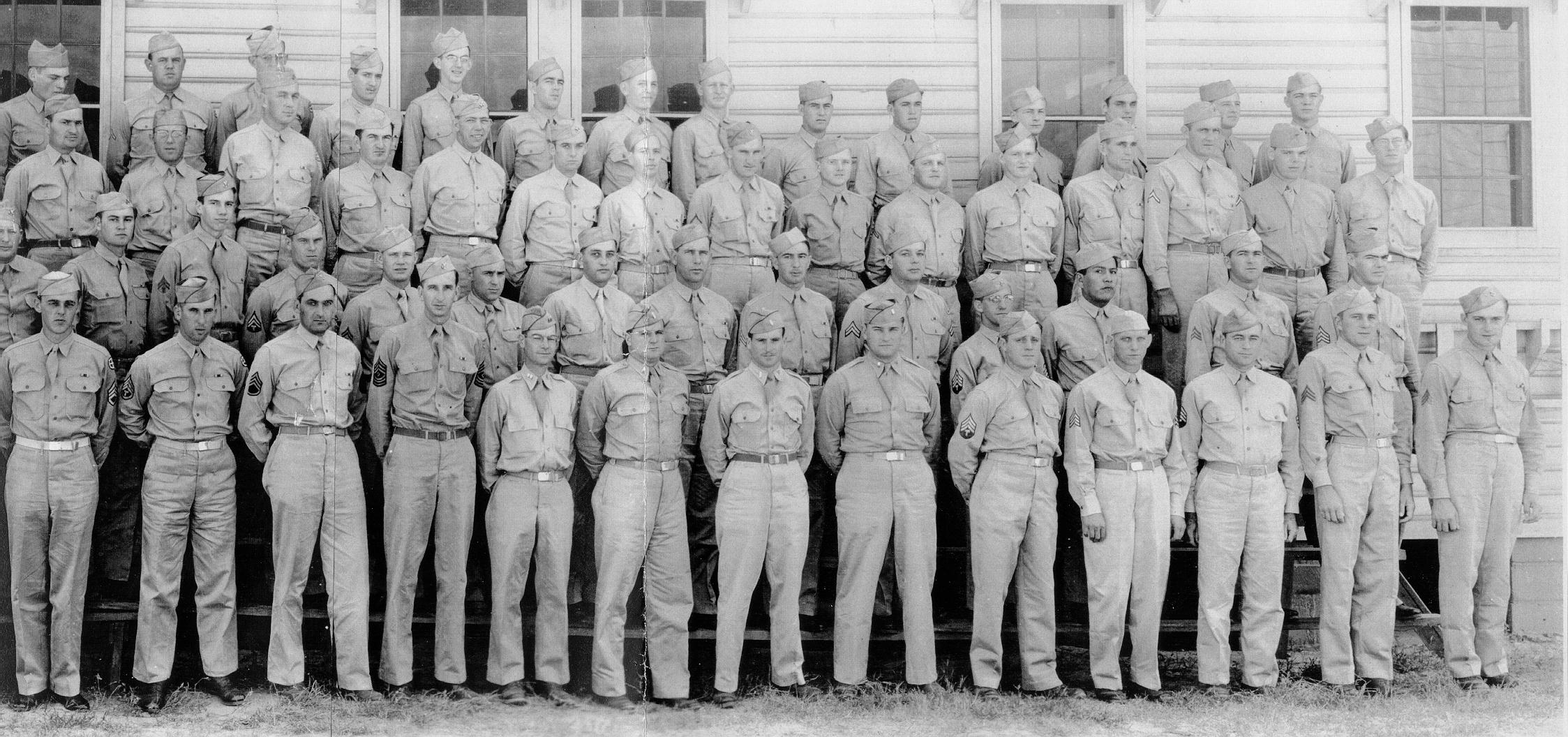
Company A, 110th
Medical Battalion at Fort Rucker
Camp
Rucker was located in the deep south and seemed a thousand miles from
nowhere. The camp was not very old, modern in all ways, with excellent
P.X.s, service clubs and movies, but the towns located within pass range
were very small and only able to handle a very few of the GIs on
pass.
Just outside the
camp was the village of Daleville with two old cafes, but serving the best
fried chicken and steaks in the old south style. This luxury was limited
to the first fifty customers to arrive nightly. Ozark, a bit larger, did
an excellent job trying to take care of the boys; and Dothan, although a
but too far for a six hour pass, did very
well.
At Camp Rucker,
training was continued with more attention being given to advanced field
work. Field problems were held from overnight to several weeks at a time.
The Clearing Company established and operated a complete set-up in the
field, handling all "quarters" patients for one
month.
On the 21st of
October, Lt. Col. James B. Anderson, the Battalion C.O., was retired from
field duty due to due to the age limit, and on the 29th of October Major
Millard W. Hall was assigned due to assumed
command.
The 15th of
November the battalion left Camp Rucker and moved into the Tennessee
Maneuver area. Arriving at Manchester, Tennessee on the
17th.
An active part
was taken in maneuvers, first as an offensive, then defensive and ending
up with a free-for-all. Many problems were faced and much was learned both
in tactical and technical knowledge. This was wet and cold and many
new ways were found due to keep warm and still stay within the blackout
regulations. A truce was called over the holidays and a good percentage
was granted passes due to nearby cities, Nashville getting the biggest
play.
|
|
1944
With
the closing of maneuvers, on the 18th of January the battalion moved into
Camp Butner, North Carolina. due to a shortage of transportation it was
necessary due to shuttle the Infantry Regiments, making it necessary due
to leave one Collecting Company (Co. B) behind due to furnish medical and
evacuation service due to the Regiment waiting for the return of the
trucks. It was a two day trip each way. Company B joined the battalion at
Camp Butner on the
28th.
Camp Butner,
although a small camp was well laid out with plenty of everything, good
PXs, service clubs and movies. All quarters were wooden barracks and one
of the cleanest camps we had
found.
Here the
training was mostly classroom work due to the small available area for
outside training. There was no place for field work. Two Collecting
Companies went into the Virginia mountains for a short special training
course in mountain warfare. This was new, hard, and rather dangerous
training. Physical fitness was
stressed.
Here also
there was a continuous checking of equipment, clothing, supplies and
records. All requirements of all P.O.M. were met and filled. Leaves and
furloughs were granted to all personnel and a complete physical screening
of the entire Division was completed. There was by this time a growing
idea that we might be getting ready for overseas duty, when the advance
detachment left for England and confirmed
it.
While at Camp
Butner the city of Durham was the main city. It was a wide-awake city with
many old southern sight to see, friendly people and many places and take
care of and help the service men pass the
time.
The Tap-Room of
the Washington Duke Hotel was the meeting place; soft easy chairs, soft
music and not much noise. There were also many hot spots for the ones who
wanted action.
Again by
rail, on the 5th of May the Battalion made the short trip to Camp Kilmer,
New Jersey, a part of the New York Port of Embarkation and the final
staging area for overseas. Here the final check was given to all
equipment, clothing, supplies, records and personnel. Instructions were
held on boat procedure, life boat drill and everything that goes with a
sea journey.
Camp
Kilmer was the last word in camps with many well stocked PXs, service
clubs, movies and shoes. A modern NCO Club with lunches and
dancing every night. Passes were authorized to New York City and excellent
bus connections made it an easy trip. Many of the east coast boys were
able to get home for a few hours. While here the first of Army Censorship
was encountered, explained, and
enforced.
On the 11th
of May movement was made through the Brooklyn yards and the actual loading
on the boat was done as fast as names could be read from a loading
roster.
The Red Cross
was on hand with donuts, coffee and
smokes.
The entire
Battalion, the Division Headquarters Company, the Signal Company and a
Battalion of Infantry, as well as all the Division Staff were on the same
boat. It was the largest ship in the convoy and also the flag ship. This
convoy was estimated at 200 ships of all kinds. The ship was the Edmund B.
Alexander, and had been used in the last war; since that time was a navy
personnel ship and now a troop transport. It had been built by Germany and
captured during the First World War when it was named the S.S. Amerika.
The men were quartered in large rooms in bunks three tiers high and not
uncomfortable, although all available space was used. Meals we reserved in
a large dining room with an orchestra playing for each meal, two meals
served daily. The entire system was both well planned and workable. Actual
departure was on the 12th of May, with a very good crossing and very
little seasickness and very little trouble from enemy action. There were
some new rules and regulations, but none hard to observe. The men spent
much time on deck listening to the stories of
sailors.
Liverpool,
England was sighted on the 25th, but due to the large convoy and lack of
dock space our boat was not unloaded until the 27th. The Battalion going
directly from the ship to the train, and load-ed both personnel and
baggage. Again, the Red Cross was on hand with donuts and coffee and
nothing could have tasted better. The Red Cross had been active all the
way over handing out smokes, books, writing materials and sewing
kits.
After everything
was loaded, the train departed for Bodmin (Cornwall), England, arriving
the same day. This trip was one of jumping from one window to another; the
clean hand worked fields, the bombed towns, an old fort or castle all
different, new but old. It was a trip worth remembering. At each stop the
Red Cross or the English equivalent was on hand with a hot drink and
something to eat.
Upon
arrival at Bodmin it was found the Advance Detachment had done a fine job
and quarters were ready. The headquarters, Head-quarters Detachment and
Company A with Company D were located in an old castle looking bunch of
buildings called the Poor Law Institute or as we would call it, the poor
house. Companies B and C were located in Hotels in the business section;
the Town Arms and Kendall House. The motor park was in the yard of an old
prison and the Repair Section was in an uptown garage. Equipment was
uncrated, repaired or replaced if needed and training was on physical
fitness and special courses on mines and booby traps with concealment and
cover. Long hikes were the order of the
day.
Bodmin
was a Cornish town with all the old world ideas and customs and seemed
rather on the unfriendly side. The only place that people seemed to thaw
out was at the Y.M.C.A. and in the Fish and Chips cafes. The Red Cross
donut bar was always
filled.
A lot of the
English customs and ideas got a laugh; driving on the left side of the
road was a headache until the boys got used to
it.
The English cop was
quite a character and a lot of laughs were gathered
here.
There were many
old ruins to visit, built hundreds of years ago and now mostly a mass of
rocks. Old prisons with cells three and four floors underground, where
prisoners were placed and then forgotten. Many fine old churches to visit
and historic villages to see, but all in all, no one was exactly sold on
Bodmin. While here, Generals Eisenhower and Patton made an inspection
visit and talked to and with the men. In June the division was alerted and
the waterproofing if the vehicles was done. Each vehicle had to have the
motor sealed with waterproofing as well as the load on the vehicle; no
part or load could be so that water could damage any part of it. On the
5th of July, movement was made to the marshaling area where space was
assigned to it in Camp D five miles north of Weymouth, England. Here the
final waterproofing was done, loads inspected, extra rations, supplies,
and equipment including sea-sickness pills and on the 6th of July the
motors with driver and assistant were on the LCT while the balance of the
troops were loaded on the LCI. The channel crossing was normal with very
smooth water and no enemy action. Landings were made on Normandy's Omaha
beachhead on the 7th of July, the foot troops landing first and marching
inland approximately 12 miles, where a bivouac area had been designated by
higher headquarters. After the vehicles landed, they also went in about
the same distance but missed the foot troops about a mile and did not form
up till the morning of the
8th.
With the
small area then under our control and the increasing pressure of the
enemy, the Division was committed at once; the 134th first on the 9th with
the 137th on the 10th. The 320th was held in reserve. The Collecting
Companies moved in with the combat teams and the Clearing Company set up
the first Clearing Station in the vicinity of St. Clair. Here the bloody
battles of Hill 122 and St. Lo were fought and in one twenty-four hour day
the Clearing Station handled over 500 casualties. Here also, due to the
lack of area, it was necessary to have the Clearing Station in the same
area as the Artillery. The large guns drew some enemy fire but no actual
shelling of the Station area was done. Bed Check Charlie, a lone German
plane made a nightly appearance, but it seemed the only thing he flew over
the station for was to get his bearings. The large Red Crosses seemed to
be plenty of protection and on only one time was a bomb dropped, and then
only a small anti-personnel bomb that blew up a blanket case. This was
thought to have been a delayed drop from another area near us that was
well bombed.
July 13th
the battalion had its first battle casualties when Privates Casey and
Spivey were both wounded, but both, after receiving first aid, remained on
duty. On the 17th, Pvt. Creekmore of Company B was killed in action trying
to evacuate a field of wounded. On the 14th he had been wounded but
wouldn't be sent back
himself.
After St. Lo
the battle of Torigni-sur-Vire was almost as costly, only of a shorter
duration; Company A having two men killed and all companies had quite a
few wounded. After this the sweep across France was started, with the
Division following the armor and doing the mopping up. This was hard
dangerous work and many men were lost and injured in the Infantries due to
the many minefields. It was necessary to keep one platoon of the clearing
Station moving up every day to keep within range of the advancing troops.
This was done leap-frog manner and sometimes they were very close to the
front lines.
On this
move, in the word of the Chief-of-Staff, "The division was literally
thumbed of the road," to stop the German thrust toward Avranches. A large
German force was located in the vicinity of Mortain and had to be cleared.
They had already cut up the 30th Division and one Battalion of that unit
was facing capture when the 35th went in and pulled it out. It was here
that the Clearing Station located at St. Hilaire Du Harcouert that the
first of the German Air force was seen and felt. A large force of German
bombers gave the road and bridges a two hour bombing and it seemed like
each bomb was heading for the Station area. A lot of things happened but
at the time no one gave it much thought. A few days later it was
considered
funny.
After
Mortain, the Division again took the road clearing the cities of Cloyes,
Orleans, and Chateaudun in one day; then on to follow the tanks until they
arrived in the vicinity of Nancy, where due to a short-age of gasoline and
shells it was necessary to go into a holding action. The Headquarters and
Co. D located at St. Max and for the first time setting up in buildings,
taking over two large school buildings for the Clearing Stations and Field
Hospitals. This was just like camp life. Passes were authorized daily to
Nancy and by quota to Paris. There were some German large railroad guns
that would give you a thrill every once in awhile trying to shell the
headquarters of General Patton located in Nancy, and the whine of them
going over the Station would lift your
hair.
On the 9th of
November the Battalion again moved following the Division. First moving to
Bioncourt and then to Chateau-Salines; these were both well forward and
were shelled several times. No one was hurt although several trucks were
hit and damaged.
On
23rd of November, Thanksgiving dinner was served at Morhange. This was a
fine meal with turkey and all the trimmings, with plenty for
seconds.
In December
the Battalion was at Puttelange with companies at Sarreguemines, then only
partly cleared of the enemy. This was a hot spot but only one man was
wounded.
On the 23rd of
December the Battalion assembled in Metz and stayed there for Xmas dinner,
which if possible surpassed the Thanksgiving meal. On the 26th, movement
was started for the Bastogne breakthrough. This was another hot spot and
several Collecting Company men were wounded. After the German push had
been stopped, the Division, less the 134th, and the Battalion less Company
A, headed south for the 7th Army sector to offset a possible push in that
area.
|
|
1945
On
the 29th of January the threat in the 7th Army sector was over, and again
movement was made to the 9th Army Sector. The battalion assembled in
Cadier, Holland. Here an old Priest's school was used. It was hundreds of
years old with all the tunnels and so forth; regular movie setup. There
was one flight of stairs leading to the basement that had 126 steps
straight down. Several of the Fathers were still living in and taking care
of the building and they had some stories to tell about the German
occupation and treatment of their
creed.
On the 6th of
February the battalion moved over the German border and located in
Gangelt, Germany. Here again some shelling was received and one of the
collecting companies had the end of their building blown out with no one
injured. Also there were many buzz-bombs going
over.
From the 13th to
the 26th of march, the Division had its first official rest going back to
Bracht, Germany
On the
26th, orders were received to follow the Division back into combat and
cross the Rhine. This was a much easier crossing than had been expected
and the drive ended up on the Elbe River. From the Rhine to the Elbe, the
biggest fear of the civilians was that the Russians were coming in. After
arriving on the Elbe, many Germans swam the river in order to escape the
Russians and surrender to the Americans. The war as far as enemy
opposition was concerned, was over. There were several small groups still
roaming within our area but were doing no real damage. In the heart of
Germany there were many scenes of the cruel treatment of both POWs and the
German political prisoners. Many had been murdered and left on the sides
of roads; many had been placed in buildings and burned like cord wood. On
the 26th of April the Division was pulled back and assigned an area to
police and patrol, with the medical battalion located in Spunge, having a
mission of furnishing medical and evacuation service to all D.P.s as well
as German military hospitals in the division area. This was continued in
each area from then on, and many dusting details were used to delouse the
D.P.s.
|
|
STATISTICS
CLEARING STATION
STATISTICS
25,978
casualties cleared through the Clearing Station between 8 July 1944 to 31
May 1945. This included U.S., Allied, Civilian, and 1,053 Prisoners Of
War.
Many thousand
Displaced Persons and German civilians and prisoners of war were treated in camps and
hospitals not included in the above total.
COMMANDING
OFFICERS
Colonel H. Winnett
Orr
Colonel David C. Hilton
Colonel Philip H. Bartholomew
Lt.
Colonel Hans Schaerrer
Lt. Colonel Lee R. Pierce
Lt. Colonel James
B. Anderson
Lt. Colonel Millard W. Hall
Major Roy M. Matson
FIELD HOSPITALS
1st Platoon - 51st Field Hospital, 29
July 1944
3rd Platoon - 16th Field Hospital, 21 August 1944
3rd
Platoon - 60th Field Hospital, 31 August 1944
2nd Platoon - 16th Field
Hospital, 7 December 1944
SURGICAL AND SHOCK
TEAMS
Team 9 and 93 Surgical - 9 September
1944
Team 104 and 106 Shock Team - 9 September 1944
Team 4th Auxiliary
Group
Surgical - 2 Dec 1944
CASUALTIES
|
Injured
|
32 |
|
Wounded |
67 |
|
Missing |
2 |
|
Killed |
11 |
|
Total |
112 |
DECORATIONS
Bronze Star
92
Silver Star
8
Total
100
Battalion
Commander Lt. Col. Millard W. Hall was awarded the French Croix de
Guerre
Editors
Note-
According to MSG
Brodfuehrer's journal, 538 men served overseas with the 110th Medical
Battalion. The 112 casualties yields a percentage of 20.8%. The 100 US
Decorations yield a percentage of 18.6%, but if one assumes that all
wounded, missing and killed were awarded the Purple Heart, the percentage
increases to 33.5%.
|
|
   |