This page was built with considerable help
from present day friends in Bodmin, England. A BIG Thank You to the good
gentlemen of the Bodmin Camera Club, John Copley and Scott Talling;
Peter Marlow and
Bob Mann of the Bodmin Folk Club, who helped make this page possible;
and Peter Higginbotham, who maintains a web page about the Poor Law
Institute in Bodmin.-
PMC 1/16/02 |
|
Bodmin
Camera Club |
Bodmin
Folk Club |
The
English Workhouse |
After crossing the Atlantic on
the SS Edmund B. Alexander,
the 110th Medical Battalion landed in Liverpool, England. The unit traveled by
train through Wales, to the town of Bodmin, the County Town of Cornwall, in the
extreme south-west corner of England. Companies A & D were billeted at the Poor
Law Institute, which was the County Poor House. Companies B & C were
billeted at the Kendall Building, which was part of the County
Lunatic Asylum, as it was called in those days. Click here for a map
of Bodmin, showing the locations of where the men were billeted.
Henry
Desmarais-
"Our quarters were an old building, an
abandoned poor house. We slept on straw mattresses with a 2" x 4" frame and a 1"
wide steel strap in both directions forming the mattress support."
Robert Roden-
"I didn't even know
where I was and guess I never really cared as I found the English a very stiff
necked group of people (Which I am ½ English, Ha!)."
Leon Cohen-
"We were in a County
Poor House in Bodmin England. It was on an incline above the road. On the other
side of the road was a brick wall. Somebody, I don't know who it was, made an
arrangement for us to go bike riding with a couple of girls. So the bicycles
were brought in for us, they drove the bicycles onto the camp grounds where we
were bivouacked. We got ready to leave the station. The bikes I had ridden at
home ,the brakes were in the pedals, not so the English bikes! Here I'm coming
down, and it's not a smooth paved road, 'What the hell is going on, I can't stop
this thing', and Whammo! Right into the wall! So I got up, went back up to the
aid station and got patched up a little bit, and went bike riding! That wasn't
going to stop me."
|
|
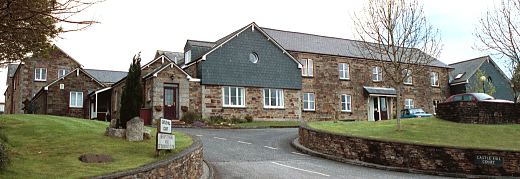
Front building of Poor Law
Institute in Bodmin, 1990s.
Note sloping driveway where Leon Cohen took his infamous ride!
Photo
by P. Higgenbotham 2001 |
Warren West-
"Each evening after chow we would walk down the hill into Bodmin. It was
here we first found Fish and Chips. We would order it and watch the man make his
own chips, frying them in grease."
"The fish were also deep fat fried. The were
served in funnels rolled from newspaper which absorbed the grease. They were
absolutely fresh and HOT."
"From there we would go to the cinema and queue up for the movie. The money
was so foreign to us for the first few days that we would just pull out a and
full of change and let the girl take what she needed. A few of the seats inside
were double seats having no armrests do that couples could sit together, We
thought that was a good idea for the theaters in the United States to
incorporate, but since we didn't date we never used them."
"Bodmin was a quaint town with many narrow streets which dated from the
middle ages I suppose and just wide enough for one English car to drive through.
The streets were cobblestone and never went in north-south directions, They
seemed to follow shortcuts from here to there which were established hundreds of
years ago and gradually became streets."
"The English pubs (Public Houses) had such picturesque names: one was
George and Dragon. Another was Cat and Fiddle, not the Cat and the
Fiddle."
 |
|
George and Dragon Pub |
Bert Pratt-
"When we were in Bodmin, England, I
asked a Bobbie [Local police officer- PMC] for a certain direction. His reply
"Go twice as far as you can see, and deny yourself one left turn and there you
are."
"The hedgerows in England made driving very
dangerous since you never knew who might come around the corner. In England they
had removed all the road signs- in case the country was invaded, the enemy would
have few clues.
"Once we arrived in Bodmin, before
crossing the channel, I was directed to serve as a reporter (since I could type)
and send public relations stories to Communications Zone (Com Z) in Paris about
the 110th. They would send the stories to hometown papers back in the States to
bolster their spirit."
"I interviewed nurses,
doctors, ambulance drivers, etc. I was permitted to go any place where the 110th
served. They even changed my rank from Corporal to Tech/Sgt. Not bad! I was
always assigned to Company A."
Warren West:
"In Bodmin we fad replaced the 29th Infantry Division who was to
participate in the invasion of Normandy on D-Day. They left us a beautiful part
of the country to train in. On some afternoons our company would take a fifteen
mile road march just to give us something to do and keep us out of mischief. We
walked down the beautiful country roads with hedgerows on each side. In the
fields were piles and piles of artillery ammunition.... fields just crammed
full. Other fields had trucks of all descriptions parked bumper to bumper, just
waiting for the invasion. We used to tell each other that if another ton of
supplies were stored in the fields, England would sink in the ocean. Maybe that
is one reason barrage balloons were so prevalent; they were holding up the
island."
"The civilians put up with a lot while the Americans were there. We crowded
them out of their cinemas, their pubs, their fish and chips shops and I am sure
it was just a little more than a mere inconvenience for them. They used to tell
us that American G.I. was over paid, over fed, over sexed, and over here!
The English humor is great.
 |
|
Another section of the
Poor Law Institute, Bodmin England
Photo by P.
Higgenbotham 2001 |
"One morning, June 6, 1944 the Bodmin church bells began ringing using the
wonderful art of pulling the ropes to create an ever-changing sequence of the
bells. We could not understand what was happening unless it was a special church
holiday. We tuned on the BBC and found that the
invasion of Normandy had begun. The 29th Division, with many thousand of
others, had landed. In one month we would follow them across the
channel....."


.