Notes on Sailing Warships Part 3
The Construction of Wooden Ships
Introduction
We can imagine the first people to travel on water using a tree log as a
float and propelling it by kicking out with the feet. Other floats, which
are still used up to the present day, included blown up animal skins or
bundles of reeds. Alexander the Great ferried troops across rivers on
several occasions using the skins which covered his men`s tents, stuffed
with grass, and sewn tightly at the edges. The next step would be to sit
astride the log or, for more stability, tie two or more logs to make a
raft. Bundles of reeds can also be used to make rafts and these rafts, as in
ancient Egypt, can not only be used on rivers but also be made large enough
to be sea-going.
From a very early period in human development dugout canoes were made by
hollowing out the trunks of trees. If the wood is soft this can be
accomplished quite easily using fire and primitive tools made of stone or
shell. With the coming of the iron age tools became available which could
easily cut and shape wood into planks and new methods of construction
became possible. The dugout trunk was reduced to a keel, in effect a
backbone, from which ribs spread upwards and outwards and the hull of the
vessel was built up using planks fastened to the ribs. Wood placed in steam
for a period becomes flexible and this allows ribs and planks to be bent
into shape without breaking.
Methods of Construction
Wooden vessels can be either CARVEL BUILT or CLINKER BUILT. The latter
method is sometimes known as LAPSTRAKE.
In carvel built craft the ribs are set up in the right position on the
keel and the planks are bent round them and fastened edge to edge so they
lie flush with one another. Each single width of planking running the length
of the of the vessel is known as a STRAKE. The strake nearest the keel is
the GARBOARD STRAKE and the top one is the SHEER STRAKE. The sheer strake is
usually strengthend by a GUNWALE, pronounced and sometimes written as
gunnel (a WALE is any extra timber added as band outside the hull). The
ends of each strake are fastened to a STEM POST to form the pointed bow
and at the other end they can either be fastened to a STERN POST in the
same way, making bow and stern similar (a DOUBLE-ENDER), or, more usually,
they can be fastened to TRANSOMS, which are timbers running from side to
side across the stern and fixed to the stern post. This gives a TRANSOM or
SQUARE STERN. Other timbers going across the width in the bottom of the hull
are known as FLOORS.
 In clinker built craft the keel and the stem and stern posts are set up and
the planks are fitted without an internal framework. Starting with the
garboard strake each plank overlaps the one below and the two are fastened
through the overlap. When the planking is complete the ribs are fitted
inside the hull and fastened to the planking. Thus it is the complete
converse of the carvel process.
Generally speaking the early carvel built ships were used in the
Mediterranean countries while northern Europe, where the saw was not yet
known, built clinker ships which required less precision in cutting timber
but were limited in size. Later all big ships were carvel built.
In a large ship the ribs are too big to be single pieces of wood steamed and
bent and they have to be made from pieces of timber known as FUTTOCKS
(originally foothooks) which are sawn to shape and several of them
together form the curved rib or frame.
Shipbuilding
 In a shipyard the MOLD LOFT is a large building where the plans of a ship
can be drawn out full size on the floor by the master shipwright. This known
as LOFTING the lines and is the important first step. From these drawings
molds, or patterns, are made from thin wood which are used in cutting out
the futtocks and other parts of the framework.
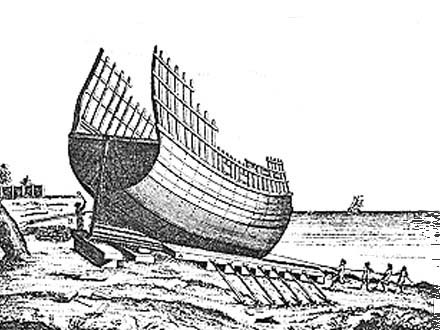
A ship is built on STOCKS on a slipway leading down to the water. Stocks are
large blocks of wood spaced some 4 or five feet apart on which the keel is
laid. and the various pieces of timber forming the stem post and the stern
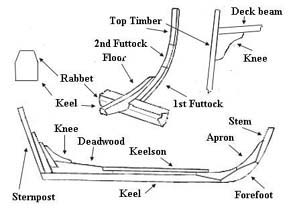
fixed in position. The names of these pieces are shown in the diagrams. The
floors are fitted in position and the KEELSON, another longitudinal timber,
is fitted over the keel inside the hull. The FIRST FUTTOCKS, the lowest,
are placed between the ends of the floors and the frames continued up to
the top of the hull, the final pieces being the TOP TIMBERS. Wherever
possible timber in which the grain follows a natural curve is used.
Wales are usually fiitted around the outside of the ribs before the planking
is started and beams, supported on knees, are fixed across the hull to
support the various decks. Vertical partitions between the decks are known
as BULKHEADS and any planking forming a skin inside the frames as a CEILING.
On small craft the planking is fastened to the frames by using copper nails
which are clenched over or riveted on the inside of the hull, drawing the
two parts tightly together. On large ships with thick timbers, parts are
joined using TREENAILS, pronounced trennels, which are round or octagonal
pieces of oak driven into undersize holes in the planking, frames and
other timbers.
After launching the masts are fitted. These go through the decks and rest
(STEPPED is the correct term) on the keelson. On a large ship the masts will
be in several sections - the lower mast, the top mast, top gallant mast
etc.
© Michael Phillips 2000
Go to Guns and Classes of Ships
Go to Parts of a Ship & Sails and Rigging
Go to Maritime History Index