Notes on Sailing Warships Part 2
A Glossary of some terms
The Hull
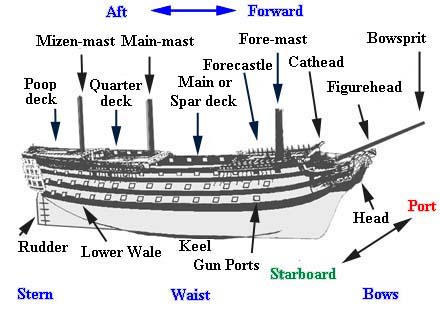
- ATHWARTSHIPS Across the ship from side to side.
- BEAM. The maximum width of a vessel. ABEAM means at right angles to the
ship`s side and ON THE PORT (or STARBOARD) BEAM means that something
(another ship, land etc.) is on that line. ABAFT THE BEAM means that is on
the stern side of that line and FORWARD OF THE BEAM that it is on the bow
side of the line. (note forward is pronounced `forrard`)
- BOW or BOWS. The front of a vessel. The sharp or rounded part that cuts
through the water. Anything which is within 45 degrees of straight ahead is
said to be on the PORT (or STARBOARD) BOW. FINE ON THE (P or S) BOW would
refer to something not quite straight ahead. BOW CHASER guns fire straight
ahead during a sea chase.
- BROADSIDE. The majority of guns in a warship were mounted on one or more
decks and faced sideways out of the ship through GUN PORTS cut in the side of
the ship. The simultaneous discharge of all the guns on one side of a ship
is referred to as a broadside, and could involve 1000 lb of iron being
fired against an opponent from very short range.
- CATHEAD. Beams projecting on either side of the forcastle near the bow
to secure the anchor after it was hoisted out of the water. An anchor thus
secured was CATTED.
- DECKS. The horizontal levels which divide a ship. The lowest level was
the ORLOP DECK . On a warship with three decks the LOWER DECK came next and
the heaviest guns were mounted here, firing through the lowest line of
gun-ports. The majority of the seamen lived on the lower deck. Above this
the MIDDLE DECK with the medium sized guns and then the MAIN or SPAR DECK
with the lightest guns. In the stern there were partial decks above the Main
deck. These were the QUARTER DECK, reserved for officers, and the POOP DECK
where the ship was steered. Three lanterns were mounted on the poop.
Another partial deck was the FORECASTLE (pronounced fo`c`sle) in the fore
part of the ship. The part of the main deck in between was the WAIST. Below
the Orlop was the hold in which the provisions required by all the crew
(more than 800 men on a 1st Rate ship) for six months or more could be
stored.
- FORE and AFT. Running from bow to stern as distinct from athwartships.
- KEEL. The lowest fore and aft timber on which the whole framework of the
ship is built. Above it is the KEELSON, a line of timbers which secure the
keel to the upper framework. This framework consists of the RIBS which rise
upward and outward to form the skeleton of the ship to which the planking is
fastened.
- PORT & STARBOARD. Looking towards the bow the left hand side of a
vessel is the PORT side and the right hand side is the STARBOARD side.
Until the name was changed in the middle of the nineteenth century to avoid
confusion, the port side was known as the LARBOARD side. The names probably
derive from `Steer-board`, a large oar on the starboard quarter which was
used to steer a vessel before the rudder arrived, and `Load-board`, the
opposite side which was against the quay for loading cargo. The color of the
navigation light on the port side is red and, on the starboard side, green.
Port is also associated with `even` and starboard with `odd`, since in a
ship`s boat known as a whaler there are two oars on the port side and three
on the starboard
- STERN. The rear end of a ship. ASTERN means behind the ship. The two
sides of the stern within 45 degrees of dead astern are referred to as the
QUARTERS. Thus another ship not directly astern could be described as on the
PORT (or STARBOARD) quarter. To GO ASTERN is to go backwards. It is used in
combinations such as STERN-CHASER, that is guns that point astern to fire at
ships chasing you.
- TONNAGE. Either the capacity or the weight of a ship. A figure for
tonnage is completely meaningless unless one knows which system of
measurement is used. The term derives from `tun`, a cask of wine, and a
ships BURTHEN or BURDEN was the number of tuns she could carry. This was
also known as BUILDER`S MEASUREMENT or bm. The figure quoted for most ships
up until the 1870`s will be bm, and can be calculated from :-
              (L - 3/5B) x B x 1/2B     where L = length in feet
       bm =  -----------------------          B = beam in feet
                     94
Warships are now measured in DISPLACEMENT TONNAGE, the weight of the water
displaced by the ship when she is fully ready for sea.
- TOP. The TOP or FIGHTING TOP. A platform at the head of the lower masts
where sharpshooters were stationed during battle to fire down on the decks
of enemy ships. A private battle often developed between the fighting tops
of opposing ships.
- TOPSIDES. the ship`s sides above the water line.
- WALES. Strengthening pieces of wood forming protective bands around the
hull. The lower wale is indicated on the drawing. The upper edge of the side
of a ship or boat is called the GUNWALE, pronounced `gunnel`.
- WEATHER & LEE SIDE. The WEATHER SIDE is the windward side, the side from
which the wind is blowing, and the LEE SIDE is the sheltered side. The
weather side of the Quarter deck being higher because of the ship`s heel was
reserved for senior officers, the midshipmen kept to the lee side.
The Weather side was always sought in naval battles because to have the
WEATHER GAGE meant having an advatange over an opponent since one could
choose the moment of attack against ships to LEEWARD. The copious amounts of
smoke produced by cannon fire was blown to leeward obscuring the enemy`s
vision. A WEATHER SHORE lies to windward and is safe, whereas a ship is
blown towards a LEE SHORE and it is very dangerous.
The Sails
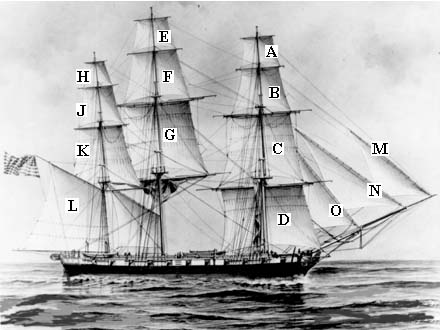
    A  Fore royal                      H  Mizen royal
    B  Fore topgallant                 J   Mizen topgallant
    C  Fore topsail                    K  Mizen topsail
    D  Main course or Fore mainsail    L   Driver
    E  Main royal                      M  Flying jib
    F  Main topgallant                 N   Outer jib
    G  main topsail                    O   Inner jib
The top and bottom edges of a square sail are called the HEAD and the FOOT.
The outer edge is the LEECH. The main belly or centre of the sail is the
BUNT. The two top corners are EARINGS and the bottom two corners CLEWS.
Sails are named by their mast and their position on the mast. They are
carried on YARDS. A SQUARE YARD is a spar tapered at each end and held at
its midpoint at right angles to the mast. The outer end of the yard is the
YARDARM. Ropes called BRACES run from each yardarm and allow the yard to be
swiveled horizontally to catch the wind. Other ropes called LIFTS from the
masthead to the yardarms and SLINGS to the middle of the yard contol the
vertical movement of the yard by means of HALYARDS. The ropes connected to
the clews are known as SHEETS. They are either fastened to the yardarms
below or, in the case of the main courses, used to control the sail.
CLEWLINES connect the clews to the middle of the sail`s spar.
BUNTLINES are used in REEFING (making a sail smaller by rolling up part of
it ) or FURLING (bundling sails up and securing them to a yard). A FOOT ROPE
runs underneath the yards for men to stand on while furling the sails.
All the ropes used to control the sails in working the ship are known as the
RUNNING RIGGING as distinct from the STANDING RIGGING which supports the
masts. In the latter case SHROUDS go from the masts to the sides of the ship
while STAYS (FORE STAYS and BACK STAYS etc.) run fore and aft.
Larger ships than the sloop shown in the illustration carry more sails.
Above the Main royal would be the SKYSAIL and the MOONRAKER and there would
be STAYSAILS, which are fore and aft sails between the masts. To get the
maximum amount of canvas in light winds STUDDING SAILS or STUNSAILS
(pronounced stuns`l) were used on either side of the main sails, top sails
and top gallants, carried on extensions to the yards. Stunsails are said to
be the invention of Sir Walter Raleigh.
© Michael Phillips 2000
Go to Guns and Classes of Ships
Go to Construction of Ships
Go to Maritime History Index