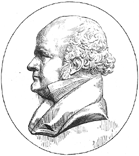
Franklin welcomed the merriment, his loving wife had draped a union flag for warmth, across his sleeping body a few days earlier, giving him an eerie premonition of death. The sight of the dove secretly eased his superstitions With the planning and training at an end, the expedition was starting its journey to forge a path through the Arctic wastes in the expectation of finding a Northwest passage. Two centuries of world-wide exploration had failed to break the icy armour that protected the passage and the bones of many brave souls lay undisturbed across it's frozen barrier.
Both Franklin and the Admiralty confidently felt that this expedition could not fail. The finely outfitted and trained crew sailed in two ships that were equipped with the most sophisticated technology that the period offered. With reinforced hulls and sheet metal covering their bows, Erebus and Terror were, in the words of one crew member, 'Ready to conquer'. So sure of success was the admiralty that no plans were drawn up for assistance or rescue should the expedition encounter difficulties, and the three years allocated for the completion of the journey, seemed by the majority of the men, as somewhat generous. After a brief stop at the Orkney islands, the expedition sailed to Whalefish islands on the west coast of Greenland, where the supply ship, Barretto Junior, replenished their stores with freshly slaughtered meat. The men took the opportunity to send their final letters back to Britain. Lieutenant James Walter Fairholme wrote of Franklin, 'He has such experience and judgement that we all look on his decisions with the greatest respect. I have never felt that the Captain was so much my companion with anyone I have sailed with before.' The Barretto Junior left the two ships on 12 July 1845 after taking four or five crew members, who for unknown reasons, would not continue the journey. Erebus and Terror moved swiftly westward toward Baffin Bay where they made their final contact with the outside world.
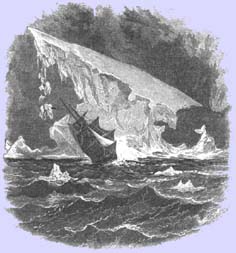
Two whaling ships, the Prince of Wales and the Enterprise sighted Franklin's expedition tied to massive ice floats and Captain Dannet of the Prince of Wales invited Franklin aboard. Captain Robert Martin of the Enterprise noted in his journals that Franklin's crews were in high spirits and that Franklin himself talked of having adequate provisions for five years that could, with care last for seven. Franklin returned the invitation to the two Captains but a sudden change in the calm weather forced the four ships apart. Never again would the crews of Erebus and Terror see men from the civilised world.
The two ships, although cramped and at times stifling, were well equipped to cater for the needs of their crews during the long spells that they would be caught fast in ice. Both carried impressive libraries totalling around 3000 volumes on various subjects. Both were heated by hot water running in pipes under the floors of the berths. Both held schooling classes for the less educated members of the crews. Perhaps most impressive of all was both the Erebus and Terror had entire locomotives weighing 15 tons each, installed in their holds. These massive 20 horsepower engines, acquired from London Railways were specially adapted to use propellers in moving the ships through broken ice floes.
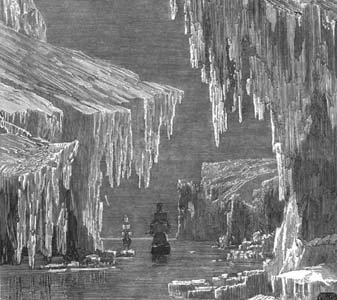
As the expedition moved slowly into the icy wastes of the Arctic, what happened in the following years remains a mystery. The British Admiralty were already feeling a sense of unease by 1847, after hearing no word of Franklin's progress from various sources, including the Hudson Bay Company. So much so that they commissioned three further expeditions to seek Franklin and offer relief.
These expeditions led by Captain Henry Kellet, James Clark Ross and Dr John Rae/Sir John Richardson, were to arrive at Franklin's aid by three different routes. They returned to England after failing to find a trace of either ships or crews. The initial unease was now clouded by a fearful urgency in locating the missing men. Rewards were offered for information leading to their discovery and rescue. Many felt secure in the knowledge that whilst the expedition had obviously run into difficulty, they were undoubtedly equipped to survive, even in a relatively comfortable state, until found. However, by the spring of 1850, �10,000 was being offered to anyone ascertaining the fate of Franklin and his men.
The same year saw fleets of ships of various sizes and nationality scouring the Arctic waters searching for Franklin. On the 23 August 1850, Captain Erasmus Ommanney of the H.M.S. Assistance finally found traces of Franklin's expedition at Cape Riley, Devon Island. Ommanney spoke of the find: 'I had the satisfaction of meeting with the first traces of Sir John Franklin's expedition, consisting of fragments of stores and ragged clothing and the remains of an encampment.' Ommanney strived to find more clues and spotted a large cairn on the headland of nearby Beechy Island. More relics were found nearby, but after painstakingly dismantling the cairn, no document or further clues were found within.
H.M.S. Lady Franklin, under Captain William Penny Joined the search as more and more fragments of the expedition's materials were being discovered around Devon Island, including remains of encampments and long stay quarters. Finally, on 27 August 1850, graves were found on Beechy Island. Three graves side by side, dug into the permafrost, complete with carved wooden headstones that bore the date 1846, suggested that the expedition had wintered in and around Devon Island. Three deaths in the first winter gave a notion that the expedition had encountered major difficulties early into their journey.
The piles of empty and abandoned tinned foods that were found, indicated that supplies taken on the expedition may have been of an inferior quality. The search parties continued to guess and surmise the fate of Franklin and his men throughout the following winter, while they also set camp at the same place as the expedition had four years previous. In the following year Lady Franklin paid for further expeditions to travel the Arctic waters in the hope of finding her beloved husband. These and following searches continued to find traces of the missing men.
Inuit told of large parties of white men dragging sledges, falling and dying on the ice. Further eyewitness accounts from natives suggested giant ships being hoisted up on icebergs before being crushed within their walls. The Innuit claimed starvation had gripped the expedition, fuelling the earlier notions of rotten supplies. However by 1854 the Admiralty noted that whilst they must endeavour to solve the mystery of the tragic disappearance of the Erebus and Terror, nothing could now be done to save Franklin and the 128 men that followed him.
Lady Franklin pleaded with the British Government to promote one last search, but the events in the Crimean War held priority in both cost and manpower, and she was sympathetically turned down. Once again she used substantial amounts of her fortune to mount another voyage. Her refusal to give up hope of finding survivors inspired those who were still searching. With her own finance and donations from the Admiralty and public appeal, Lady Franklin purchased the steam yacht, the Fox. Placed in command was Arctic explorer Captain Francis Leopold M'Clintock, who set sail from Scotland July 1. 1857. After being stuck in ice around Baffin Bay, the Fox reached Beechy Island in the August of the follow ing year. A second winter forced the party to base at the entrance to Bellot Strait. M'Clintock used the months of inactivity to wander the vast icy stretches that filled every horizon. He decided to travel by land to King William Island, and took a small party of men, including his second in command, Lieutenant William Robert Hobson. They reached their destination by April 1859, where M'Clintock decided to split his party into two groups. The return journey would in this way, cover the east and west coasts.
M'Clintock encountered a group of Inuit, and traded with them for the clearly visible Franklin relics that many had about their person. The Inuit told the Captain that they acquired the various garments and artefacts from a gigantic wrecked ship some years ago. The party continued the search. On 25 May 1859, they came across a complete skeleton, still dressed in a stewards uniform, M'Clintock spoke of the pitiful sight: 'This man seems to have selected the bare ridge top, as affording the least tiresome walking, and to have fallen upon his face in the position in which we found him. It is probable that, hungry and exhausted, he suffered himself to fall asleep when in this position [and] his last moments were undisturbed by suffering.' A notebook and comb were lying alongside the remains, and inspection of the book revealed its owner was a Harry Peglar, petty officer on H.M.S. Terror. M'Clintock's second in command, Hobson had found something considerably more important three weeks earlier, although this was unknown at the time to M'Clintock. Hobson had come up on the only written record of the Franklin expedition.
Two scribbled notes on a page of Naval record paper had been discovered under a cairn close to victory point. The first signed by Lieutenant Graham Gore gave longitudes and latitudes of the expedition's progress up to May 1847. It also gave Sir John Franklin as the commander of the expedition. But around the margins of the paper was a second, more urgent message:
April 25th, 1848 - HM's Ships Terror and Erebus were abandoned on 22nd
April, 5 leagues N.N.W. of this, having been beset since 12th September
1846. The Officers and men, consisting of 105 souls, under the command
of Captain F.R.M. Crozier, landed here in Lat. 69' 37' 42" N, long. 98' 41' W.
This paper was found by Lt. Irving under the cairn supposed to have been
built by Sir James Ross in 1831, 4 miles to the northward, where it had
been deposited by the late Commander Gore in June 1847.
Sir James Ross' pillar has not, however, been found, and the paper has been
transferred to this position, which is that in which Sir James Ross' pillar
was erected. Sir John Franklin died on 11th June 1847; and the total loss
by death in the expedition had been to date 9 Officers and 15 men.
James Fitzjames, Captain H.M.S. Erebus.
F.R.M. Crozier. Captain and senior Officer.
Start on tomorrow, 26th, for Back's Fish River.
M'Clintock learned of the discovered message some weeks later and praised how the expedition's leaders had exercised great calmness in the face of: 'A last bold struggle for life.' Hobson continued his search, and days later came across a lifeboat, littered with clothing, weapons and skeletons. The sight was described by Hobson as 'Pitiful.' The only food found around the boat was chocolate and tea, yet, the astonishing array of needless articles such as books, slippers, toothbrushes, silk cloth, combs, boots, vast amounts of soap, and many other items, puzzled Hobson, the extra weight in this mountain of luxruries must have only caused unnecessary burden to an already exhausted party. Further searches uncovered more remains, some of which bore the horrific evidence of cannibilism, a theory that was backed by Inuit stories. As the years past, interest in the lost expedition diminished, as the hope of finding survivors became non existent.
Only a small proportion of the 129 men's remains were ever found, and many excursions into the Arctic today still come across an occasional human bone or Franklin relic. The Fox sailed back to England in September 1859 with the news that finally told the world that the Franklin expedition was dead. Lady Franklin took solace from the news, as well no doubt did many other wives and mothers. Questions concerning the deaths of 129 men would and still do remain unanswered. The country was left with not only a sense of loss, but British exploration in general, was left reeling by this huge casualty list. Franklin and the crews of Erebus and Terror went in to the Arctic with the goal of completing a navigational passage through the ice bound straits. However, modern mapping has since noted that no one route is credited as being the Northwest passage, and it was accessible through a maze of ice floatation's with an ever changing degree of entry. M'Clintock and Hobson's discoveries on King William Island told the world that the expedition had succumbed to death by whatever means. The 129 men died over a period of unknown years, yet in their last march, they had indeed discovered a route that led through to the Northwest Passage. Whether or not they realised their success, is questionable. But as they staggered along the shores of Simpson Strait, their exultation, if any, must surely have sounded hollow. HM ships Erebus and Terror, once the pride of the Royal Navy, remain undiscovered. Reports of seeing ghostly ships floating in the icy waters have crept into the years following the tragedy. One such sighting by air in 1937, reported seeing a massive bulk lying motionless on top of a huge ice berg, but after returning home to refuel, the pilot was unable to relocate both the ship and the floating ice mass. Just what went so drastically wrong with the Franklin expedition has come close to being answered through forensic evidence taken from the Bodies in the Graves at Devon Island and painstaking research of the numerous artefacts found littering the Arctic ice. The huge quantities of tinned food bought by Franklin as part of the ration supply, were concealed in airtight tins that were lined with lead solder. Lead poisoning is now attributed as the primary cause for the expedition's early and continuing deaths among the crew. This type of poisoning was not readily known by physicians aboard the Erebus and Terror, and its visible effects were, to the surgeons, much the same as starvation and scurvy. Franklin's expedition carried with them, the very best that industry and development could offer. It is ironically tragic that preserved tinned foods were at the time one of those new developments