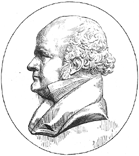
We left Captain Franklin after his appointment to lead an expedition to the mouth of the Mackenzie River.
"My most valued friend, Dr. Richardson, offered his services as naturalist and surgeon, and also volunteered to undertake the survey of the coast to the eastward while I should be occupied in endeavouring to reach Icy Cape. Lieut. Bushman, who had served under Captains Ross and Parry, was appointed to accompany me but, long before the party was to leave England, I had to lament the death of that excellent young officer. Many naval officers were desirous of filling the vacancy; but my friend and former compnion, Lieut. Back, having returned from the West Indies, the appointment was offered to him, and accepted with his wonted zeal. Mr Edward Nicholas Kendall, admiralty mate, and recently assistant-surveyor with Capt. Lyon, was appointed to accompany Dr. Richardson to the eastward and Mr Thomas Drummond, of Forfar, was appointed assistant naturalist.Franklin had learnt his lesson on the first expedition and determined that the members of the next one would not suffer from starvation.
A residence in the northern parts of America , where the party must necessarily depend for subsistence on the daily supply of fish, or on the still more precarious success of Indian hunters, involves many duties which require the superintendence of a person of long experience in the management of the fisheries and in the arrangement of the Canadian voyageurs and Indians; we had many opportunities, during the former journey, of being acquainted with the qualifications of Mr Peter Warren Dease, a trader with the Hudson`s Bay Company, for these services, and I therefore procured the sanction of His Majesty`s Government for his being employed on the expedition."
"Pemmican, the principal article of provision used for travelling, being made during the winter and spring, the orders for providing the quantity required for the expedition, though sent out from England by the earliest conveyance, so as to reach the provision posts in the summer of 1824, could not be put into effect sooner than than the spring of 1825, hence it was not proper that the main body of the expedition should reach the Fur Countries before the latter period. Some stores were forwarded from England, by way of New York, in March 1824, for the purpose of relieving the expedition as much as possible from the encumberance of heavy baggage, and thus enabling it, by moving quickly, to reach its intended winter quarters at the Great Bear Lake. These stores, together with other articles obtained in Canada, loaded three north canoes, manned by eighteen voyagers; and they were delivered, before the winter set in, to Mr Dease, at the Athabasca Lake".Captain Franklin oversaw the construction of three boats at Woolwich. They needed to be small and light, but strong enough to withstand the rapids and numerous portages between York Factory and the Mackenzie River. The largest, later named the Lion was 26 x 5 feet and the two smaller ones 24 feet, with a slightly narrower beam. They were double-ended, built of mahogany over ash frames and fitted with two lug sails. The larger was intended to be rowed by six oarsman who could carry the boat on their shoulders. It was capable of carrying 3 tons of cargo. The others had five oarsman and could carry an additional 5600 lb. The boats were sent out to York Factory in June 1824, together with more stores, two carpenters and a party of men. They were to make their way towards Bear Lake during the summer, and as soon as navigation opened the following spring, when they should expect to be overtaken by by the officers of the party travelling by way of New York and Canada. Two large canoes, with stores, were ordered to be deposited at Penetanguishene, the naval depot on Lake Huron, for the use of the latter.
The Departure.
When Captain Franklin and his party embarked on board the American paddle-ship Columbia at Liverpool on 25 February 1825 he was facing a struggle between a sense of duty and his affection for his family. His wife was dying, but urged him, if he valued her peace of mind, not to delay his departure. She made and presented him with, a silk union flag which was not to be unfurled until he reached the Polar Sea. Six days later she died, leaving a daughter only eight months old.
About the same time Commander F.W. Beechey was commissioning the
Blossom.24 at Woolwich. He had orders to sail round the Horn to meet the western part of the land expedition in the Bering Straits, the eastern party were to make their way back down the Coppermine River to the Great Bear Lake.
On 29 June Captain Franklin and Dr Richardson, after travelling though Upper Canada from New York, met up with the expedition`s boats which Augustus and another Inuk interpreter, Ooligbuck, had brought 1200 miles from York Factory. Meanwhile Lieut. Back and Mr Kendall
were bring three heavily laden canoes from Lake Superior and all parties reached Fort Norman on the Mackenzie River by 7 August.
From here they employed themselves on a number of different expeditions. While Messrs. Back and Dease prepared their quarters for the approaching winter, Dr Richardson surveyed the shores of the Great Bear Lake and determined the point nearest to the Coppermine River, his jumping-off point for the following year. Captain Franklin, with Mr Kendall and Augustus, in the largest boat descended the Mackenzie River to its mouth. This journey, including a short stop at the Company`s new post at Fort Good Hope, only took six days, and they found that the river discharged into the Arctic Ocean among a number of low islands. In an attempt to find the division between fresh and salt water they put out to sea towards a large island in spite of a strong contrary wind, but after rowing for five hours, drenched with spray and the waves which came into the boat, they set the sails, double-reefed, and found that the boat rode over the waves in a very safe manner. After a hour they crossed a line of strong ripples which marked the end of the fresh water.
"The sun was setting as the boat touched the beach, and we hastened to the most elevated part of the island, about 250 feet high, to look around. Never was a prospect more gratifying than that which lay open to us. The Rocky Mountains were seen from S.W to W half N; and from the latter point, round by the north, the sea appeared in all its majesty, entirely free from ice and without any visible obstruction to navigation. Many seals and black and white whales were sporting in its waves; and the whole scene was calculated to excite in our minds most flattering expectations of our own success and that of our friends in the Hecla and Fury. I wrote for, Captain Perry, an account of our progress, with such information as he might require in case he wished to communicate with Fort Good Hope, or our party, and deposited my letter, with many others that I had in charge for him and his officers, under a pole erected for the purpose , on which we left a blue and red flag flying to attract his attention."Captain Franklin named the new island after Nicholas Garry, the Deputy Governor of the Hudson`s Bay Company and unfurled the flag sewn by his wife.
"I will not attempt to describe my emotions as it expanded to the breeze - however natural, and for the moment, irresistible, I felt that it was my duty to suppress them, and that I had no right, by an indulgence of my own sorrows, to cloud the animated countenances of my companions. Joining in with the best grace I that I could command, in the general excitement, I endeavoured to return, with corresponding cheerfulness, their warm congratulations on having thus planted the British flag on this remote island of the Polar Sea."They returned to the mainland on 17 August and the following day a strong gale came down from the north and the temperature dropped. The geese and swans were seen taking advantage of the fair wind to fly south. On the 5 September he arrived at the winter quarters on the Great Bear Lake. He had intended to call it Fort Reliance but found that the members of the expedition, now all assembled for the first time, had done him the honour of naming it Fort Franklin. Its position was determined as lat.65deg.11`56" N. long. 123deg.12`44" W. and its population, including three Indian womem and six children, numbered fifty.
"We were stopped by ice, unbroken from the shore and closely packed to seaward with no water to be seen. We were now scantily supplied withfuel, the drift timber being covered by ice high up the bank. The easterly gale gave place to a calm on the morning of the 7thand as this change, though it produced no effect in loosening the ice to the northward,caused more water to flow in the channel between the island and the main, we succeeded in crossing the flats that had before impeded us. Beyond this bar the water gradually deepened to 3 fathoms; and a favouable breeze springing up, we steered for the outer point of land in sight."For the next eight days they had thick fogs and heavy gales. The temperature dropped to 35deg and ice started forming in small pools near the tents.
Our couse was continued until we came to an island lying three miles from the shore and connected to it by a reef on which the wind drove the Lion agroundby which accident she took much water. We stood along the weather shore looking for a favourable landing place, that we might obtain shelter from an approaching storm. At length some posts, erected by the Inuit, denoted an approachable part, and we effected a landing after carrying part of the cargo 200 yards through the water. We were prevented from moving by thick fog until the morning of the 8th when it cleared for two hours and enabled us to perceive that the ice, which had been observed at a considerable distance from the shore, was now tossing about, in large masses, close to the border of the shallow water. We ascertained the latitude 70deg.16`27" n. and longitude 147deg. 38`20" W.
"The weather became clear, after the sun rose, on the 16th and we embarked as soon as the flowing of the tide enabled us to launch the boats, all in the highest spirits at the prospect of escaping from this detestable island. We took advantage of the fair wind, set the sails, and steered parallel to the coast. We never had more than three to six feet of water until we passed round the reef that projects from Point Anxiety, a distance of 7 miles. Between this an Point Chandos, eight miles further to the westward, land was occassionally seen; but after rounding the latter point we lost sight of it and steered acros the Yarborough Inlet. The fog returned, and the wind freshening soon created such a swell upon the flats that it became necessary to haul further from the land; but the drift ice beginning to close around us, we could no longer proceed with safety. We were frustrated in finding a landing place by the shoalness of the water and the height of the surf. We stood out to sea with the view to making fast to a large piece of ice, but fell among gravelly reefs and effected a landing on one of them. The patch of gravel on which we encamped was about 500 yards in circumference, devoid of water and with no more drift-wood than a few willow branches, barely enough for a fire."The period had arrived when Franklin had to consider whether it was worth exposing the party to increasing risk by carrying on. They were only half-way from the Mackenzie River to Icy Cape but he knew that the coast around the cape resembled that which they had already passed. The summer, bad as it had been, was now nearly at an end. Back in 1821 the comparatively warm summer at Point Turnagain, two degrees to the south of their present position, had ended on 17 August withstorms of wind and snow. Even the Inuit seemed to shun this stretch of coast.
"In the evening I communicated my determination [to return] to the whole party; they received it with the good feeling that had marked their conduct throughout the voyage. The readiness with which they would have prosecuted the voyage was all the more creditable because many of them had their legs swelled and inflamed from continually wading in ice-cold water. Could I have known that a party from Blossom was only 160 miles from me, no dangers or difficulties should have prevailed on me to return. I had no right to expect that she had advanced beyond Kotzebue Inlet, or that any part from her had doubled Icy Cape."They reached the mouth of the Mackenzie on 30 August in a violent gale with thunder, lightning and torrents of rain. They arrived safewly at Great bear Lake on 21 September after traveling 2048 statute miles. 610 miles, including 374 along the sea coast were through unexplored territory.
Dr Richardson`s party travelled 1980 miles, including 863 by sea, and accomplished all their objectives. His second journey to the Polar Sea was in marked contrast to the first, which has been marked by so many disasters. Immediately on his return he set off in a canoe to the Great Slave Lake to continue his geological researches. Meanwhile Captain Franklin remained at Great Bear Lake until 27 February 1827, when he set out on foot for Fort Chipewyan, accompanied by five men, to meet the Doctor. The other officers and men were instructed to proceed to York Factory as soon as the ice broke, and take a Hudson`s Bay ship to England. Franklin and Richardson met on 18 June after a separation of nearly 12 months. They made they way to New York and received an enthusiastic reception from scientific institutions and private individuals. The city Corporation presented him with a splendidly bound volume of "Golden`s Memoir on the New York Canals", and the medal which had recently been struck to commemorate the opening of the Erie Canal.
On 1 September they sailed for home on board the packet-ship James Cropper, after being passed through the custom-house without inspection, and arrived in Liverpool on the 26th. Commander Back brought the rest of the party over to Portsmout exactly a fortnight later. Only two men had been lost on the expedition; one died of consumption and another was accidentally drowned.
On 5 November 1828 he married Jane Griffin. She became Lady Franklin when he was knighted on 29 April 1829. Other honours include the Gold Medal of the Geographical Society of Paris and an honorary degree as a Doctor of Civil Laws bestowed by the University of Oxford. On 23 August 1830 he was appointed
to command the Rainbow,28, fitting out at Portsmouth for the Mediterranean Station. Commander Back took Terror to the Arctic in 1836 and spent nine months beset in the ice.
In 1845 the Admiralty organised one more attempt at the Northwest Passage. By now there was a comparatively small gap between Parry`s furthest west, Melville Island, and Back`s Great Fish River, still left to be explored and for more than a year leading scientists had been urging it on the Government.
Franklin had just returned from a very unhappy period as Lieutenant-Governor of Tasmania, where he had been blamed for an economic depression over which he had little control. Both he and Lady Franklin believed in kindness, not only towards convicts but also towards the Aborigines, who were being hunted down and killed by the settlers. This did not accord with the policies of Lord Stanley, the Colonial Secretary, and the local administrators. After much innuendo against them had flowed back to London, Franklin was recalled in 1843 and let it be known that he would go to the Arctic if asked.
Lord Haddington of the Admiralty had reservations about Franklin`s age which the record showed to be sixty. "Oh, no, my lord, I am only fifty-nine." was his rejoinder when tackled with it. So the offer was made and Franklin was appointed to command the new expedition in Erebus accompanied by Captain Crozier in Terror.
Both vessls were completely overhauled and fitted with auxiliary screw engines. They sailed fronm Greenhithe on the River Thames on 19 May, provisioned for three years and, in the third week of July their last letters were taken on board by a transport which had accompanied them as far as Disko Island off Western Greenland. They were sighted by a Whaler on 26 July, moored to an iceberg, and waiting for a favourable time to enter the ice of Baffin Bay. That was the last time any of them were seen alive, except by Inuit, and it was not until 1854 that anything certain was learnt of their fate.
No anxiety was felt for a year and a half but by 1848 public disquiet became general and several relief expeditions were sent out. Eventually thirty-two vessels were sent ot by England, three by the United States and there were five land expeditions largely funded by the Hudson`s Bay Company. They located Franklin`s first wintering place on Beechey Island and found the graves of three of his crews bearing the dates 1845 and 1846. In October 1854 a Hudson`s Bay Company party under Dr. Rae at last learnt something from Inuit about the fate of the crews of Erebus and Terror. Six years before, they were told, forty white men had been seen dragging a boat and sledges over the ice. They were suffering from starvation and exposure and trying to reach an area where they could find game. Later some thirty corpses and some graves were discovered by the Inuit on the mainland and five uther bodies on an island. Dr Rae obtained a number of indentifiable relics and the Admiralty. satisfied that the entire party had been accounted for, paid Dr Rae the 10,000 pounds reward that had been offered for definite information.
Lady Franklin was not satisfied and, although she had already spent a large part of her private fortune on the search, bought the steam yacht Fox and with some help from private subscriptions, asked Captain F.L. M`Clintock, with a small crew of 25 volunteers, to have another look. Fox left England on 30 June 1857 and was beset by the ice of Melville Bay in August. They drifted 1385 miles with the ice over a period of eight months until it started to break up at the end of April 1858. They spent the summer searching without finding any trace of the lost party and then spent the winter of 1858-9 in much more favourable circumstances in a harbour in the Bellot Strait. In March they made contact with Inuit and gained more information which sent them to King William Island. Here they heard of two ships which had been seen,
one had sunk in deep water but the other was forced on shore by the ice. It had been "the fall of the year when the ships were destroyed and all the white people went away towards the 'large river' taking boats with them, the following winter their bones were found there." It was Lieutenant Hobson, who found the record of the Franklin Expedition, quoted at the beginning of the first part, at Point Victory on the north-west coast of King William Land. M'Clintock reached the spot on 29 May and encamped beside a boat which contained the portions of two human skeletons, one of a youg person, the other of a large middle-aged man. Five watches, loaded guns, scriptural and devotional works, large amounts of clothing and twenty-six pieces of plate - spoons and forks, were among the objects found, mostly dead weight on a sledge journey. The only provisions were a little tea and about 40 lb of chocolate.
A month after Lieutenant Gore had placed the paper in the cairn Sir John Franklin was dead, The following spring Captain Crozier attempted to lead his 105 starving men towards the Hudson's Bay teritory up the Back or Great Fish River, but they fell down and died as they walked along. The wrecks were never found, presumably the Inuit had taken the beached vessel apart.
Fox returned to England during the third week of September , and her officers and crew were awarded the Arctic Medal.
Compiled from the Journals of Captain Franklin, Commander Back and other contemorary texts.

In recent years, a number of search parties have scoured the area between Beechey Island in the north and the Adelaide Peninsula to the south of King William Island with varying results. Among them the Lady
Franklin Memorial Expedition of 1993 led by Lieut. Ernie Coleman of the
Royal Navy and Dr. Peter Wadhams, former head of the Scott
Polar Institute. Coleman thought he had found Franklin's grave, but after
much money spent getting to King William Island, the "grave" turned out to
be just a large rise in the earth and an empty air pocket below.
Another party was led a couple of years ago by an Ontario school
teacher and amateur historian who found more bones in the area of
McClintock's findings. The bones were tested in a university laboratory
in southern Canada and confirmed Dr. Rae's findings last century that
cannibalism did occur among Franklin's men.
The third group, of which I was a member and which included at one
point both Lieut. Coleman and Dr. Wadhams, was led by a weather technician based
at Resolute Bay, Wayne Davidson, who was directed to a boat wreck site on
Prince of Wales Island, adjacent to Peel Strait, by local Inuk hunters. The
remains were that of a 28-foot whaleboat. Dr. Wadhams took some paint
chips back to Cambridge for Carbon-14 testing, but so far the results
have been inconclusive. On my first trip to the site in 1993, our group
used a metal detector to find a very old, rusty tin can two feet
underground. It contained what appeared to be a bottle cap and a metal
ring. Efforts to identify the can have been unsuccessful, although it was
similar to cans found from Franklin's search parties (I've seen the latter
at the Canadian Museum of Civilizations here.) The 'ring' appears to have
been part of a theodolyte. The first impression is that the boat was from
a rescue ship, but no rescue ship went down Peel Strait at the time
because it was reported by Lieut. Browne of Omanney's ship that the
strait was not a strait but a bay. Browne travelled half way down the
strait by sledge in a very cold, miserable April 1851.
There have been some more interesting finds in this area of Prince of Wales Island, but since it's uninhabited and difficult to reach, and my friend's funds are pretty meagre, I think further searches will be delayed some time. What Dr. Wadhams suggested in a press release he issued in 1993 was that the boat was manned by Franklin crew members who were trying to get back to Beechey Island the way they came. Once at Beechey,they'd most likely meet up with whalers.
This year, a small group headed by John Harrington of Toronto walked part way down the coast of Graham Gore Peninsular and found beams and heavy timbers from a wooden ship about 12 miles south of Cape Crozier, and near Cape Crozier located a "quite old" cache or cairn that measured 10` x 10` at the base and was 3` high. It had two rectangular openings. Neither could be directly linked to Franklin, however. It was Harrington`s fifth year of trecking in the area. Details are on his web page at www.franklintrail.com
In August, some 40 academic and Canadian government experts, as well as author David Woodman, spent two weeks in the Kirkwall Island area south of King William Island seeking one or both of Franklin`s ships. Despite their use of of the latest in side scanning sonar, they found no sign of the ships. However they did find numerous pieces of copper sheeting and a copper disc with a special marking on it on the islands around O`Reilly Island in the same area. The disc had what appears to be the number 8 over a letter S and both are contained within a circle.
Robert Gernier, chief of underwater archaeology at Parks Canada, said that the disc looked like the lid from a perfume or tobacco container. Among the party was a TV production team from Halifax, Nova Scotia - based Eco-Nova, which is preparing a documentary on the Franklin expedition.
Two recent books about Franklin by Canadian author David C. Woodman
have also attracted a fair amount of attention so obviously there is still a fair amount of interest in Franklin`s story and the search for more information about it is far from over.
However, like everyone else involved I realize the odds are long and
the funds are short so if there is a breakthrough in the story, it will
probably be purely by chance.