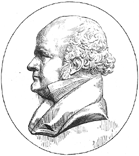
Like the "War of 1812" pages the inspiration for this section came from a correspondent. Dave Mullington from Ottawa shares a general Canadian interest in the saga of Sir John Franklin who, in 1845, set out to find the North-West Passage with 134 men in two ships, Erebus and Terror. They were seen by a whaler waiting to enter the ice of Baffin Bay and from that July day they were never seen again alive. No fewer than 32 vessels were sent out by England to search for them and it was not until 1854 that the first clues emerged as to the fate of the expedition. It was to be another nine years before a more complete picture of the tragedy came to light.
To commemorate the 150th anniversary of his death, I am contributing the story of Sir John`s earlier life, based on his journals and contemporary references, and using Dave, with his personal experiences of the area, to bring the story up to date.
If you share his interest he can be contacted at [email protected]

In 1859 Captain Leopold M`Clintock of the steam-yacht FOX found a small cairn on the north-west coast of King William Island. It contained a paper.
28 May 1847 H.M. ships Erebus and Terror wintered in the ice in lat. 70deg 05min N. long. 98deg 23min W. Having wintered, in 1846-7, at Beechey Island, in lat. 74deg 43min 28sec N., long.91deg 39min 15sec. W., after having ascended Wellington Channel to lat. 77deg., and returned by the westside of Corwallis Island,
All well.
Party consisting of two officers and six men left the ships on Monday24 May 1847.Gm. Gore, Lieut.
Chas. F. Des Voeux, Mate
Around the margin another hand had written the following words:-
April 25th 1848 - H.M. ships Terror and Erebus were deserted on the 22nd April, 5 leagues N.N.W. of this having been beset since 12 September 1846. The officers and crews, consisting of 105 souls, under the command of Captain F.R.M. Crozier, landed here in lat. 69deg. 98min. 41sec. W. Sir John Franklin died on 11 June 1847; and the total loss by deaths in the expedition has been, to this date, nine officers and fifteen men.F.R.M. Crozier, Captain and Senior Officer.
James Fitzjames, Captain of H.M.S.Erebus
And start to-morrow, 26th, for
Back`s Fish River.
The story starts in 1786 when he was born in the small town of Spilsby in the county of Lincolnshire in Eastern England.It is said that he first saw the sea when he was at grammar school in Louth, some 15 miles from Spilsby, although his home was barely 10 miles from the coast. His father intended him for the church, but young John was determined to be a sailor. To discourage him he was sent on a voyage to Lisbon in a merchantman but this only confirmed his decision and, as a 14 year old, he joined the 64-gunPolyphemus as a midshipman.On 1 April 1801, under Capt. John Lawford, she took part in the bombardment of the Danish fleet at the Battle of Copenhagen. Casualties were very heavy on both sides; in Polyphemus a midshipman, four seamen and one marine were killed and the boatswain, twenty seamen and four marines were wounded.
In June he was transferred to Investigator, a north-country built ship of 334 tons which had been bought in 1798 as Xenophon and used inthe North Sea. In 1801 she was renamed, newly coppered and repaired, and fitted out to survey the coast of Australia under the command of Matthew Flinders, a relative of Franklin`s. They sailed from the Downs on the 2 June.
Having completed most of his mission Flinders decided that the upper works of Investigator were rotten so she was laid up at Port Jackson (Sydney) in July 1803 and Franklin joined the armed store-ship Porpoise as a supernumerary master`s mate for the journey back to England. Porpoise, commanded by Lieut. Robert Fowler, was formally the Spanish packet Infanta Amelia.
At the beginning of August 1803 two ships lying in Sydney Cove, bound for Batavia, asked to accompany Porpoise through the Torres Strait. These were the Cato of London and the Hon. East India Co's Bridgewater. After receiving dispatches from the Governor the three vessels sailed on the morning of 10 August and steered north-east. On the 17th, some two degrees to the east of the Barrier Reef and just north of the Tropic of Capricorn, Cato signalled for land. This proved to be a drysand bank which was named Cato`s Bank (Cato Island, about 190 miles due west of Keppel Bay in Queensland) but, as it seemed not to be connected with any other, it did not seem necessary to heave to during the night, and the ships continued under easy sail with a warrant officer on lookout on the forecastle. At eight o'clock Cato was about a mile away on the port quarter and Bridgewater about half a mile on the starboard; no bottom was found at 35 fathoms. An hour and a half later breakers were seen ahead and Porpoise, being carried amongst them,struck on a coral reef and heeled over on her port side, fortunately towards the reef. Shortly afterwards Cato, having hauled to the wind and passed Bridgewater on opposite tacks, struck on the reef about two cables from Porpoise and fell over, losing her masts.
Porpoise's people managed to launch a gig and a cutter in the lee and Capt. Flinders endeavoured to reach Bridgewater which was standing away from them. When this proved impossible Mr Fowler set his men to work to make a raft, while the gig went to pick up Capt. Park and his men from Cato which had been breaking up during the night. Three boys were drowned as they swam out to the gig.
At low water the reef was dry near the Porpoise so stores and both crews were got on shore. The two cutters and the gig were pulled above the high water mark but the latter floated away when the tide rose higher than expected during the night. A large blue ensign was hoisted as a signal to Bridgewater but she had already abandoned them; without closing to investigate, Capt. Palmer sailed off to India to report that they were all lost.
By the 22nd most of the stores and water had been brought ashore and three tents had been erected. It was then decided that an attempt should be made to go for help. On the 26th the largest cutter was prepared for a long voyage, launched and named the Hope. Capt. Flinders and Capt. Park embarked and sailed 750 miles against a prevailing south wind back to Port Jackson where they arrived on 8 September. Here Governor King arranged for the ship Rolla, Mr Robert Cumming, then waiting to sail for China, to go to the rescue of the officers and men on the reef, accompanied by the Francis to bring back those who wished to return to Port Jackson. The 29 ton colonialschooner Cumberland was completed from the stores of the Investigator and turned over to Capt. Flinders for the return voyage to England.
They sailed from Port Jackson on 21 September and arrived at the reef on 7 October, to receive a salute of 11 guns from the carronades which had been landed from Porpoise. While Capt. Flinders was away they had dug a saw-pit, set up a forge and started to build a new boat. An island some 9 or 10 miles away was visited in the cutter and they brought back a plentiful supply of eggs, they had plenty of flour and a violent storm of rain supplied enough water to last a fortnight.Rolla and Cumberland were met by two boats, the remaining cutter and the new boat constructed over the past month, it was about the same size as Cumberland, decked and called the Resource.
On the 10th the Rolla and Cumberland sailed, parting company the following day as Rolla steered north-eastward to China and Capt. Flinders directed his course to the Timor Strait to continue his survey. Note1
From Canton those returning to Enland sailed as passengers on board the Hon. East India Co`s. Earl Camden in a valuable homeward bound fleet on 31 January 1804.On 4 February they had a celebrated encounter with a Frenchsquadron consisting of a line-of-battle ship and three frigates under Rear Ad. Linois. The merchant ships drove off the enemy by forming line of battle. Note 2
On his return home young Franklin joined theBellerophon,74., Capt. John Cooke, in the Mediterranean.In October 1805 she was in Vice Admiral Collingwood's Lee Division at the Battle of Trafalgar, with Midshipman Franklin in charge of signals.
Bellerophon broke through the Spanish line under the stern of the Monarca,74, and, while hauling up to engage her to leeward, she ran on board the French Aigle in the smoke. The French ship being much higher and full of troops, Bellerophon suffered a lot of casualties from musket fire. Capt. Cooke was killed by a shot in the right breast while he was reloading his pistols and Lieut. William Price Cumby took over command. He fired several broadsides into Aigle's stern as she fell of and then forced Monarca to surrender. Bellerophon lost 27 officers and men killed and 123 wounded. Of the 40 people around Franklin on the poop, all but eight wereeither killed or wounded.
In the gales after the battle the badly damagedBellerophon rolled so much that the wounded were suffering as they were thrown around. A midshipman, Mr Daniel Woodriff, nailed capstan bars along the deck of the captain's cabin to hold the beds until the wounded could be moved to the hospital in Gibraltar.
In his next ship the Bedford, which he joined in October 1807, he was promoted to acting lieutenant two months later. His commission was confirmed by the Admiralty on 8 February 1808. The ship formed part of the squadron which escorted the Royal Family of Portugal toSouth America and on her return she took part in the blockade of Flushing in 1811.
In September 1814 Capt. Walker in Bedford took command of a squadron which embarked the advance guard of Major General Keane's army being sent against New Orleans. On 14 December her boats joined in the capture off five American gun-vessels anchored in Lac Borgne.She had one seaman killed and Lieuts. John Franklin and H.G. Etough, and James Hunter, master's mate, were wounded. Note3
He also served ashore with the army in command of Bedford`s party of armed seamen and took part in cutting a canal across the neck of land between the Bayou Catalan and the Mississippi to allow boats carrying a diversionary force to cross to the right bank of the river. His actions were comended in a letter from Sir John Lambert, who had succeeded to the command of the army, to Vice Admiral Cochrane.
His next appointment, in Sepember 1815, was as first lieutenant of the Forth,40, Capt. Sir William Bolton
First Experiences in the Arctic.
On 14 January 1818 Lieut. John Franklin was appointed to his first command, the hired brig Trent. She and the hired sloop Dorothea, were employed on an expedition led by Captain David Buchan with orders to explore the Polar sea to the north of Spitzbergen.
The two ships sailed to the northward between Greenland and Spizbergen in bad weather, with thick fog, separated on 28 May, and met up again in Magdelena Bay in Spitzbergen which was full of decaying ice from four glaciers.Here a musket shot half a mile away brought down a huge piece of ice from 200 feet above the water. This produced a 96 foot wave which swept away Trent`s launch. The crew barely escaped with their lives as it was thrown up on the beach. Dorethea,which was being carreened four miles away, was righted. The iceberg was measured as nearly a quarter of a mile in circumference and 100 feet high. Spitzbergen was teeming with life. Note4
They left the bay on 7 June and spent 13 days in an icefield before reaching open sea. However the way northward was blocked by more ice and when a gale sprang up they had to force their way, under storm-staysails, through the crashing floes at the edge of pack to find refuge inside the ice field. Both ships were badly damaged, Dorethea nearly foundering, so when the ice released them,they carried out some repairs at Spitzbergen and returned home.
The land expedition to the Polar Sea
In 1819-22 Lieut. Franklin made a perilous land and river journey from Hudson Bay to the Coppermine River in the company of Midshipmen George Back,and Richard Hood, Dr John Richardson, a naval surgeon, two sailors, John Hepburn and Samuel Wilkes, and four Orkney boatmen. The purpose of the expedition was to determine the exact position of the mouth of the river and map the shore of the Polar Sea to the eastward.
They sailed from Gravesend in the Prince of Wales on 23 May 1819 and, after being nearly wrecked on Resolution Island, reached York Factory, the principal depot of the Hudson`s Bay Company, at the mouth of the Nelson River in Manitoba, on 31 August.His instructions had suggested that he would be able to secure a schooner here to take them up to Wager Bay, but the vessel was unuseable and no guides could be obtained along the coast. He therefore decided to accept the advice of the people at York Factory and follow the chain of Hudson's Bay posts to the Great Slave Lake.
The left by boat on 9 September to make the ascent of the numerous rivers, rapids and lakes between York Factory and the post at Cumberland House, between Pine Island Lake and the Saskatchawan River, a distance of about 690 miles. That it took them 44 days is hardly surprising when sometimes one whole day would be spent in carrying the boats and cargo over a long portage. During one such portage on 2 October, Lieut. Franklin fell in the river between two falls. He was swept for a considerable distance before he managed to grab a willow and was rescued by a boat. That night the thermometer dropped to 25 deg.F.
With the rivers frozen Franklin proposed to continue on from Cumberland House as far as Fort Chipewyan by sledge and he, Back and Hepburn set out on 18 January 1820, accompanied by Mr Mackenzie of the Hudson`s Bay Company who was going to Isle a la Crosse. They reached this post on 23 February and completed their journey of 857 miles in the depth of winter at the North West Company`s post at Fort Chipewyan on 26 March.
Spring arrived for Franklin on the 10 May when the trees started to put forth their leaves and the first mosquitoes appeared.
Further south, for Hood and the others, it was the first shower of rain on 15 April and the return of the geese and ducks which signalled the change in the weather. On the 17th the temperature rose to 77 deg. in the shade. Two canoes were constructed and when more stores had been brought to the post they were able to enter the mouth of the Sturgeon River and start out for Fort Chipewayan on 13 June.They joined Franklin on 13 July having been delayed for three days by the loss of one of their bow-men when a canoe was upset in a strong rapid.
The stores which they now distributed between three canoes did not ammount to much, apart from two barrels of flour, three cases of preserved meat, some chocolate, arrowroot and portable soup, which they had brought from England and intended to keep for their journey to the coast the following season, it was barely sufficient for one day`s consumption. They set off on 18 July, spent two days at the Hudson's Bay post of Moose-Deer-Island, where they obtained a small supply of dried meat, and arrived at Fort Providence at the western end of the Great Slave Lake, the most northerly post of the N.W. Company, on the 29th.
On 1 August their Indian guides set out for the mouth of the Yellowstone River and Lieut. Franklin and his companions joined them on the 3rd. The party included Frederick Wentzel, a clerk with the N.W. Company, sixteen Canadians, one Irequois and two interpreters, - three women accompanied their husbands in a small canoe, they were going to make shoes and clothes for the party during the winter. There were also three children making a total of 31. According to Franklin the Indian women proved noisy companions, quarrelling frequently. Progress was slow, due to the shortage of provisions and the frequent portages around rapids and shallow lakes, so that they had only covered 553 miles from Fort Chipewyan by the 20 August when they decided to stop and build their winter quarters. This they named Fort Enterprise and it was located at lat. 64deg. 28min. N. long. 113deg. 6min. W.
A few days later Franklin was surprised by the early symptoms of the approach of winter with small pools frozen over and geese flying south. He had hoped to be much farther north, near the mouth of the Coppermine River, but had to content himself with a small expedition th the head of the river in Point Lake. When he returned Mr Wentzel had nearly completed the winter-house - a log cabin 50 feet long and 24 feet wide, divided into a hall, three bedrooms and a kitchen, but for a while they had to live in their tents. The cabin was completed on 6 October and they spent a cheerful evening before a blazing fire in the clay chimney. Although their store house contained the carcases of 180 deer, with 80 more stored outside, and more than 2500 lb of white fish this was barely sufficient so, on the 18th, Messrs. Back and Wentzel with two Canadians and two Indians and their wives set out for Fort Providence to try and obtain more stores. Ammunition and tobacco was also required, the latter for the Canadians, who stipulated it in their contracts, and to preserve the friendship of the Indians.
The men completed their cabin towards the end of October, 34 feet long and 18 feet wide placed at right angles to the officer`s building. The weather in December was very cold, on one occassion the thermometer fell to 57 deg. below zero and the mean for the month was -29.7 deg. The thermometer which hung in the bedroom about 15 feet from the fire stood occasionally at 15 deg below zero even in the daytime, once being as low as -40 deg. before the fire was lit. The trees froze as hard as stone and by the end of the month they had only one axe unbroken. On 1 January 1821 Franklin was promoted to commander and Back and Hood to be lieutenants.
Mr Wentzel returned on 27 January with two Inuk interpreters, but it was to be 17 March before Mr Back appeared after an absence of nearly five months.
"during which time I had travelled 1104 miles on snow shoes, and had no other covering at night, in the woods, than a blanket and deer-skin, with the thermometer frequently at -40 deg. and once at -57 deg.; and sometimes passing two or three days without tasting food."A few days later the last of the winter`s stock of meat was used up and Franklin had to issue some pounded meat he had reserved for making pemmican. Now it was not so cold the officers joined in the men`s sport of sledging down the steep river banks and on one occassion Franklin was thrown off and, nearly buried in snow, badly sprained his knee when a large Indian woman drove her sledge over him.
25 July. Constant rain with thunder during the night. Nets only furnished only three salmon-trout. Paddled against a cold breeze until thick fog caused us to land. Just as we were endeavouring to double a bold cape, the fog partially cleared away, and allowed us an imperfect view of a chain of islands on the outside, and much heavy ice which was pressing down upon us.The voyage ended after 650 miles on the 25 August at the mouth of a river he named after Lieut. Hood. Here he left an assortment of iron materials and beads, etc. in a conspicuous place for the Inuit and planted a union flag where it could be seen by ships in the offing. He also left a tin box for Capt. Parry, who was exploring the Arctic sea from the eastward, with an outline of his proceedings.
15 August. In the evening we were exposed to much inconvenience and danger from a heavy rolling sea, the canoes received many severe blows, and shipped a good deal of water, which induced us to encamp at 5 P.M. Mr Back reported that both canoes had sustained material injury. Distressing as were these circumstances they gave me less pain than the discovery that our people, who had hitherto displayed a courage beyond our expectation, now felt serious apprehensions for their safety. The strong breezes we had encountered led me to fear that the season was breaking up, and severe weather would soon ensue, which we could not sustain in a country devoid of fuel. I announce my intention of returning at the end of four days unless we should previously meet the Eskimos, and be enabled to make some arrangement for passing the winter with them.
16 August. We round a cape which now bears the name of my lamented friend Capt. Flinders, and had the pleasure to find the coast trending N.N.E. with the sea in the offing unusually clear of islands. Our course was continued along the coast until 8 P.M. when a change of wind, and a threatening thunder squall, induced us to encamp.The Canadians now had an opportunity of witnessing the effect of a storm upon the sea; and the sight increased their desire of quitting it.
18 August. The stormy sea continuing there was no prospect of our being able to embark. Dr Richardson, Mr Back and I, therefore , set out on foot to discover whether the land within a day`s march inclined more to the east. Though it will appear from the chart that Point Turnagain (so this spot was named) is only six and a half degrees to the east of the mouth of the Coppermine River, we sailed, in tracing this deeply indented coast, 555 geographical miles, which is little less than half the distance between that river and RepulsE Bay; supposing the latter to be in the longitude assigned to it by Middleton.
The Return Journey.
After only 13 miles from the first rapid they encountered a cascade 250 feet in height beyond which the river was so rapid and shallow that the two big canoes were useless. Capt. Franklin ordered them to be taken to pieces and rebuilt as two smaller ones for crossing any lakes or rivers. By leaving behind all unnecessary baggage the weight of each man`s load was reduced to about 90 pounds. On 31 August they started the march towards the part of Point Lake opposite the spring encampment, some 149 miles away. 5th Sept. "As we had nothing to eat and were destitute of the means of making a fire, we remained in our beds all the day; but our blankets were insufficient to prevent us from feeling the severity of the frost, and suffering inconvenience from the drifting of the snow into our tents. There was no abatement of the storm next day and ; our tents were completely frozen, and the snow had drifted around them to a depth of three feet; even in the inside there was a covering of several inches on our blankets. The morning of the 7th cleared up a little bit .... from the the unusual continuance of the storm we feared that the winter had set in with all its vigour and that by longer delay we should only be exposed to an accumulation of difficulties; we therefore prepared for our journey , although we were in a very unfit condition for starting, being weak from fasting, and our garments stiffened from the frost. Q considerable time was consumed in packing up the frozen tents and bed-clothes, the winds blowing so strong that no one could keep his hands long out of his mittens."
On the 8th they had to ford a stream and their clothes soon became stiff with frost. The thermometer that night was no higher than 17 deg. On the 10th a herd of musk oxen was seen and two hours were spent before the hunters could get within gunshot and shoot one of the largest cows.
"To skin and cut up the animal was the work of just a few minutes. The contents of the stomach were devoured on the spot, and the raw intestines, which were next attacked, were pronounced by the most delicate of the party, to be excellent. The few willows, whose tops were seen peeping through the snow in the bottom of the valley, were quickly grubbed, the tents pitched, and supper cooked and devoured with avidity."Supper on the 12th consumed the last of the meat and their only food now was the litchen the Canadians call tripe de roche. This soon became nauseous to the whole party and some, Mr Hood particularly, suffered severe bowel complaints. On the 13th there was a near fatal accident as they attempted to cross a river flowing into the Rum Lake.
"[Two Canadians] St. Germain, Solomon Belanger and I embarked in order to cross. In mid-channel the canoe became difficult to manage and the current drove us to the edge of the rapid where Belanger lost his balance. The canoe was overset but we fortunately kept hold of it until we touched a rock where the water did not reach higher than our waists; here we kept our footing, notwithstanding the strength of the current, until the water was emptied out of the canoe. Belanger then held it steady whilst St. Germain placed me in it, and afterwards embarked himself in a very dextrous manner. It was impossible, however to embark Belanger, as the canoe would have been hurried down the rapid, the moment he raised his foot from the rock. We were compelled therefore to leave him in in his perilous situation; but had not gone 20 yards when the canoe, striking another rock, went down. The place being shallow, we were able to empty it and get ashore. In the meantime Belanger was suffering extremely, immersed to his middle in the center of a rapid, the temperature of which was little above freezing point, and the upper part of his body covered in wet clothes exposed to a strong breeze. He called piteously for relief and St. Germain on his return endeavoured to embark him , but in vain. At length, when Belanger`s strength seemed almost exhausted the canoe reached him with a small cord and he was dragged, perfectly senseless, through the rapid."On the 25th they succeeded in killing five small deer, and this unexpected supply reanimated the drooping spirits of the men and they immediately petitioned for a day of rest with two substantial meals after eight days` famine. They reached the Coppermine River on 26th and encamped at the east end of Point Lake, about 40 miles from Fort Enterprise. The men did not believe that this was the Coppermine and all despaired of seeing the fort again. Franklin sent Mr Back forward with the interpreters to hunt. If they found meat they were to search for pines, build a raft to cross the river, and send Indians with food. The rest of the party followed an hour later. They halted when the carcase of a deer was found; it was putrid, but nevertheless a fire was kindled and and a large portion devoured on the spot. The next day they started cutting willows to make a raft but the wood was green and had little buoyancy. unable to support more than one man at a time. All efforts to pass the raft across the river failed. Dr Richardson then proposed to swim across the river with a line. When he got a short distance from the shore his arms were numbed with cold but he turned on his back and had nearly gained the opposite bank when his legs became powerless and he sank. He was hauled back in an almost lifeless state, rolled in blankets and placed in front of a fire until he recovered.
Murder
On the evening of the 28th Dr Richardson and Hepburn arrived with the news that Mr Hood and Michel were dead and that Perrault and Fontano had never reached them. Hepburn having shot a partridge, the Doctor tore out all the feathers, held it to the fire for a few minutes and then divided into six portions. It was the first morsel of flesh they had eaten for thirty-one days.
The Doctor told them that Michel had appeared at their tent on 9 October with a note from the captain recommending removal to a clump of pine trees a mile or so to the northward. Michel said that Boulanger had left their fire about two hours earlier and must have lost his way; he then produced a hare and a partridge. The following day they moved part of their camp to the new site while Mr Hood remained in bed, returning to him in the evening. On the 11th they completed the move, Mr Hood being much affected by all the symptoms of extreme debility. Michel arrived at the same time with what he said was a piece of wolf meat, but which, in the light of future events, must have been a portion of the body of Belanger or Perrault. Over the next few days Michel refused to hunt or cut wood and his manner became more surly.
On Sunday the 20th the Doctor went out to gather some tripe de roche leaving Hood sitting by the fire arguing with Michel. A short time later he heard a gun shot and Hepburn calling out in alarm.He found Mr Hood lying lifeless at the fireside a ball apparently having entered his forehead. His first thought was that poor Hood had taken his own life, but the conduct of Michel aroused suspicions and upon examination he found that the shot had entered the back of the head and passed out through the front. The gun, which was of the longest kind supplied to the Indians, had been fired so close as to set fire to the night-cap and must have been placed in position by another purpose. On the 28th they all set out to journey to the fort, Michel`s conduct and expressions of hatred towards white people bringing them to the conclusion that he would destroy them on the first oportunity that offered. They were in no condition to resist even an open attack from the Indian who was armed with two pistols, a bayonet and a knife and when Hepburn, on the first occassion they were left alone, acquainted the Doctor with other details of Michel`s behaviour they concluded that there was no safety for them except in his death. Hepburn offered to be the instrument of it but the Doctor decided to take the responsibility and, when Michel came up, he shot him through the head with a pistol. Michel had said he was looking for tripe de roche but it was evident that he had halted to put his gun in order with the intention of attacking them.
Rescue.
At Fort Enterprise the Doctor scarified Adam`s oedema and gave him some relief but with 48 hours the other Canadians, Peltier and Samandre had died and the strength of the three Englishmen was nearly exhausted, when relief, in the form of three Indians, arrived on 3 November.
"They brought but a small supply, that they might travel quickly. It consisted of dried deer`s meat, some fat, and a few tongues. Dr Richardson, Hepburn and I, eagerly devoured the food, which they imprudently presented to us in too great abundance, and in consequence we suffered dreadfully from indigestion, and had no rest the whole night. Adam, being unable to feed himself, suffered less. The youngest of the Indians, after a rest, returned to (his chief) Akaitcho, with the intelligence of our situation, and he conveyed a note from me to Mr Back requesting a supply of meat as soon as possible. The two others remained to take care of us, until we should be able to move forward."Their new supply of food lasted for eight days then they were again reduced to eating putrid deer skin before the next supply arrived with a note from Mr Back saying that he, St. Germain and Belanger had recovered their strength and were preparing to set out for Fort Providence. On the 16th Capt. Frankin and his party started out for Akaitco`s camp.
"The Indians treated us with the utmost tenderness, gave us their snowshoes and walked without any themselves, keeping by our sides, that they might lift us when we fell. They prepared our encampment, cooked for us, and fed us as if we had been children; evincing humanity that would have done honor to the most civilized people."They travelled slowly south with the Indians until 8 December when they pushed on for Fort Providence and joined Lieut. Back, whose sufferings had scarcely been less than their own.
"Lieut. Back, Dr. Richardson, John Hepburn, Augustus and I returned to York Factory on the 14 July. Thus terminated our long, fatiguing, and disastrous travels in North America, having journeyed by water and land (including our navigation of the Polar Sea), 5550 miles."
Commander Franklin was promoted to post captain on 20 November 1822 and was married to Eleanor Anne Porden, the daughter of the achitect of the King`s stables at Brighton Pavilion, on 16 August the following year, Lieutenant Back joined Superb, Captain Sir Thomas Staines, on the Leeward Islands station and Dr. Richardson was appointed surgeon to the Royal Marines at Chatham.
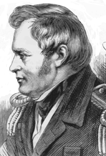
Compiled from the journals of Capt. Franklin and Cdr. Back and other contemporary texts.
Most of the locations mentioned in Franklin`s two Canadian expeditions can be found on a modern road map. I was unable to locate two of them until Dave came to my assistance, they were farther south than I anticipated. Fort Chipewyan is at the western end of Lake Athabasca in northern Alberta and Cumberland House is on the southern shore of Lake Cumberland, just inside Saskatchewan, 150 miles west of the northern end of Lake Winnipeg. One can now drive up to Fort Providence, and beyond, along the Mackenzie Highway.
Captain Franklin had not finished with his explorations in Northern Canada. At the end of 1823 the British Government decided that another attempt should be made to navigate a passage between the Atlantic and the Pacific and offered the command to Captain Parry. Captain Franklin submitted a plan for an overland expedition to the mouth of the Mackenzie River and thence, by sea to survey the coast as far as the Coppermine River, to act in conjunction with Parry. His idea was approved and Lord Bathurst appointed him to commamd the expedition which was also to explore the coast to the west of the Mackenzie River and link up with a ship in the Bering Straits.