Memoirs of a veteran naval officer - 3

The Memoirs of a Veteran Naval Officer

by
Lieutenant William Hunter of Greenwich Hospital

Part 3

In this dilemma, necessity became again the mother of invention. We recollected that below the Dockyard a wooden Bridge had been placed over the marshy ground, for the convenience of people going to Upnor; and upon this bridge a small house, or shed, had been placed for shelter in case of rain. There we took up our nightly abode, and a rare cold one it was; the sides of our dormitory being made of old ship`s planks with the trunnel holes left in them. When the lasdt night of our roughihg it out arrived, Mr John Willock, the first lieutenant, a most worthy officer, told us, he had received the Captain`s order for us to sleep on board; and never did I so much feel the luxury of a warm bed; they who have only slept on beds of eider down, can have no conception of what I felt; nor ever will, unless they first resort to an Hay-Stack and a Hovel.
As the Bedford was but badly manned, and even the few hands we could muster were poor Orkney Fishermen, Capt. Douglas requested the Mids to exert themselves in rigging the ship; this order produced considerable emulation among us, and was particularly p;easing to me, and my Hay-Stack Chum, since it gave us an oportunity of vying with our young gentry. When the Ship was ready to proceed to Blackstakes, our Carpenter found a defect in the Fore-Mast, which was accordingly condemned, unrigged, and taken out by the Sheer Hulk; and another rigged, and fitted for sea the same day. This was considered as brisk work; more especially when done by Mids, who were employed at the Mast-Head on this Service. We waited in the Downs for orders, and sailedthence as convoy to the Straits, with the Princess Louisa,60, Portland,50, and Bristol,50. After a tolerable passage we anchored in Tangier Bay; and having having taken in water at Gibraltar, sailed to the eastward as far as Cape de Gatt, where the Phoenix, Capt. Augustus Hervey, took charge of the Merchant Vessels; the Bristol returning with us to the Rock. During our stay there, while I was one day watering at the ragged Staff, (so called from the Stump Mast that was fitted into the Launch, when sent to get water, in order to hoist the casks in and out.) I observed the Sea suddenly to recede, or fall, very fast; our Boat immediately grounded on some rocks; and being apprehensive of her bilging, I started the water casks. Before this was half done, the sea rose again very rapidly. I could hardly believe the evidence of my senses; and not being able to explain so strange an event, proceeded to fill my casks, thinking that Davy`s Locker was bewitched. On my return to the Ship I found her shake, as if she had touched the ground. I threw the Lead, but found the same depth of water as when we came to anchor. It then occurred to me that a dreadful earthquake must somewhere have taken place. We soon sailed for Cadiz, where the water had risen to an amazing height; and having smuggled all the money on board that was in our power, proceeded to Lisbon; where we found the town in ruins, and its wretched inhabitants living in tents by the riverside. [*]


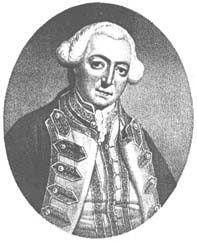
Admiral Edward Boscawen
We freighted our ship with as much money as we could procure, and sailed for England; when we were soon put under the command of Admiral Boscawen, who had lately arrived from Halifax, to relieve Sir Edward Hawke of Brest. The threats of invasion had been made by the French, who immediately after the declaration of war collected a formidable number of flat-bottomed boat for that purpose, and greatly alarmed our Government. On our second return from the Western Squadron to re-fit, Capt. Douglas left us, and Capt. Fowke succeeded him. We sailed under Admiral Holburne from St. Helens, 16 April 1757, the troops destined for North America were to embark at Cork; which having done , we left that harbour on 7th May, and arrived at Halifax on the 9th July. During our passage we carried away our main-mast, and with it one of the greatest rogues that ever entered on board a Man of War, called Spanish Tom; the rascal, however, though born to be hung, a punishment he afterwards underwent, was not born to be drowned.

At the time the accident happened he was stationed in the main-top, and was precipitated with it to a great depth in the Ocean; he, however rose like a cork, and to our astonishment survived. On our arrival in Halifax in Halifax we took the Arc de Ciel`s[**] main-mast for a main-mast, and proceeded with the rest of the Admiral`s fleet to cruise off Louisbourg. We stood in close with the harbour and saw a number of Ships of War lying there; then returned to Halifax, re-victalled our Fleet, and appeared again off Louisbourg to block up the enemy.
This attempt to block up the the powerful French fleet in Louisbourg. was made in consequence of the arrival of Capt. Geary, in the Somerset,64, with the Devonshire,64, Capt. W. Gordon; Eagle,60, Capt. Hugh Palliser; and the York,60, Capt. Hugh Pigot. But the whole was frustrated by a dreadful Hurricane which blew dead on shore; it began in the east, in the evening of September 23, and during the night veered round to the south; and thus continued with a violence that had never been surpassed, for the time it lasted, until eleven o`clock the next morning; when it got round to the north. The ran on shore, and was wrecked about two leagues from Louisbourg; her Captain and most of her Crew perished. The Ferret sloop foundered, and every soul went to the bottom. Our ship, unlike most others, was not dismasted, her masts were saved by knocking out the wedges. When the gale first came on, there were but little hopes that any of the Fleet would be saved, as we were only thirteen leagues from the land. Had not Providence favoured us with a shift of Wind of eight points, it would have been all over with us. Many of the disabled ships were sent to England under Sir Charles Hardy and Commodore Holmes. We were ordered to take Prince Frederick in tow; and proceed with her to Aqua Forta in Newfoundland, the Admiral returned with the other ships to Halifax, and thence to England,; leaving the command to Lord Colvill in the Northumberland. Having fitted the Prince Frederick with jury masts, we returned home with a large convoy. During our passage another hard gale came on at S.W. The Convoy was totally dispersed, and never joined company; and the Prince Frederick again rolled away her masts. On our arrival at Plymouth, where the Bedford was docked, I found a considerable degree of party spirit had arisen in consequence of the conduct of Admiral Holburne, and Lord Loudoun, who commanded the land forces. One of the best answers that appeared, was a letter from a gentleman in Bristol dated September the 17th, an extract from which is preserved. The ingenious writer concluded with the following postcript:- "No Captain of a Man of War ought to be consulted about wintering in Halifax; not one of them will give his vote for it, as there are no public diversions there. Nor should any man be listened to who deals in Navy Jobs."

The year 1758 is ever memorable to a Seaman, for the Bill that was then brought forward, and passed under the auspices of the Hon. Mr George Grenville, enabling our honest Tars to remit money with care and safety, to their families.
Government had resolved that the operations in America should commence with the siege of Louisbourg. The gallant Admiral Boscawen, who, on 5 February had been promoted Admiral of the Blue, was appointed to command the fleet, having under him Sir Charles Hardy, lately made a Rear Admiral of the White, and Commodore Philip Durell. These two officers sailed previous to the remainder of the fleet, the first early in January, the other in February. We followed with the Admiral on the 19th of the same month, having a number of Transports in company. For the better preservation of the Soldier`s health, this prudent Commander made a southern passage, by getting into the Trade Winds, which ran down a great part of our longitude. We made Madeira, Teneriffe and the Bermudas; and having arrived at our destination, Left Halifax on 28 May, and with a fleet of 157 sail stood for Gabreuse Bay, the general rendezvous.
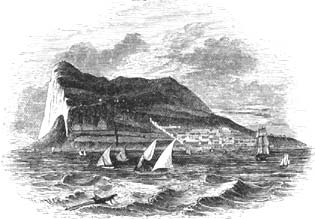

Gibraltar


* The dreadful Earthquake began at Lisbon, on the 1 November 1755, about ten minutes past ten in the morning. The Sea rose six feet every fifteen minutes, and then fell as much; this flux and reflux lasted until the next morning. It was not felt at Gibraltar until 17 November, at half an hour past eleven in the forenoon. The greatest shocks at Lisbon were on the eighth, and eleventh.

** L`Arc en Ciel, of 50 guns, was taken in 1756, after a sharp action, by the Litchfield and Norwich. She had on board 578 men, 190 of whom were soldiers. The late Comptroller of the Navy, Sir Henry Martin, was made Post in her.


Transcribed by Michael Phillips from the original of 1805.
Go to the fourth part of Lieut. Hunter`s story