Memoirs of a veteran naval officer - 4

The Memoirs of a Veteran Naval Officer

by
Lieutenant William Hunter of Greenwich Hospital

Part 4

The success of this attack is well known. I witnessed the landing of our brave troops under the most tremendous fire of cannon and musketry. We though as much of this exploit at the time, as we have since of the landing in Egypt. On the capitulation of Louisbourg our ships went into the harbour; and soon afterwards the Admiral sailed for England with part of the squadron, leaving the remainder to winter in America with Rear Admiral Durell, who had been promoted in August. By this Admiral`s order Capt. Fowke discharged me into the flagship, the Princess Amelia.
We remained some weeks in Louisbourg Harbour; but whilst there, were hardly secure from a gale of wind that blew with much violence. Our anchor came home, and the Captain ordered the sheet anchor to be cut away; when, observing that our Men were cutting the stopper in a very awkward manner, I ran forward, seized the axe and cut it away myself. - This was not lost on Capt. Bray, and from this time I became a great favourite of his, as well as of the Admiral. We wintered in Halifax; and waited there until the ensuing spring, for tyhe arrival of Admiral Boscawen, our successor on the station, with a powerful reinforcement.
The year 1759, termed by Paul Whitehead Annus Mirabilis, or the year of wondrous Feats, was particularly brilliant both in Naval and Military Events, as that Poet described it in Stanzas well-known to Seamen.

"Of Roman and Greek
Let Fame no more speak,
How their Arms the Old World did subdue;
Through the Nations around
Let our trumpets now sound,
How Britons have conquer`d the new.

East, West, North and South.
Oupr Cannon`s loud mouth
Shall the rights of our Monarch maintain;
On America`s strand
AMHERST limits the land,
BOSCAWEN gives law to the Main."

The French, irritated by their constant defeats, were again reduced to the necessity of threatening England and Ireland with a formidable Invasion. But they soon found cause, paticularly from our achievements in America, to lay aside their gasconading accounts on a new construction, which were to steal across the Channel in a dark night, and carry all before them.

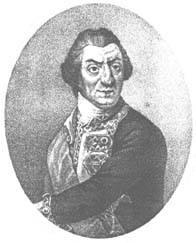
Vice Ad. Charles Saunders
Admiral Boscawen was succeeded in North America by Vice Admiral Saunders; who sailed from England on the 17 February, with General Wolfe, in order to co-operate with him in an expedition against Quebec. This was only one of four grand Expeditions in America, planned originally by the Earl of Loudoun, which this year, 1759, were carried into effect. Sir Charles Saunders, I remember, had his Flag on board the Neptune,90, Capt. Broderick Hartwell; and Admiral Holmes, who left England a few weeks before him, on board the Dublin; a name that I hope will one day be be again revived in our dockyards. This fleet arrived within sight of Louisbourg on the 21 April; but found the harbour so choked up with ice, that the Admiral was obliged to proceed to Halifax.
We were sent early in May with a Squadron to the small Isle de Coudre, situated in the middle of the River St. Lawrence, about 20 leagues below Quebec; in order to interupt some French Transports and Victuallers, who had proceeded up the river.[*]
During the passage Capt. Simcoe of Pembroke,60, died in the Gulf, and was succeeded by Capt. John Wheelock; one of our lieutenants was sent for the time being to command the Pembroke, and Admiral Durell, who in February 1759 had been promoted Rear Admiral of the White, appointed me to act in his stead. As we proceeded up this noble river I was particularly struck by its beauty. At its mouth it is full thirty leagues wide, if measured from Cape Rosiers; and is thence navigable as far as Quebec, upwards of 400 miles from the Ocean. Some make it forty leagues wide, by probably measuring from the Bay and Point of Gaspee, which are a little to the South. Above this latter Bay is a steep broken rock, with an opening in the middle of it, through which a small sloop might sail; it is on this account called The Pierced Island. On our arrival at the Isle de Coudres, the Squadron anchored in the afternoon with great difficulty; as the tide runs at the rate of nine knots. It is generally the custom to keep in the North Channel,though the southern, which is called the Pass of Ibberville, from a General of that name, is not near so dangerous. According to report, an earthquake in 1663 overturned a mountain and threw it on this Isle, which it increased by one half; and, in place of the mountain, a dangerous gulf was sunk. Admiral Durell did not allow me to remain idle. Observing several canoes and a large Launch on the beach, he ordered three boats to be manned and armed, to destroy them; which I did accordingly; but, on returning to the beach found our boats, to our surprise, all high and dry. The water had fallen six feet in an hour! Our situation necame now extremely perilous; and as we could only launch one boat at a time, and were much exposed to an attack from the woods by the Indians, I every moment expected a retaliation from the Natives, whose Scalping Knives wer not suffered to rust for want of use. Our companions on board the Princess Amelia had been informed of this danger by Mons. de Vitney, the Pilot, who coming on deck, and hearing the service we had been sent on, declared we should run the utmost risk of being cut off. The Admiral immediately made the signal to return, but it was too dark to see it. We laboured hard to get the boats afloat, and at last succeeded without any molestaion from the natives. It was now adifficult and most arduous task, with such a tide running, to reach our respective ships; I therefore particularly cautioned the Officers in the other two boats, to beware of getting athwart Hawze, and go on board the first ship they could reach; - they missed every ship, and being carried away with the whole Ebb Tide, could not return until morning. Our boat had better success; we were fortunate to get on board and relieved the Admiral from his anxiety.
The next service on which I was employed was to sound the River in the Barge; we were soon attacked by nine canoes, which we beat off. The Admiral on this placed me for greater security in an armed Schooner prize, and by the time I had finished the Soundings, Admiral Saunders entered the River on board the Hind,20, Capt. Robert Bond. I was sent to meet him and furnish instructions for passing the Straits of Coudre; which being done by the 23 June,Admiral Saunders gave me his ordersto hasten down to Capt. Alexander Schomberg of the Diana,32, who had charge of the first division of Transports, and give him directionshow to proceed up the River. On my return the Princess Amelia was sent up to the Isle Madame, where she remained stationary during the siege; and Admiral Durell was ordered to send an officer with two Petty Officers and one hundred men , in order to assist with the preparatory operations. I was now superceded as acting Lieutenant in the Princess Amelia.
Before Admiral Saunders advanced further up the River, he shifted his flag from the Neptune into a ship of less burthen, the Stirling Castle,64, Capt. Michael Everitt. In this ship he proceeded up the River with the first division of the Fleet and Transports on the 26 June; and anchoring of the Island of Orleans, a little below Quebec, immediately prepared to land the Troops, which was done the next morning. Soon afterwards a heavy gale came on, which did much damage to the Transports, and swamped many of the Boats. Our boats were afterwards variously employed, until the plan wasc finally fixed on the first of July; when Admiral Saunders moving up between the Points of Orleans and Levi, on the ninth prepared to land on the North Shore, below the falls of Montmorenci; having placed his Majesty`s Sloop, the Porcupine,14, Capt. John Jervis, and the Boscawen,16, armed Ship, Capt. Charles Douglas, in the Channel between Orleans and the North Shore, to cover the Boats. The Troops were obliged to continue in the boats until it was near low water, when there was a flat, hard sand to land them on. While we were lying on our oars, the French were not idle in in saluting us with shells, but they did no damage. On the 18 July, two Men of War, two armed Sloops, and two Transports, among which were the Sutherland,50, Capt. Rouse, with Adfmiral Holmes` Flag, and the Squirrel,20, Capt. Hamilton, passed Quebec without any loss, and got into the upper River. I was also ordered to pass the Town, with eighteen more, our oars being all muffled; during which the batteries on Point Levi kept up an heavy fire. We stopped at Major Goram`s Post, joined the ships, and proceeding up the River, endeavoured to land at a village named Point au Tremble, but the French were too strong. We then attempted the other side, St. Antoine, where we met with little opposition; raised a redoubt on high ground, and left in it a party of Marines; we the advanced higher up the River, and landed at Dechambo, where we destroyed some magazines. We were thus employed for nearly 18 days before we again repassed Quebec.


* Admiral Saunders in his dispatches of Sept. 5 says, " Before Admiral Durell got into the River, three frigates and seventeen sail, with provisions, stores and a few recruits, got up: and are those we are anxious, if possible, to destroy.


Transcribed by Michael Phillips from the original of 1805.
Go to the fifth part of Lieut. Hunter`s story