WALKING VERDUN
SOME NOTES AND GUIDANCE FOR VISITORS
For some time I have been working on a book called Walking Verdun. For a number of reasons, it is unlikely this book will be available in the immediate future, so I have added some notes here for those who wish to walk the Verdun battlefields - a most rewarding experience.
To give you an idea what there is to see, the following is an abbreviated description of a walk I made in March 1999 with one of my regular battlefield groups (thanks to Clive, Bob, Pete and 'Wiffy'). This walk will eventually appear in the book, and like some of the others I am researching, it will be based around a number of walks suggested by the Verdun Tourist Office and the Memorial de Verdun at Fleury. An A4 folded information sheet exists for each of these walks, and they available free from the Mémorial at Fleury or the Tourist Office in Verdun. English editions exist, but are often in short supply!
One word of warning - do not take or attempt to take items (souvenirs) from the battlefield. It is a criminal offence, which can carry a fine of up to 50,000 French Francs (7622.45 Euros). Despite the fact that many of these locations are isolated, they are regularly patrolled, so it is unwise to engage in such activity. Leave the battlefield as you find it, and remember that there are thousands of French and German soldiers still buried among the shell holes and trenches - these are their graves, and we have no right to disturb them.

DOUAUMONT - HARDAUMONT WALK
This walk looks at the ground north-east of Fort Douaumont, largely fought over in the opening stages of the battle in February 1916, and then again when the French retook this area in December. The whole area is part of the National Forest, and there are no problems with access for any of the places visited en-route. With the numerous stops, and forays into the 'bush' it took us just over five hours to complete the walk. It is often tough ground, with a lot of steep climbs, and those not used to walking should make sure they are adequately prepared.

Click here to view full size map.
We parked our vehicle in the parking area of Fort Douaumont, and made for the main information boards alongside the car park. We then followed a signboard for 'batterie tourelle est de Douaumont', which takes you off into the trees. Passing signs of shell holes and trenches, the path brings brought us out to a memorial on a concrete bunker. This commemorates the 74 R.I. who, during the fighting for Fort Douaumont on 22nd May 1916, lost 72.2% of their effectives within twenty-five hours - a high casualty rate. From here we continue on through the trees, and joined a main ride through the forest that would eventually take us to the site of Bezonvaux village. However, as we had brought with us a number of French trench maps, we decided to try and find 'Post Command Alsace', which we noted was off in the 'bush' somewhere nearby. After about an hours searching we finally found a large mound with a few odd bits of concrete which we suspected to be P.C. Alsace. This was a most rewarding diversion, and is typical of the type of exploration you can get up to, quite legitimately, in the Verdun forests.
The ride eventually took us downhill into Bezonvaux. This was one of the 'lost villages' of Verdun - never rebuilt after the war. In 1914 it had been a small community with 149 inhabitants, and by the time of the Battle of Verdun, was just behind the French front line. It was captured in the early
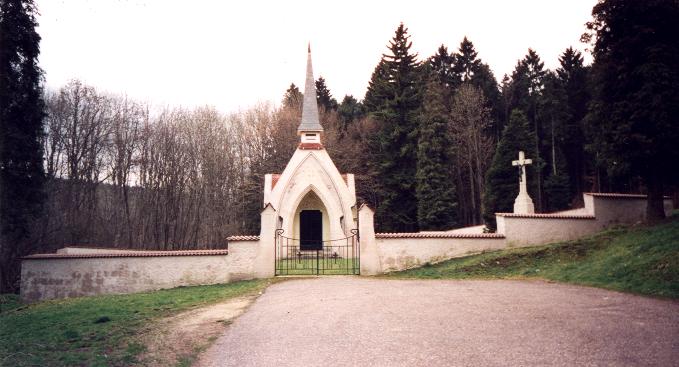
The chapel at Bezonvaux (©Paul Reed)
stages of the battle in February 1916, and remained in German hands until the end of the battle in December. As with most of the 'lost villages' of Verdun, although houses were never rebuilt, there is a chapel and memorial on this site, plus an information board with further details of what went on here.
Leaving Bezonvaux, we returned in the direction of Douaumont, this time following a different route, and roughly in the line of the German advance in February 1916. From Bezonvaux the ground rises up to a high point, and following the ride, and using our trench maps, we eventually came out to where the main defensive position was in this area - the Ouvrage de Bezonvaux. An Ouvrage is an earthwork, a small redoubt with trenches, dugouts, firing positions and barbed wire. There are many of them on the Verdun battlefield, and they formed part of the overall defences in the area - it wasn't just large forts!
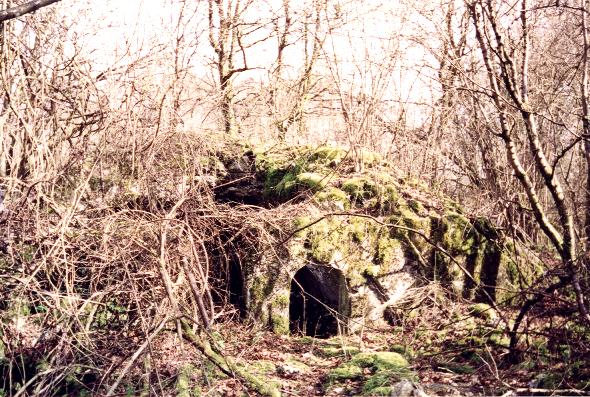
Entrance to an infantry shelter at the Ouvrage de Bezonvaux (©Paul Reed)
Although this area is now forest, in 1916 the Ouvrage de Bezonvaux had a clear field of fire and an imposing view across this part of the battlefield. It consisted of a number of trenches and firing positions, along with several concrete infantry shelters. Attacked in the early stages of the battle, it fell to the advancing Germans and was thereafter used by them as a billeting area until retaken by the French at the end of the battle. We found the Ouvrage only twenty yards or so into the 'bush' from the main ride, and there was clear evidence of heavy shelling, and also the later German occupation: one shell hole contained the remains of mess tins, wine bottles and ration tins. The concrete infantry shelters were in good condition and looking inside, we found the original rifle racks still in evidence. Entrances to dugouts were also found and here another word of warning - many of these are deeper than they look, and it is unwise to disappear down them, as you might not be able to get back up! This is especially so if you are walking on your own. I can assure you that you are unlikely to find a German Picklehaube hanging from a peg down there - remember this position would have been looted by both sides in the fighting of 1916, and experienced soldiers would have left nothing behind! You are more likely to find rubbish, thrown down there after the war. However, this visit to the Ouvrage de Bezonvaux is again typical of what there is to see in the off-the-beaten track locations on these walks.
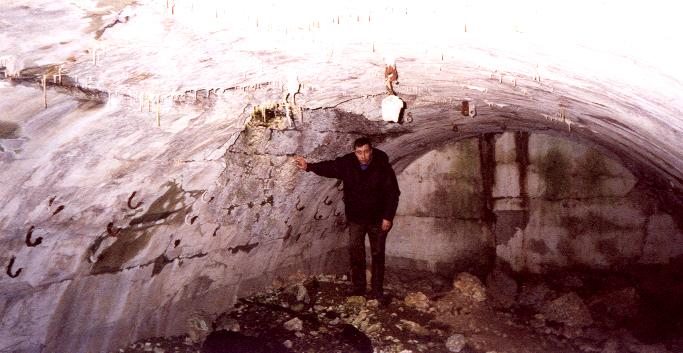
Inside one of the infantry shelters - the hooks for the rifles can be seen on the left (©Paul Reed).
Continuing along this ride, we followed it through and past several ravines (Ravin de Pré Sud and Ravin du Muguet), typical of the battlefield, and in one location found an old trench with a line of barbed wire pickets still out in front - it was as if time had stood still! As the main ride went west, back in the direction of Douaumont, we made a quick exploration of the Ouvrage d'Hardaumont. The Bois d'Hardaumont was on the right flank of Douaumont, and heavily fought over during the battle. However, we found fewer traces of this location, and as the rain was beginning to fall quite heavily by now, we continued on and back to the car park near the fort.
I hope this has wetted your appetite a little for Walking Verdun - the book should be out in 2003, but in the meantime email me with any questions or if you require help on visiting this fascinating battlefield.
TEXT & IMAGES ©PAUL REED 2001