OSSUARY & NATIONAL CEMETERY
DOUAUMONT
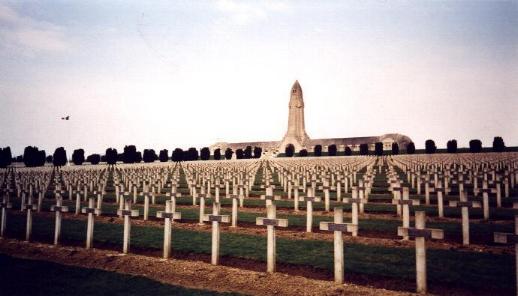
The Ossuary & National Cemetery, Douaumont
In the years following the war, the British erected a large number of memorials to missing on their sectors of the old battlefields. The French never followed this example, and the nearest they have to anything like this is the huge and impressive Ossuary at Douaumont.
Work began in the early 1920s, but was not finished until 1927, when the Ossuary was inaugurated on 18th September. Within, the walls were covered with the names of men, regiments and divisions who fought at Verdun in 1916/17 – many are to soldiers killed in the fighting whose bodies were lost. This is their only memorial. Many memorial plaques tell a poignant story – such as the one which commemorates a small patrol wiped out near Fort Vaux in June 1916.
Within the Ossuary all is silent – talking is forbidden.
But the Ossuary is not just a memorial – the very word ‘ossuaire’ in French directly translated means a ‘charnel house’. For beneath this mammoth building are the bones of more than 120,000 soldiers who fell at Verdun. Curiously, many can be viewed in glass fronted cabinets – where the grinning skulls stare out at you in a macabre fashion. In this respect, it is unique.
The huge tower has a lamp which flashes across the dark battlefields at night, and it is possible to climb the steps to the top and acquire an unrivalled view. A small shop at the rear also sells books, souvenirs and postcards.
FRENCH NATIONAL CEMETERY, DOUAUMONT
The largest of the Verdun cemeteries, there are 16,142 soldiers buried here from the fighting around Verdun. Like most French cemeteries, this one is a concentration cemetery and was constructed in the years 1923 to 1936, when graves were brought in from all over the battlefield. Further graves were added in the mid 1960s. French soldiers of every rank from simple soldier to a General are buried here – General Petain wanted his ashes to be scattered here, or to be buried amongst his men, but his leadership of Vichy France in the Second World War denied him this wish.
©PAUL REED 2001