FORT VAUX
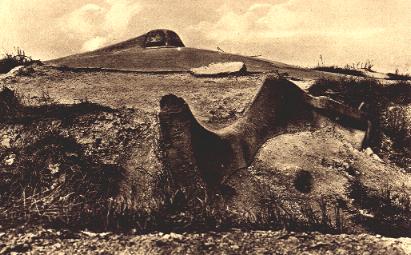
Observation Post, Fort Vaux. In the foreground remains of a 75mm turret destroyed by a 420mm shell in 1916.
Fort Vaux was built between 1881 and 1884, as part of the Region Fortifiee de Verdun (RFV). It was the second largest fort to Douaumont on what would later become the battlefield of Verdun. The superstructure was reinforced in 1888 with a concrete shell 2.5 metres thick, and further improvements continued until 1913. The main armament in 1914 consisted of two Bourges casemates with rapid-firing 75mm guns, a 75mm gun turret and several observation posts. The total cost of the fort came to 2.9 million gold francs. Like most forts in the RFV, it was disarmed in 1915 and the guns in the Bourges casemate removed. The 75mm turret stayed intact.
In the period leading up to the fighting for Fort Vaux, it was heavily bombarded by German shells of all calibres, including numerous 420mm’s. On 26th February a large German shell struck the 75mm turret completely destroying it. Heavy shells had also cracked some of the interior walls, and the armoured observation posts were either destroyed or unusable. The fort meanwhile served as a magnet for French troops serving in this sector, thousands of whom took shelter at Vaux. More than 2,000 men were in the fort each day, which meant it was virtually impossible to move around properly.
The German attacks reached the area of the fort by June 1916, when they assaulted the nearby Fumin Wood on 1st June. The next day at dawn four companies of German infantry reached the trenches just below the fort. They then moved down into the right hand coffer of the main gorge, and succeeded in entering it after sweeping it out with flame-throwers. From here a tunnel ran right into the fort. Meanwhile, more German troops reached the top of the superstructure and dug in. The left-hand coffer was entered with explosives, and fighting then began in the narrow passageways of the fort. Parties of Germans were led by flame-thrower teams, and the whole position was saturated with gas.
Life inside the fort for its commander, Raynal, and his men, was truly awful. They had sealed up the ventilation system to stop the gas getting in which meant the air had gone fowl. Water was soon rationed, and then ran out. Casualties mounted, and the dead and the dying blocked the passageways. Several attempts by the Germans to blow their way in through the roof were thwarted when Raynal called down French artillery fire onto his own position – often causing some casualties to his own men, but stopping the Germans. Finally conditions became so bad that Raynal had to consider a surrender. He sent his last message from the fort via pigeon, the pigeon Valiant, which although wounded and gassed reached the Citadelle in Verdun – where it promptly fell down dead.
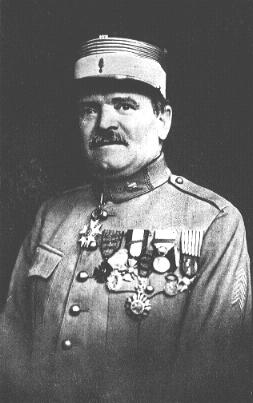
Colonel Raynal, commander of Fort Vaux.
Vaux fell at six o’clock in the morning of 7th June 1916. The Germans respected the tenacity of the French defenders, and the Crown Prince gave a special sword of honour to Raynal several days later at Stenay. He spent the remainder of the war as a prisoner.
The French tried to recapture Fort Vaux in the October 1916 offensive, but it proved more difficult than Douaumont. The first attack on the 25th failed, despite the fort being bombarded with 400mm shells from French railway guns. Another attack was planned for 3rd November, but the Germans withdrew from Vaux on the 2nd, after blowing up the last remaining observation post and some of the internal passageways. It thereafter remained in French hands until the end of the war.
Today Fort Vaux is one of the few forts on the Verdun
battlefield open to the public. For a small entrance fee you can go on a
self-guided tour of the fort, see the site of Raynal's HQ, walk the tunnels and
visit the Bourges casement, with some 75mm guns re-instated. Further details on
the Verdun Museums page.


