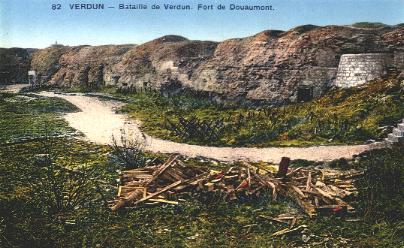
FORT DOUAUMONT
"The abandonment of this position was the equivalent to losing several thousand soldiers"
General Rouquerol
Commander of 15th Division, February 1916
Arguably the greatest wartime symbol of Verdun, Fort Douaumont was part of the so-called Region Fortifiee de Verdun (RFV), constructed in the years following the Franco-Prussian War, when a ring of forts and defences were placed around the city.
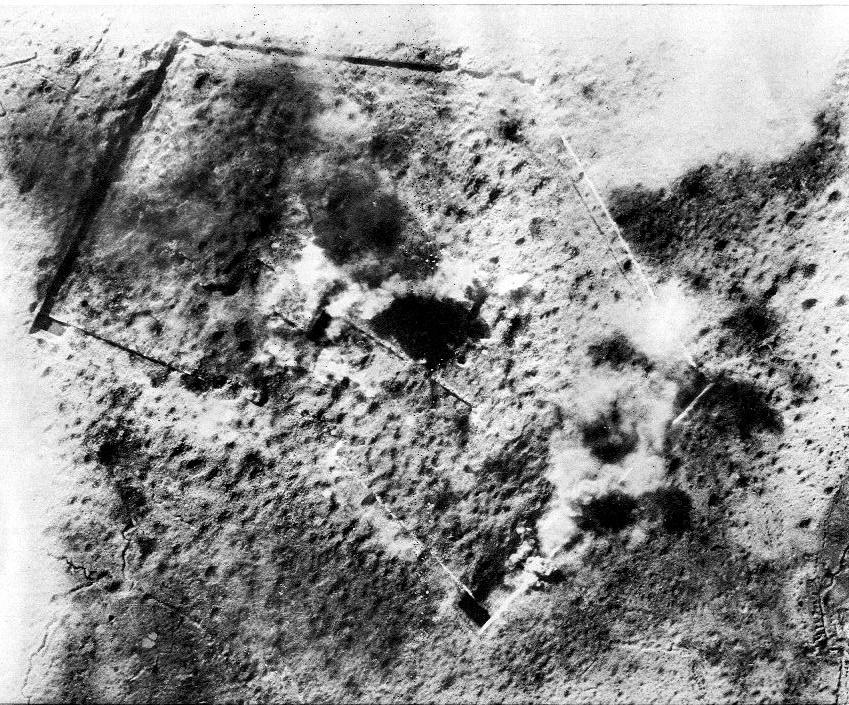
1916 Aerial Photograph of Fort Douaumont (©Paul Reed)
Click on image for larger view.
This mighty fort cost 6.1 million gold Francs, and was constructed between 1885 and 1913. In addition to the usual defences, it was protected by a concrete apron between 1.5 and 2.5 metres thick. Equipped with numerous armed posts, the key armaments were the 155mm-gun turret, the 75mm gun turret, 75mm guns in the Bourges casemate, and the machine-gun turrets. With a deep gorge, flanking casemates protecting the flanks and a large spiked fence, it was believed to be impregnable.
However, in the opening phase of the Great War Germany invaded Belgium and smashed the large border forts with huge 42cm guns – known as the ‘Big Bertha’. Similar in construction and design to Douaumont and the other fortifications in the RFV, the failure of these Belgian forts led the French High Command to downgrade the defences at Verdun and Douaumont lost much of its key armament in August 1915. The 1914 garrison of more than 400 men was also reduced.
When the German attack began on 21st February 1916, Fort Douaumont was some distance behind the French front lines but was immediately bombarded by the German heavy artillery. In 1915 it had already been struck by several 42cm shells, but these did not cause any considerable damage. However, as the fighting moved close to Douaumont, and defended only lightly with a handful of ageing territorials, the fort fell to elements of the 24th German Regiment on 25th February 1916. They entered the fort at the north-east corner of the gorge, and literally walked into Douaumont, taking the garrison prisoner without a fight and with no casualties. Its loss was a shock to the French nation, and directly led to the appointment of Petain as commander of the Verdun sector.
French counter-attacks to try and regain the fort began in May 1916, but failed with heavy losses. During the German occupation, a grenade dump explosion on 8th May led to the deaths of more than 800 soldiers who perished when a fireball swept through the narrow tunnel-ways. Some 679 of them were buried in a casemate within the fort, which is now an official German cemetery.
Fort Douaumont was recaptured by the French Colonial troops on 24th October 1916, when the Germans withdrew from the position and there was no major fighting on or within the fort itself. The preliminary bombardment for this attack consisted of nearly 4,000 shells of large calibre, including 300 370mm shells and 100 400mm shells, fired from railway guns. By this time the shell fire had almost obliterated the external workings, turning the whole Douaumont area into a moonscape.
To give some idea of the intensity of the shelling, during the period from September 1914 to November 1917, Fort Douaumont was struck by more than 120,000 shells of all calibres. Of this number, more than 2,000 were shells larger than 270mm calibre. It is estimated than more than 100,000 French soldiers fell in the attempts to recapture Fort Douaumont.
©Paul Reed 2002

