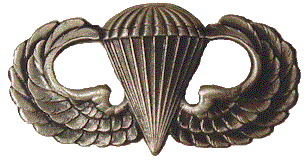
THE CORREGIDOR HISTORICAL SOCIETY AND THE 503rd PARACHUTE REGIMENTAL COMBAT TEAM ASSOCIATION, WORLD WAR II, INC. PRESENT
HOW I REMEMBER IT
by
Chet Nycum
CHAPTER 1
This is my recollection of events that occurred, starting May, 1939, and lasting until August, 1945. I was just about to complete three years in the military at Fort George G. Meade in Maryland, serving initially in the Quarter Master Corp. My duties involved driving trucks and performing labour in the warehouses storing supplies; this duty was not to my liking.
 (Photo
- Me
and my bride to be, Margaret.)
In the winter of 1939 I met a young girl who was doing domestic work for a Colonel's family, and fell madly in love, we were married in August of 1940. After our marriage she went to work for an officer in the Medical Corp. It was at this Officer's suggestion that I transfer into the Medical Corp. I served as X-ray technician at the Base Hospital; this total period of service lasted from May, 1939 until March, 1942.
When
the Japanese attacked Pearl Harbor on Dec. 7, 1941, I was on reenlistment leave
hunting deer in the mountains of Pennsylvania. When word was broadcast of the
attack I was ordered back to my outfit at Fort Meade and notified that I was
being held for the convenience of the Government, and would not be discharged
while serving in the Medical Corp.

I
became close friends with a young ward attendant also serving at the Hospital.
His name was Arvil Maxwell (Maxie). War was raging in the European Theater and
it looked as though we would be getting into it. The Army posted notices on
bulletin boards asking for volunteers for the parachute troops; Maxie ripped a
copy of the notice from the board and came to me determined to get me to join
the Troopers with him; needless to say he succeeded. Going to the Commander I
requested a transfer to the Parachute troops; my request was denied; the
Parachute troops would not take married men.
 Determined
not to let this stop me, I went to see a friend who was a notary Public. His
name was Jimmy Salyers. Together we concocted a lie and made up papers to claim
non-dependency for my new wife. Needing her signature to validate this claim, I
lied again and told her she had to sign a paper to get an allowance from my
monthly pay. Allowing her no time to read the paper, trusting me completely, she
signed it. This was all I needed for the transfer.
I
was transferred to Ft. Benning, Georgia and started Basic training with the
501st. Parachute Battalion. Within a week, my new wife was in the Commanders
office demanding that I be taken out of this "suicide outfit." The
Commander called me in to his office and told me to straighten this problem out
or he would have to let me go. Determined not to leave the parachute troops, I
met my wife at a Motel in Columbus, Georgia and during a heated argument gave
her a choice the parachute troops or a divorce.
She decided to let me stay.
We
made our qualifying jumps at Ft. Benning, Georgia. It was during this
qualification period that I witnessed my first chute malfunction. A jumper named
McGrath in a moment of panic pulled his emergency chute as he left the door of
the plane, this chute wrapped around his main chute that had deployed
automatically giving him a "streamer." He fell a thousand feet,
hitting the ground about just a short distance from where I had just landed. The
fall broke almost every bone in his body and the sound he made on impact I shall
never forget -- sort of a booming thud. His chute settled over him as though to
hide the horror from the other jumpers.
Our
training started with body building, push ups, trampoline, rope climbing,
tumbling, arm and leg exercises and running. In fact, none of us were allowed to
move outside our barracks and NOT run. Run to the mess hall, run to the exercise
field, run to the hangar or anywhere on base. There were times while running
that I lost complete feeling in my ankles, but with time I got to a point that I
could stay with the best of them.
As
time passed, we started Parachute training - learning to rig the chute, pack it
and finally to jump it. Learning to land after a jump was done from 200 ft.
towers and a mock up door of an airplane that would allow you to slide down an
angled cable, and hit the ground with forward momentum forcing the jumper to
tumble. The final events in our training were the qualifying jumps. Five jumps
were needed to qualify.

Armies worldwide are "Hurry Up and Wait!" . Ours was no different. I wait at Pope Field, Ft. Bragg, North Carolina. The trooper in front of him is McCann. The resting trooper is unidentified. Any takers?
Having
completed training we were allowed to leave the Post and go into town. Columbus
had so many troops wandering around its streets that we decided not to frequent
the town, rather we went to Phoenix, Alabama here we found a Bar named "The
Lonesome Pine".
It was here I watched as Maxie picked a fight with a guy much bigger than he,
the two of them went outside. After a few minutes Maxie came running in,
grabbed me by the arm and stated he had just killed a man.
Not
knowing what had happened I ran outside to see what he had done, his opponent
was lying prone on his back and truly appeared to be dead, as I knelt beside him
to check his pulse I noticed he was trying to gasp. Maxie had inadvertently hit
him on the Adams Apple totally cutting off his breath, I went back inside and
told Maxie what had happened.
Relieved
that the man was all right, we bought a beer to drink on our trek back to camp.
 After
training was completed at Fort Benning we moved to Ft. Bragg North Carolina. (We
were the first full Regiment of Paratroopers formed in the
U.S. Army) After approximately 3 months training at Fort Bragg, making
jumps both day and night, on one night jump I had a chute malfunction, and had
to use my emergency chute to break the fall.
My landing was rough, but I did walk away from it.
I
was luckier than one of the other jumpers, who landed in a large pond tangled up
in his chute and drowned.
We
were picked up at the jump field by trucks for the return to our barracks,
during the ride the Troopers were singing one of their favorite ego building
songs - "Gory! Gory! What a hell of a way to die" sang to the tune of
“Battle Hymn Of The Republic.”
On
another night jump, after my chute opened and I was drifting toward the ground I
was straining to see where or what I was going to land on, and suddenly saw what
appeared to be tree tops. I immediately crossed my legs, stiffened my body, and
placed my arms across my face to protect it as I slid down through the branches.
What a surprise! What I thought was trees turned out to be a field of fully
grown corn. I hit the ground in a vertical position, stowing my legs from my
hips to my feet. I had trouble walking for several days.
The
clock was running for us that sooner or later we would be sent overseas. After
making our last jump at Ft. Bragg, we were told that as soon as we repacked our
chutes we could go home for a three day leave. Well, I never saw chutes packed
faster or in so many different places. They were spread on the barracks floor in
the day room outside on the ground and in the packing shed. I think that within
30 minutes every one had his chute packed and back in the storage rack. Well, we
dressed and headed for the train station at Fayetteville.
The
train arrived but we were not allowed to board, it being completely loaded. As
it pulled out, Maxie shouted to me to grab on to one of the hand rails
used in boarding. Running to catch up I grabbed the rail and hung on, a short
way down the tracks the train stopped and the Conductor allowed us to board.
After
boarding we walked through the cars looking for a seat. We came upon two young
women occupying a double seat. They were seated facing one another, so I
approached them and asked if we could sit with them, whereupon the one girl
moved over and sat beside her friend. Maxie and I sat down and we started talked
of home towns, sports, and hobbies. After
a while the conversation dwindled into silence.
After several minutes sitting there and trying to think of something to
say, Maxie suddenly sat erect, pointed his forefinger upward, and spouted
"Poem." Pausing while we sat there wondering what was coming, he
related this verse:
"A
c*** is a hell of a creature,
all covered with fuzzy hair,
it looks like a Methodist Preacher,
and smells like the ass of a bear".
Two
totally embarrassed young Ladies leaped from their seats and in a huff went
rapidly down the aisle away from us leaving Maxie and I, now with enough room to
sleep as the train made it's way on into Baltimore.
After
returning to Camp, word came that we were being sent overseas. Making sure
parachutes, weapons and personal gear were Packed, we boarded a train at
Fayetteville, North Carolina for the trip to California. No time was lost
boarding the Ship. After sleeping quarters were assigned, our ship backed away
from the dock and headed into San Francisco Bay. The ship was Dutch and carried
the name "Poullalot." Her Skipper was Dutch and her crew was Javanese.
Only the Captain spoke broken English. Moving out into San Francisco Bay the
ship took a heading toward the open waters of the Pacific. Passing the island of
San Quentin Prison I over heard one of the Troopers comment "I think I
would rather be in there than on this ship." Pondering this in my mind, I
concluded that I had to agree, free room and board, no one shooting at you, and
the inmates knew how long they had to stay.
 (Photo:
For Airborne, we sure spent a long time being ship-borne.)
As
the ship left the Bay area, the Golden Gate Bridge grew larger, I thought to
myself, ‘here is a sight all Americans should see, the city of San Francisco
off our left stern, the land rising sharply from the Bay on the right, and dead
ahead was the Golden Gate Bridge, glowing with a bright golden glow in the
morning sun. I stood on the bow of the ship and enjoyed the most beautiful
panoramic view I had ever seen. Somehow it did not seem fair that so many
upright young men would have to die winning the war and in doing so secure the
safety of those radicals who spend their lives trying to destroy the society
that we were committed to protect. Passing under the bridge I was awed at its
size and height, giving me a deep feeling of pride in the technology that went
in to its construction and of the people who made it all possible.
Moving
out into the Pacific, the ship turned south heading for Panama where we would
pick up a Battalion of troops who had been sent there for jungle training. They
would form our First Battalion, making us three Battalions in
strength and changing our identify to the 503rd Parachute Regiment.
Arriving
in the Canal Zone, we anchored off the City of Balboa. Having never been in
tropical waters before I could not help wondering what kinds of fish were
swimming under the ship. Seeing the Troop Commander I approached him and asked
if there was any fishing tackle on board. He responded that he had tackle in his
cabin, and we headed for his cabin, where he supplied me with fishing (tackle,
rod, reel and pickled bait. This bait appeared to be either horsemeat or beef
cut into one inch cubes.) Walking
to the rail, I baited and released the lock on the reel and let the bait drop to
the bottom. I waited for about four hours without a strike. Eventually word came
that the troops were loaded and we were ready to leave, so I started to retrieve
my line. No sooner than the bait cleared the bottom, I had a strike. Pulling it
in I had the most streamlined fish I had ever seen. The Javanese chef on the
ship (through the Captain) told me it was a Queen Fish and ask if he could have
it. I had no way to cook it myself,
so I gladly gave it to him.
The
ship moved back into the Pacific and we were on our way. Our days were spent
practicing the abandon ship procedure and learning to speak a few words of
Japanese, just in case we were taken prisoner. This made no sense to me at all,
as paratroopers were usually dropped behind enemy lines and were shot as Spies
if captured. Nevertheless we were taught Japanese, learning to say ‘I am an
American,’ ‘I need water’,‘I surrender’ and ‘Hello’ (ko-ni-chi-wa).
Hello in Japanese was the only word I mastered, and I considered it to be
useless, for if I met a Jap and had time to say anything, ‘Good-bye’ would
be more appropriate.
Several
days out of Panama the gunners on the ship decided to have Target practice. A
small weather balloon was deployed about 150 yds. behind the ship.
It's altitude was, I estimate, to be about 300 ft. and the forward speed
of the ship caused it to oscillate back and forth, an easy target for the 20mm
gunners. Meanwhile the troops on board had crowded the stern to watch the show.
The forward gun opened fire, firing three rounds, then the aft gun fired three
rounds, neither gun hitting the target. This sequence of firing went on until
about 90 rounds were expended, without a hit. The inaccuracy of the Gunners
irritated the troops watching to the point that they began shouting insults at
the them. One totally frustrated
trooper with his M-1 in hand stepped to the rail, took careful aim and put a
bullet through the balloon. This ended the target practice but not the insults.
Now the gunners were ticked off since they claimed they had not been shooting at
the Balloon but were actually trying to cut the tow line just beneath it.
Not
much else happened until we crossed the Equator. I suppose all ships crossing
the equator for the first time had a ceremony, for each of us were initiated
into the "Realm of Neptune." For the initiation each man stripped
naked, had a sticky substance poured over him and feathers applied, simulating a
tar and feather application, then was forced to climb a ladder and walk the
plank. Going off the end of the plank was about a ten foot drop into a makeshift
pool of water. The route to the ladder was lined with Ship's crewmen armed with
paddles. Although we did not realize it initially, it was the ideal time for
them to get revenge for the insults they suffered during target practice. It was
quite humorous to watch the color of a man's backside change from a normal skin
tone to a bright red as he scampered up the ladder. Until it became my turn,
at which point the humor completely disappeared. I feel sure I broke
every sprint record that had ever been set moving through the line and getting
up the ladder, out of reach of those stinging paddles.
Little
happened for the next 42 days and 12,948 miles as we travelled our zig zagging
way to Australia, except for the fist fights and arguing that normally occur
when you jam 3000 men together on a 300ft ship. Those, and an event that took
place as the cooks were preparing Thanksgiving dinner (Nov. 1942).
The
turkeys were cooked and laid out for carving when someone yelled
"Whales!" and all the mess personnel ran to look out the port holes,
with their backs to the carving table. Five turkeys were stolen. The culprits
rushed the turkeys into the lower hold where they were quartered, opened the
bulkhead into the ships bilge, wrapped the turkeys in GI blankets and hid them
until the search was over.
And
what a search it was! Anything that looked large enough to hold a turkey was
thoroughly investigated. Luckily no one thought to look in the bilge. Even
though dinner was 5 turkeys short it did not appear anyone suffered from lack of
turkey for their Thanksgiving dinner. Later that day, after the turmoil of the
search had subsided those of us who were in the know enjoyed a full belly of
turkey. Looking back I now feel this was a dirty trick to pull on the men I
would soon learn to depend on so heavily in the near future.
At
the first sight of the Australian coast the Troopers on board tried to get
vantage points for a better view of Sydney Harbor. As the ship approached the
Harbor, men were clinging to the highest rigging and hanging out on the booms,
driving the Dutch Captain crazy. It was a joy to listen to him shouting over the
public address system, raving in English with a pronounced Dutch accent. Our
ship stopped initially at Sydney, but for some reason unknown to me, we were not
to disembark. I supposed we were needed somewhere else.
The
Ship headed back to sea and we turned north, and as we progressed up the coast
of Australia, rumours started that we were being tracked by a Japanese
Submarine. Whether this was true or not, the ship did stay inside the Great
Coral Reef until we were off the coast of Gladstone, where we dropped anchor and
sat for 3 days. Rumour had it that we were waiting for the sub to leave. The sun
was hot, the decks were hotter and tempers were rising, fights were breaking out
for little or no reason all over the ship. That was until one brave soul decided
to go swimming, diving from the rail (about 30ft.) to the water. Within seconds
nearly 100 men were in the water and the ships Captain was once again at his
wits end. All his efforts to get the men out of the water failed until he
announced over the public address system that there were Barracuda and Sharks in
the waters. This brought the men scrambling for the rope ladders that had been
put over the side earlier in a vain attempt to get them on board.
I
meanwhile I had gone back to the Troop Commander and again borrowed his fishing
gear. With high expectations, I baited with a chunk of pickled bait, and let the
bait go to the bottom, the depth I judged was about 300 ft. Then, leaning on the
rail I patiently waited throughout the morning and well into the afternoon, all
the while becoming more and more disheartened. Gazing down at the water, I
noticed the line beginning to drift under the ship. It was my belief the ship
was swinging on it's anchor chain, well it was late anyway, so I started reeling
in my line, to my surprise I felt gentle tugs on the line, overjoyed I
instinctively shouted "fish on" (as I have done many times while game
fishing off the coast of Maryland). Instantly the men crowded the rail around
me. With the rod tip pointing down in line with the incoming line so as not to
expose the bend in the rod (this would have given away the fish's weight) I
began reeling slowly and pretending great strain. It took some time to finally
get the fish to the surface and what a surprise! I had the damnedest catfish,
about 18 inches long a very thin body but with a head and mouth that were
enormous. Needless to say I took a
ribbing.
The next day we were on our way again, stopping at Townsville and then on to Cairns and finally disembarking. From the docks at Cairns we moved to an area along the Little Mulgrave River west Of Gordonvale.
In Gordonvale, near Cairns, an American Officer told volunteers from the local women's group 'just to make up some hamburgers' for the 503rd Parachute Infantry Regiment then expected. 'We didn't know what a hamburger was', Nancy Drexl said, but they obligingly 'made them in some sort of fashion'.
The site for our camp was ideal, flat
land and right along the river, where I knew there had to be some good fishing.
Pyramidal tents were put up and we settled in. Unfortunately no one had asked if
it was going to rain, and boy, did it rain. I was awakened by the whooping and
yelling around me, leaping from my cot to find out what was happening, I was up
to my knees in water and it was getting deeper, barracks bags, boots and socks
were floating everywhere, and the river was rising fast. It was a mad scramble
to collect your gear and feel your way in the dark to the high ground that lay
to the north.
Plodding
barefoot (there was no time to put boots on) we settled in small groups to await
daylight. Though it was still raining, we lay down on the wet ground with the
rain pelting us, and waited it out. Morning came and with daylight the rain
stopped. Everything looked bright until someone noticed a large black leech
clinging to his ankle. To our surprise we were covered with them, sucking on our
necks, hands, ankles, feet, face and other places where they had found their way
inside our clothing. We were a bloody mess. Applying the burning end of a
cigarette to the body of the leech would cause it to fall off. After removing
the leeches we made a naked dash back to the high water we had moved from the
night before, and washed the blood from our bodies.
After
a C ration breakfast we moved to a new camp site and spent the day cutting brush
to clear the area and set up tents.
The
Commander of the Regiment was a Colonel, whom I shall not mention by name, but
will refer to as the "Old Man" (typical Army slang for a Commander).
He was a man who dreamed of creating a horde of man-killing animals. He showed
no compassion for weakness or inability, and unless a man could not move he
considered him capable of everyday duties.
Each
morning was the same. Fall out in
your shorts, listen to a brief ‘Gung-Ho’ speech and then run 5 miles
before breakfast. After returning take a bath, have breakfast, fall out for
inspection and move into the field for combat practice, a practice Parachute
jump or a cross country march (usually 30 miles). I do not recall the number of
Parachute jumps we made while in Australia, but three jumps do come to mind.
 The
first was when we had a jumper drift into an electrical high line killing him
instantly. We were told prior to the jump that power to the high line would be
off during the jump. Apparently someone didn't get the word. (We named this
field "White Field").
The
second jump that comes to mind was a demonstration jump for some high ranking
English and Australian brass. As I recall this jump, we left the plane at an
altitude of five hundred feet, with a ground wind blowing at between 20 and 30
knots, (not ideal jump conditions). Leaving the plane, I turned to face the
tail, allowing my chute to deploy out in front of me. This is normal procedure
because the blast of air from the propellers is instrumental in opening the
chute. All went well, I had a normal chute opening, but as I lost altitude and
approached the ground I saw that I was going to land directly on a member of the
brass. He was holding a camera up to his face and was unaware of my presence.
Having to do something to avoid the collision, I reached up and pulled down hard
on my forward risers causing the air to spill from the rear of the chute, this
gave me enough forward momentum to pass over him. Having picked up speed with
this manoeuvre, I now had to slow down. This required pulling down on the rear
risers, to force air to dump from the forward portion of the canopy. Desperately
grabbing the risers I pulled, but it was too late. My feet impacted the ground
with a force that broke bone in my right ankle. The pain was unbearable, it
sapped the strength out of me and I could not collapse the chute that was being
held open by the ground wind and dragging me across the field.
Luckily
some of the jumpers came to my aid. An ambulance was brought in and I was
delivered to a Dr. Bradford in Gordonvale, where my ankle was set and put into a
cast. Several weeks later the cast was changed to one I could walk with (this
cast had a wooden knob attached to it's base) and returned to normal duties.
The
third jump I did not make because of my cast. My assignment for this practice
jump was to recover the static lines after the string of jumpers had left the
plane (static lines are 30 ft. web straps that have one end hooked to a cable in
the plane, and the other end fastened to the cover of the parachute pack. As the
jumper leaves the plane the static line plays out, pulling the cover from the
chute pack. This in turn is fastened to the shroud lines with a break cord. As
the jumper falls the entire parachute is pulled from the pack before the break
cord snaps freeing the jumper and allowing the chute to fill with air.)
Standing
in the rear of the plane out of the way of the string of jumpers I waited until
the last man cleared the door, then I stepped forward to grasp the static lines
that were now being held against the outside fuselage of the aircraft by the
blast of the props. I approached the door cautiously, since I had no parachute
and grabbed a handful of webbing. At the moment I started to pull, the pilot put
the plane into a hard left bank throwing me toward the open door. Grabbing
desperately, I braced myself with my hands locked on to each side of the door.
In this position I was looking almost straight down at the ground one thousand
feet below me. With my heart pounding wildly and the wooden knob on the cast
slipping on the aluminum floor of the plane giving me stomach pangs, I held on
for dear life until the plane leveled off. It took several minutes to regain my
composure, and then satisfy myself that the pilot had not considered my position
when he made the turn. After landing I was moved by truck into the field to
rejoin my Company at the jump site.
Two
man tents (Pup Tents) were set up and we settled in for the night "Oh, What
A Night." Australia has an ant, red in color, about one half inch long that
loves the taste of plaster of Paris, salt and human flesh. The ants moved into
my cast and worked their way, all the way, to the arch of my foot, stinging and
biting as they went. Breaking out my jump knife I went to work on that damned
cast, carving it off my leg and getting rid of the ants, what a relief! My legs
itched until I returned to an irritated Dr. Bradford, who put some lotion on my
leg and proceeded to install a new cast all the while expressing his feelings
about a Commander that would put a man in the field with a broken leg.
To
better describe the Old Man’s character, his morning talks usually were
debasing to the troops. One I remember started with "Did you sleep well
last night? Did you get any mail? Did
you tear it up like men or did you act like the bunch of babies you are and read
it?" This type of tongue-lashing meant very little to the troops, but as
time went on, his actions and demands on the Regiment became impossible. 30 mile
cross country marches (day or night) over mountains and rivers were common and
on one occasion crossing a very swift river hand walking a rope that one of our
Officers had succeeded in swimming to the opposite shore. One man lost his grip
and was lost to the river.
The following day the Old Man posted a notice on the bulletin board stating that the drowned man would be held responsible for his lost equipment and the cost would be paid for from any monies he may have due him.
In February two GI's on three-day manoeuvres drowned trying to cross the Little Mulgrave River; another died in April. During May a paratrooper died landing on power-lines; a fifth's parachute failed to open - he fell to his death in the presence of MacArthur and Blamey.
 (Photo:
The occasion for MacArthur's visit was to inform The Old Man about the upcoming
Markham Valley Mission. That day the troops were called out in formation, and
the General moved through the ranks and shook hands with each man, whishing him
good luck and good hunting. This being unusual for the General, some of the
other troops gave us the name MacArthur's Playboys. The men of the 30th Division
at Negros would later call us "The Banzai Boys" because we had no
heavy weapons and had to take every inch of ground with small arms. )
With the Officers and the men becoming more and more disgruntled, the
situation finally developed to a point that an Inspector General was called in
to investigate.
I
did not learn the results of the investigation until some Months later. The Old
Man was to lose the Command.
Maxie,
my closest friend in the Regiment, was from
Ada, Oklahoma, and he used Mexican words laced into an English sentence.
The most common was "moocho" meaning many or much. He was
roughly 5 ft. 8 in. tall, with a stocky build. His main characteristic was his
roughness - he loved fist fighting. On one occasion he took on 7 Australians one
at a time (the Aussies always fought fair) and beat each one into submission.
Getting
used to Australian customs was sometimes called for strenuous physical effort.
On an occasion, in a bar in Gordonvale, Maxie finished a glass of beer before I
did so he turned his glass upside down and sat it on the bar, indicating (or so
he thought) that he did not want any more. We were unaware that this action
meant something different to the Aussies who were seated at the bar, to whom it
meant “I am ready to challenge anyone in the Bar to a fight.” One of them
approached Maxie, tapped him on the shoulder, and said "I'll give it a go,
Mate." In total surprise, Maxie said "You'll give what a go?" The
Aussie replied "You turned your bloody glass upside down, that means you
are too good to drink with us, and we consider that an insult." Well, Maxie
leaped from his stool, looked the Aussie in the eye and said "Lets give it
a go." It did not matter to Maxie how big an opponent was, he was always
ready and willing to prove his ability. The Aussie led the way outside.
In
just a few short minutes Maxie was back pulling my arm and saying, “Lets get
the hell out of here,” for as we left there was a group of Aussies trying to
bring Maxie's opponent back to a state of consciousness.
None of the group challenged him as we passed.

When the paratroops arrived beer was scarce in the Gordonvale area, as it usually was in the wet season. nevertheless, the Mountain View Hotel, run by the three Winifred sisters, became a second home to many of the men. At night after dinner the tables would be cleared as Miss Betty gathered groups around her piano for singing sessions. Playing by ear, she gave them whatever they wanted; "Paratroopers' Song', 'God Bless America', 'Yankee Doodle Dandy', the latest hits; before their departure a favourite became 'The Three Little Sisters'. George Daly went every night he could - sometimes walking and sometimes catching 'the white car'. a local bus, riding on the roof if necessary. The sisters were seen as 'adopted aunts', indulgent ones, who permitted paratroopers to jump off the high hotel balcony, but who otherwise kept a firm hand on the behaviour of both Digger and GI.
On
another occasion, I could not believe my eyes, I never dreamed I would ever see
Maxie cry. Just prior to going overseas he married a girl that I feel he truly
cared for. He spent most of the evenings in camp writing letters to her, and on
this occasion he came to me with tears in his eyes. He had received a "Dear
John” letter, his wife wanted a divorce. He came into my tent, tears rolling
down his cheeks, totally depressed as he sat down on my cot. Holding the letter
out for me to read, he said "Some Goddamn no good Air Force Bastard long
dick'd me." This was his way of telling me she had wanted another man.
 (Photo:
Bob Hope and Gerry Colona paid us a visit.)
After
a few weeks restrictions were lifted and the men were permitted to leave camp.
My first excursion was with Maxie. We decided to hike into Gordonvale, find a
restaurant and get a good meal. Arriving in town we found a small restaurant
went inside and sat down. As the waitress approached, Maxie commented that he
was hungry enough to eat the napkins. Hearing this, the waitress stopped and
took a step back, turning bright red as she blushed. (Also unknown to us, the
Australians used the word serviette to refer to table napkins. Napkins, to them,
were kotex to us.)

(Photo: Maxie and me)
It
took some time for us to get used to the Aussie accent. In a few seconds the
waitress recovered her composure, and came to our table asking what we would
like to have. I asked what they had to offer, she replied “naike an aiges”.
Not being able to interpret her words, Maxie looked at me and asked “What did
she say, snake?” The waitress responded with “No, no, naike, naike, naike an
aiges.” We sat there and stared intently at her as she spoke it appeared she
was trying to say steak. I blurted out, "Oh, you mean steak, steak and
eggs." With a nod and a big smile, exposing the fact she appeared to have
no teeth, we proceeded to place our order. Turning to me she asked how I would
like it cooked, I told her medium rare. Turning to Maxie, she askes " 'ow
bout you?" He replied, "Oh, I don't care - knock his horns off, blow
his nose, wipe his ass, clean his hoof's and trot him in here.” Well, needless
to say the young lady was again embarrassed. In a huff, with order in hand, she
turned and walked briskly to the kitchen. After about a ten minute wait she
brought two orders of steak and eggs to the table, my steak was cooked to
perfection, Maxie's had never been near the fire, his was totally raw.
Recognizing
the error of his ways, he asked politely if she would please have the cook brown
the steak a little where upon she returned his steak to the kitchen. A full
twenty minutes passed before his steak was returned and it was burned black,
hitting it with a knife handle would cause pieces to break off. This was too
much for Maxie, he leaped up from his chair, nearly upsetting the table and made
a dash for the swinging doors that led to the kitchen. Though his entrance was a
dash, his exit was a sprint! The cook, a man of about fifty years, was behind
him with a meat cleaver swinging it wildly. Maxie went out the front door and
did not return. The cook came over to the table where I was enjoying my steak
and explained that he just could not stand having his daughter embarrassed that
way. It was during this conversation that he and I both learned of the
Australian and American differences between serviette and napkin.
 (Photo:
Most of us who could ride were able to acquire a horse. We looked like
'Sundowners')
Back
at Camp, I occupied my leisure hours wandering through the bush investigating
the area, trying to see as many new animals as I could.
There were many small tree-dwelling creatures that looked a lot like our
Opossum in size, but with pink nose and ears. Iguanas averaging three to five
foot long, flying squirrels, flying fox and a great variety of birds. It was
during one of these excursions that I met a Young Aboriginal boy named Tommy
Ambryum.
Unlike
the tribes further north, Tommy spoke fluent English with an Australian accent.
Listening to him talk was novel, totally unlike any Black I had ever
heard speak before. As time passed I met Tommy's family. His Mother was a woman
about five foot tall, weighing about 180 lbs. and his Father about the same
height but would only weigh in at about 110 LB. Tommy had two brothers and two
sisters, Tommy being the oldest.( I judge about 14.) Through Tommy's Father, I
became quite adept at throwing a spear (a six foot lance made from the iron wood
tree).
I
recall an incident while spear fishing in the Mulgrave River, when Tommy's
Father speared a fleeing Eel from a distance of thirty feet, he was extremely
accurate with the spear. I spent many hours listening to him relate tales of the
old days catching Brumbies (wild horse), Kangaroos, Wallaby and the Dingo (wild
dog). Having developed a close relationship with this family, Tommy's Mother
asked if she could do my laundry? So, for two Pounds per week she performed this
task for me. The money I paid her
was quickly drunk up by her husband (he loved his Booze).
Meanwhile
Tommy trapped Parakeets and brought them to me in an effort to find one that
could be taught to talk. During one of my early excursions into the bush, I met
an Australian appearing to be about my age.
He was in the bush not for sight-seeing but to hunt wild pig. My first
thought was, why is he not in the Service? This question was put to him
immediately after introductions. He explained to me that he was Italian by
birth, and that his father and brother were incarcerated for the duration of the
war, but he and his Mother (he referred to her as Mum) were left to tend the
farm.
With
an awful lot in common for the bush country, we soon became close friends. His
name was Berto Poppi. Their farm was about three miles from camp, located on the
south side or the Little Mulgrave River, and their crop was sugar cane. Each
evening after dinner, I would hike to the farm. Sugar cane was a new commodity
for me, and I wanted to learn more about it. When there was no cane to cut or
tend, and after the horses were bedded down, Berto and I would head into the
bush, he with his 22 caliber rifle, while I carried a 45 caliber pistol (Army
issue). I must admit that we seldom killed game, a few scrub turkeys, a pig, and
a few pigeons are all I remember carrying back to the farm.
 The
name of my horse was Slow Motion. No prizes for the reason why.
Most
of our time was spent with Berto teaching me the things to avoid while in the
bush. Through Berto I became familiar with the "Stinging Tree" and the
"Wait-a-while Vine." The Stinging Tree grew as small as a bush, and to
as large as an Elm, it had a large heart shaped green leaf covered with a stubby
fine hair like substance and portrayed a purple spot at its center. While
pushing my way through the bush, I accidentally had a leaf brush my nose, it's
sting felt as though I had been hit by a Hornet. I spent the next hour splashing
water on my face and packing mud on my nose to relieve the pain. He also
demonstrated how a Small Stinging bush could be wrapped in a cloth, and beat
between two rocks to get the sap running, then tying the bundle to a rock and
tossing it into the water. The
potency of the sap would stun the fish and cause them to float to the surface
belly up. Catching fish was a matter of just picking them off the surface. After
a few minutes the remaining fish would recover and swim away.
The
wait-a-wile vine is named for it's action when coming in contact with a moving
person or a thin skinned animal. Just slightly larger than a Spider's web it
hangs from the trees with thorns pointed upward from it’s dangling end.
Contact with it causes an immediate stop to one’s forward progress.
Especially if it happens to attach to the bridge of one’s nose.
After
a period of about nine months in Northern Australia roaming the bush country
with Berto, I became quite adept at moving silently and avoiding stinging trees
and wait-a-while vines, and my eyes grew sharp at spotting movement in the bush.
I feel it was this exposure that made several of my enemy kills possible
after moving into combat in the jungles of New Guinea, and the Philippines.
(Photo: Gridiron puzzled Australians as much as Australian rules, rugby, rugby league or soccer did Americans. Newspapers often included serious articles trying to explain the game. A series beginning with 'The History of American Football' appeared in the Cairns Post on 3 August 1943, continuing with other pieces explaining the rules, before a match between teams from Cairns and Gordonvale, the latter consisting of real paratroops (there were unreal ones? - Ed) It ended in a scoreless draw before a crowd of 8000.)
Word
finally came that we were to prepare to move out. We were given two days to
strike camp and completely clear the camp site. The land was to be turned back
to the Australians as we had found it, except for the vegetation we had cleared
away.
On
my last evening I went to see Berto, to my surprise all the people I had met at
Berto's farm were gathered to bid me good-bye.
It was an evening I shall never forget.
The
following morning we boarded a ship and left Australia.
GO TO PART 2
- THE 503rd IN NEW GUINEA -


(Extracts are from 'Yanks Down Under 1941-45, the American Impact on Australia' by E. Daniel Potts & Annette Potts, Oxford University Press, Melbourne 1985).
