| "Better have the books corrected." |  |
| "Better have the books corrected." | |
Mac leaves the Rock - but from where?
|
|
 North Harbour (1999) North Harbour (1945)
North Dock
South Harbour (1999)
South Coast looking towards Camp and Ordnance Points (1999) These photos are from the crest of Malinta Hill, which is one of the most rewarding of the trails. |
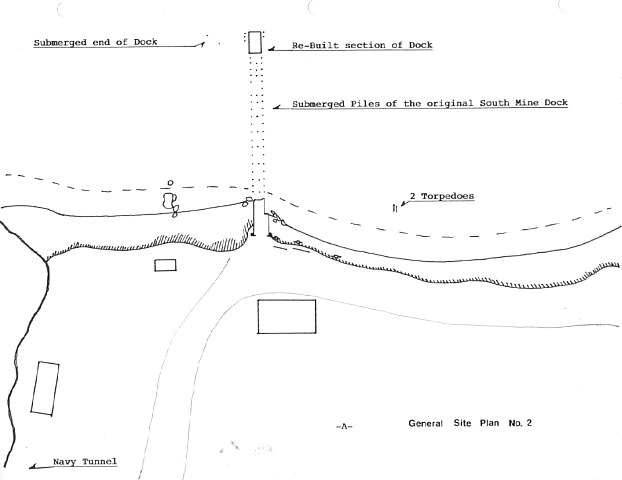
North Harbour was the Army's installation. The USN installation was South Harbour. I don't doubt there was a lot of Army-Navy rivalry, but I don't accept being told by the Corregidor Foundation's official guides that MacArthur left Corregidor from the Lorcha Dock which serves the North Harbor just because it was the Army facility. The Foundation, succumbing again to the temptation of rewriting history, has even put a larger than life-size "I shall return" statue of MacArthur on the shore of the North Harbour. D. Clayton James, MacArthur's pre-eminent biographer (at P.100 of The Years of MacArthur Vol 2) says he left from South Dock. MacArthur himself described the scene (Reminiscences., McGraw Hill 1964 P.142).
|
The interesting thing is that, in all probability, MacArthur, his biographers, and most of the textbooks who follow them, were wrong. How do we know this? What started this was that a veteran member of our Corregidoros "loop", Al McGrew, reminded me that his long-time buddy, Bill Delich, stationed at Searchlight No. 1 (which is at Battery Point, on the North of the Island) was to shine the light to guide Bulkeley's PT-41 through the north channel minefield. Instead, when the searchlight was turned on, it squarely illuminated Bulkeley's boat with its "precious cargo" on it. Bill, Al says, never forgot the ass-kicking he got for that.
This caused much controversy amongst us, particularly me, because I admit to being a stirrer who wasn't about to accept the eye-witness testimony easily when I had MacArthur's own word for it. Unfortunately, the details of lesson in history that I was served got wiped in a recent website move (I would dearly love to reproduce it, honest!) However, at the end, I had to cry "Enough! I'm convinced!" when Jay Cole, of Kennesaw Georgia, wrote and told me that a colleague, Ned Jay of Atlanta, had interviewed retired Admiral John D. Bulkeley, skipper of the PT Boat upon which MacArthur departed the Rock, in 1987 for a TV Documentary.
| JOHN D. BULKELEY:
|
"We came to the North
Dock...and that is the north side of Corregidor. The real genius of MacArthur, going back,
is this: Despite everything being said in various newspapers and books, was the fact
that he chose to go by Motor Torpedo Boat, and a breakout by high speed boats. No one
thought, and certainly no military people, and certainly not the Japanese, that this was
feasible. Naturally, such a breakout would have come from a...would be by submarine. But
it'd be most difficult to use submarines for a breakout, or for...to take General
MacArthur to the south. And the real secret was to breakout of the Manila Harbor
itself...the entrance. The Japanese by this time had approximately 22 ships blockading the
entrance there...entrance to Manila Harbor...and, of course, blockading Corregidor. The
intent and purpose was to capture MacArthur, and it looked like it was almost hopeless for
him to make a breakout. MacArthur went down each line of the Generals, shook their hands, and picked each one, or told each one, that he was nominated to make the breakout with him. The others we left behind, and, he said the proper words of condolences and so forth. He also said that he would promote them one rank, so that when they're...if and when they are captured, that at least they'd be better treated in the prison camp. As far as the Breakout is that...Breakout, itself is concerned, it was dark, and it was a rather rainy, misty night. We went at high speed, ran through the mine fields, which we knew like the palm of our hands...no problem at all."
|
| BRUCE M. BACHMAN As a naval Lieutenant and member of the Inspection Board, Mr. Bachman was also Aide to Admiral Bulkeley, and accompanied him on a 1977 visit to Corregidor. So, this , then, is also an eye-witness account.)
|
It
was August 7, 1977. Bulkeley and his Washington board were on the tail end of one of their
patented ship inspections in Subic Bay, Philippines...
August eighth. Typically hot, sweaty, and humid in the P.I.'s. Armed with piercingly accurate memories and poignant accounts, Bulkeley, with twelve of his men, boarded a navy helo at 12:38 P.M. for what was to become a trip of emotion, reverence, and gratitude... At 1:30 P.M. on August 8, 1977, John Bulkeley stepped from the lumbering copter onto the personally familiar sand and grass of Corregidor. The helo had touched down not more than 100 yards from the monument that had been erected in 1949 to commemorate the significance of Corregidor as the seat of the Commonwealth of the Philippines during World War II and the subsequent shelter for Philippine president Quezon and the scattered American forces... His twelve-man group had now become thirty, as Filipino marines assigned to the island rushed to the area where Bulkeley stood. (Bulkeley laid a wreath at the monument). Salutes were snapped off at a crisp, appreciative pace by the newcomers. They too were aware of the significance of Bulkeley's presence on this stifling August day... Bulkeley seemed anxious to move out (from Malinta Tunnel), as he and the bus driver knew the next stop, even though the two of them had not spoken since the initial greetings of the afternoon. When the bus rumbled to a slow stop near the water's edge, Bulkeley jumped from his seat and exited. By the time the last passenger on the vehicle had stepped down, Bulkeley had sighted and positively identified the pier from which he and his PT 41 boat had departed with his "precious cargo". "There it is! No question about it." "Are you sure, Admiral? The Philippine history books say it was that one over there," the P.I. marine officer escort cautiously replied. "Well, the books are wrong. This is definitely the pier we left from. The north pier. Better have the books corrected," the admiral quipped with a twinkle in his eye... Ten children between the ages of six and sixteen descended upon the pier, screaming and holding a book above their heads. "Admiral, Admiral, Admiral," the little ones yelled as they ran... Dripping with sweat and visibly moved, the admiral opened his arms and allowed the young Filipino children to encircle him and touch his uniform and body. He had returned, this combat hero that was a part of every P.I. child's history...One at a time, they fumbled through the books they had brought, looking feverishly for the chapter on Bulkeley. "The oldest of the youngsters found it first and eagerly showed the returned hero a picture of himself, taken nearly thirty years ago...Bulkeley stared at the photograph for a brief period, smiled, and began autographing the books, one at a time, asking each child his name and taking the time to personalize each inscription as he proceeded...Each child shook hands with the man they had run nearly two miles to see, stepped back, and saluted. Before their hands had returned to their sides, they were off and running, screaming at the top of their lungs of their new treasure. The impact on the American visitors was awesome..."Where did the children come from, Major?" questioned Bulkeley of the Philippine escort. "The deeply tanned major turned to Bulkeley and replied, "They are the children of the officers and men who are assigned to Corregidor as guards...I can guarantee you, Admiral, that every man, woman, and child who has lived here or will live here in the future knows of John D. Bulkeley. And not only because of General MacArthur. President Quezon's escape is regarded as greatly by our people as your general's escape." "And your sinking of Japanese ships saved the lives of more than just a few of our soldiers as well. So,Admiral, although you are an American hero, you are our hero as well. Okay, Admiral?" "Okay, Major. Yes, okay." -An Honorable Profession. The Life and Times of One of America's Most Able Seaman:Rear Adm. John Duncan Bulkeley, USN. Bruce M. Bachman. Vantage Press, New York.1985. pp. 186-191
|
|
The Lorcha Dock |
|
| MacArthur | GHQ | |