
The Lean Years
Paschal N. Strong
The author, a Colonel in the Corps of Engineers, was involved in the construction of the Malinta Tunnel. This is the story of how malinta was built.

As any intellectual will tell you, the phrase "military mind" represents the nadir of mental negativity, the dividing line between the vegetable and the animal kingdom. Our profession was in particular disrepute between World Wars I and II, and while we were kept in a pleasant enough captivity, our childish antics as we played make-believe soldier with pop guns and cap pistols must greatly have amused our keepers.
These reflections were occasioned by the running of a home movie which showed the construction of the Corregidor tunnels fifteen years ago. I kept this reel hidden under the bottom of a trunk in 1942 convinced that if the Japanese even obtained and discovered how the tunnels were built they would assault Corregidor with the first stray battalion they could shake loose from Bataan. Curiosity, if nothing more, would urge them on, for indeed few modern fortifications have been built with the assistance of a Moro who would be a free man today if he had tempered his resentment against his mother-in-law. I was ordered to the Philippines at the close of 1932 as a lieutenant of engineers of some ten years service. Promotion at the bottom paced vacancies at the top in those days and the Army was deplorably healthy. My station was Corregidor and the engineer mission there was expressed with simplicity: Build tunnels in the rock but don't bother us with foolish requests for money or equipment..
This refusal to be bothered for money or equipment was not as bizarre as it seemed. Ten years previous we had sat down at a table in Washington with England, France and Japan and when the admirals had been carried out in straightjackets we emerged with a 5-5-3 Navy and a promise to Nippon not to modernize the Gay Nineties fortifications of Corregidor. For this we received a gleeful promise from the Japs not to fortify the mandated islands of the Pacific. It was distressing to know, in 1932, that the Japs were as busy as little bees in those islands with concrete and guns, but Congress would not appropriate a nickel to provide air raid shelters on Corregidor because "it would be an insult to a friendly nation". Insult or not, the commander in the Philippines was worried. He was keeper of the gates, and was responsible for the defense of the Philippines regardless of what had happened elsewhere. I knew nothing of high army policy for though a lieutenant of those days was roughly equivalent to a major of today, neither rank provided much insight into the workings of generals' minds, Ralph Ingersoll to the contrary. Nevertheless I suspect that the Department Commander had sleepless nights as he considered the bird's-eye view of a fortress designed when the Wright brothers first flapped their wings. I remember especially our only two really long range guns, Smith Number One and Smith Number Two. Sited the middle of a circular concrete blanket, they resembled from the air two inviting bull's eyes. And while they and other guns could be partially concealed by umbrella camouflage, undoubtedly the enemy already had every gun position on his maps. And nowhere in the three square miles of the "Rock" was there an air-raid shelter where even a rabbit could hide. TUNNELS FOR CORREGIDOR
So the commander, if I read his mind correctly, consulted with his conscience, weighed his responsibilities and the lives of his garrison against promises which were now unilateral, and told the engineers to build tunnels in the 'Rock" in spite of no money or equipment. He didn't really expect us to claw out the tunnels with our fingernails, so we set out to rustle up what ever the Islands could furnish. We found, as he hoped to find, that the gold mine owners of Baguio were peculiarly sensitive to the matter of a possible Jap attack. And while their sensitiveness didn't drive them to such drastic extremes as offering us funds or usable mining equipment, still there were some abandoned compressors, *** drills and mining ***oars in their junk piles that we were welcome to - for a nominal rental. The items were rusty museum pieces, but we took them all and made them work. The next necessary thing was explosives, lots of explosives. We found a bonanza in the Ordinance Department, which had thousands of tons of condemned TNT in the States that was about to be destroyed as unfit for human destruction. We gratefully accepted the lot, and an Army transport brought it over. We were dismayed to find it in powdered form instead of the usual blocks, which fit so nicely into holes in the rock, but the ladies of the post came to our rescue. They saved all their old magazines, and with the pages we wrapped the condemned TNT into useable cartridges which could be inserted into the long holes drilled into the volcanic rock.
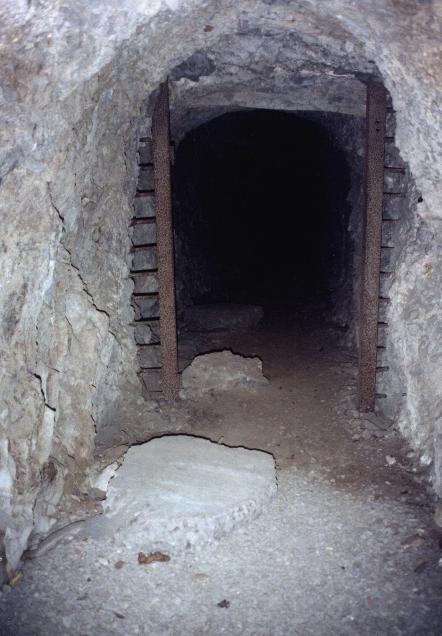
Labor was the next item. The Philippine Government, after some persuasion, offered us a thousand Bilibids, so name after Bilibid Prison from whence they came. Most, if not all, of these convicts were serving life sentences. There was no capital punishment in the Islands and they were a mixture of Tagalogs, Igorots, Moros and for all I know, many other peoples of the Islands. The Moros represented a special problem, of which more anon, but all the convicts had one thing in common. They had to eat to work. The fish and rice provided by the Philippine Government's daily ration of six cents kept them alive in prison, but it was soon evident that we must dig into our pin money if they were to shovel rock. A company of engineers from the Philippine Scouts provided an excellent gang of foremen, clerks, et cetera and an Irish sergeant whom I shall call McCarthy was general foreman when sober, which he frequently was. He drove the workmen hard, for which he received a shattered skull in due time, and was precious to me beyond rubies. Thus the work began. The idea was to punch a large tunnel through Malinta Hill, in the center of the island, and to excavate a total of twenty four tunnels on either side, at such an angle that the project resembled the backbone of a fish with twelve smaller bones slanting from each side. The large tunnel was nearly 1,000 feet long, 15 feet high and 24 feet wide. The smaller tunnels were 10 by 12 by 100 or so feet long. We worked on the main tunnel from both sides of Malinta Hill, and my favorite nightmare was that the two headings, instead of meeting head-on in the center of the hill, would pass each other quietly like ships in the night. The midnight that we set off our first blast was a memorable one. We had a pattern of seventeen loaded holes in the heading each to be detonated by a short length of time fuse. Electrical caps were a luxury beyond our dreams. My mind was on engineering rather than on military matters, and I overlooked certain trivia, such as that I was working within a fortress whose guns and search lights were perpetually manned by a skeleton alert, and whose garrison was never allowed to forget that any Jap attack would be unheralded. So I failed to notify the defenders what to expect.
At precisely twelve, the soft tropical night was rent by a series of explosions which sounded like the uneven salvo of attacking battleships. The echoes had hardly bounced back from Bataan when a dozen alarms sounded, searchlights stabbed frantically into the China Sea and soldiers rushed to their stations in all clothing and no clothing. I was gratified to note this stirring example of a garrison that would not be caught napping but the commanding general summoned me and concealed his pleasure admirably. If I was mentioned in dispatches, it was not the kind of mention to dwell upon. BILIBID TROUBLE The main headings pushed slowly into the volcanic rock, much too slowly and the reason was obvious. The Bilibids were loading into the ***ears an average of 1 yard of rock a day per man. They were no fools. They could be worked only eight hours a day, and if they worked slowly, we could do nothing. So they chattered like happy children as they leaned on their shovels and greatly enjoyed our exasperation. Clearly some understanding with them was in order. We constructed shower baths in the cool of the mango trees outside the tunnel, and furnished cigarettes for them to smoke as they lolled about after a shower. All they had to do was to complete a certain task each day and out they could go to the showers and smokes. After some experimentation, we reached a mutual agreement that 4 yards of rock a day per man was just about right. They could complete that in six hours, and have two hours to bathe, smoke and loaf before returning to the stockade. Five yards a day required seven hours to complete and the Bilibids figured it wasn't worth it. Our lack of funds produced one interesting phenomenon. The main tunnel was slightly downgrade and on the upper side of the bill a donkey steam engine let the train of narrow gauge cars roll down into the tunnel then pulled it up to be dumped. But we had no money to buy coal. We had plenty of compressed air, furnished by the rusty electric compressors operated by the Corregidor diesel power plant, so we ran the donkey engine on compressed air. As a result, the steam cylinders were coated with frost as the expanding air cooled, a sight that required constant explaining to unscientific visitors.
As the two main headings progressed toward one other through the bill, we punched out the side tunnels and made crude blowers to exhaust the poisonous TNT gases. It was in one of these side tunnels that McCarthy's skull was splintered into a jigsaw puzzle. A gang of eight Moros worked this heading, and one day when McCarthy was in there they turned on him with pick and shovels, possibly hoping to exp*** their arrival in the seventh heaven of the Mohammedans. One of the Moros dragged the unconscious *** away from the *** before they finished but when the surgeon examined the X-rays, McCarthy was measured for his coffin. However they underrated the resilience of Irish skulls, and he *** to see the tunnel completed. The incident furnished me with my most cherished memory of Filipino officialdom. I wrote to the authorities in Manila, told them about the Moro who had saved McCarthy and requested that some clemency be shown to him. In due time I received an answer, written in the *** script of the Filipino clerk. The government was happy to inform me that they had granted a full pardon to the Moro for the unfortunate murder of his wife. However, as he was serving a concurrent sentence for the slaying of his mother-in-law, his services would still be at my disposal.
While McCarthy was still recovering from his battered skull, I happened to be in a heading with a group of Moros when the lights went out. I had tossed away my lighted cigarette, and in the darkness I quietly eased across the width of the tunnel. I thought of the *** that the Moros were promised upon returning to heaven after killing an infidel, and deplored *** for virgins in the hereafter. The Moros knew that I was scared witless, and their delighted chuckling still echo in my more obnoxious dreams. FINISHING THE JOB The night that we blasted the last remaining rock between the two approaching tunnels found me *** and confident. The Coast Artillery officers had placed bets on how closely the two headings would meet, a large crowd of them were present for the occasion. I was offered odds that the two headings would match in line or elevation by several feet, but being a man of honor I would accept only even money. The headings matched by inches, a fact which I had previously determined by punching an exploratory drill hole through the rock wall. . To date we had spent only small change on the tunnels. But now we found the brittle holes in the rock would not stand up by itself. It peeled off in large chunks from the roofs, and gave evidence of sloughing indefinitely. An inspecting **** general very nearly conked by a roof fall, and though he suspected that I had arranged it purposely, still he agreed that the tunnels must be lined with concrete. Concrete requires sand, stone and cement, and the latter was beyond our ability to manufacture. The Army had money only for pay, food and a few rounds of ammunition a year and maintenance of barracks and ***. I can not say that the "brass" deflected the maintenance funds. I know only that they dug up $10,000 somehow and that our quarters began to leak. With the bulk of this money we bought cement from the Japanese. They offered it to us for 50 cents a barrel, delivered at Corregidor. The prevailing price was more like $2.50 a barrel, but possibly the wily Jap knew he was merely lending the cement to us in return for concrete to be delivered at some future date. At any rate we lined the tunnels with concrete placing it above the arch forms with Rube Goldberg machinery made in our machine shop by using mechanical geniuses. OPERATION NEGRITO
It was about this time that the defenders of Corregidor were faced with an emergency that called for resolute action. One of the Bilibids escaped. He was a diminutive Negrito whose natural habitat was the highlands of the Marivales Mountains on Bataan. How such a child of nature became involved with the Filipino law I do not know: possibly an arrow from his little bow feathered itself into the pants seat of some Filipino official hunting the wild pig. At any rate, he was with us, and he escaped. Since there was no way for him to get off the Rock without swimming the 3 miles to Bataan, obviously he must have found a hiding place nearby. Night after night he foraged, morning after morning some icebox among Officers Row would be stripped. Sentries were posted, doubled and trebled, but the little creature continued his raids. The gauntlet was hurled, and the Army met the challenge gallantly.
The staff went into action first and prepared plans annexes** and maps. In later years I was involved in the planning for the invasion of Normandy, a comparable activity and I like to think it was on such groundwork as Operation Negrito that our General Staff developed its excellence. With the plans and annexed** and maps prepared, the officers of the three regiments were briefed. Then to the clarion call of the bugle we took the field. We moved swiftly and energetically. Within a few hours every square yard of the Rock was searched. Not a bush, building or ravine was overlooked. The sweep was made in a continuos line of warriors so that the quarry if forced from one hiding place to another, would eventually be forced into the sea. But when the unbroken line reached the cliffs and looked down upon the raging breakers below, the child of nature was still free.
IWeeks later his hiding place was discovered - a hole in the vertical face of the cliff looking across the bay to his mountains. He was captured soon after that and everyone was sorry. He had endeared himself to us by that time and the bolder housewives had taken to leaving special dishes for him in the icebox on nights when they thought he might be around. By this time the tunnels were completed and I was able to build a boat and cruise among the Southern Islands before returning home. Years later more tunnels were built in Malinta Hill, but the builders had money and equipment. The Army was already being spoiled, and if this sort of thing continued there's no telling what it may lead to.
|

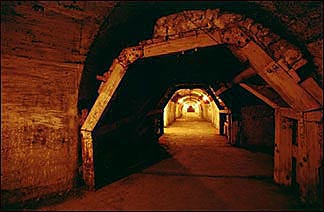




 It is doubtful that the Hospital Laterals ever presented such a picture of
quietude and benign hospice, except in the propaganda photographs distributed to the
press.
 On Corregidor, the Japanese will now
gather almost 12,000 men in the 92nd Garage area, and will leave them there in the tropic
sun without cover, water or food for several days. They will be used as
workers for the Japanese war effort, and the lucky ones will end the war in the coal mines
and factories of Japan and Korea. The United States Government will continue to ignore the
hardships that these men endured, both upon their return and even today. Of 33,021
US servicemen captured in the Philippines, approximately 14,000 will die before cessation
of hostilities and their repatriation.
