| MAIL
CALL visual and opinionated, brickbats and bouquets, questions answered, answers questioned, copyrights acknowledged, punches pulled, hats blocked.
|
Editorial Staff at Corregidor - Then CT&N STAFF Contact Ed at [email protected] |
| MAIL
CALL visual and opinionated, brickbats and bouquets, questions answered, answers questioned, copyrights acknowledged, punches pulled, hats blocked.
|
Editorial Staff at Corregidor - Then CT&N STAFF Contact Ed at [email protected] |
 |
|
| MAIL OF THE WEEK WHAT WAS CORREGIDOR LIKE BEFORE THE WAR ? - SELMA HARRISON CALMES ANSWERS...... |
Ed, In October 1940, U.S. Army Captain and Honors West Point graduate Rufo Caingat Romero was arrested and subsequently convicted of attempting to sell for $25,000 ($291,000 in 1999 dollars) classified maps of Bataan and Corregidor to an Army-concocted Mindanao Sultan with implied Japanese connections. Romero, the regimental intelligence and topographic officer for the Philippine Scouts 14th Engineer Regiment, was cashiered and sentenced to 15 years in prison at McNeil Island penitentiary in Washington State. Romero is the only U.S. Military Academy graduate to ever be tried and convicted on espionage charges. Romero's American wife - the former Lorraine Becker of Brooklyn, New York - was a battered spouse but also a witting collaborator in this aborted map selling effort. Mrs. Romero was never charged with a crime and subsequently survived the Japanese occupation of Manila and the destructive liberation of Manila in 1945." I would be interested in corresponding with anyone who possesses knowledge of any of the aforementioned espionage cases and particularly with anyone who knew Captain Romero and/or his American wife Lorraine as I am currently writing a history of this particular espionage case. Scott Harrison -oo0oo- |
|
FROM OUR MAILBAG |
Ed, The trip to Manila on business a couple of years ago, which I mentioned in my first note, sparked my interest in Corregidor. I don't know how anyone could tour the island and not be moved. Sadly, the tour guide I had tried to make a joke at every stop on the tour. After a while, myself and another guy broke off some from the group, realizing that the island was not funny, but a monument and memorial to those who died and served there. I did wonder how the Japanese tourist felt, when touring the island. My interest in history goes back to being a little kid, I enjoyed reading books on WWII. I can remember going to the beach, and running ashore from the ocean, pretending that I was assaulting the beach. I don't know if I can say that one aspect of the island interests me more than another. I just finished reading the book, "Retaking the Philippines" loaned to me by a Filipino neighbor. His wife knew that I was interested in the Philippines. I am 38 years old. I also enjoy studying the history of manned spaceflight. Ry PS My wife and I love travelling to look at lighthouses. She loved the pictures of the lighthouse that I brought home. "Lighthouse Digest Magazine" has an article on the Corregidor lighthouse in this month's issue. It is posted online at http://www.lhdigest.com/archives/1999/June_1999/Corregidor.htm . Enjoy. -oo0oo- |
| Ed, My grandfather
was one of the Navy code breakers stationed on Corregidor during WWII. -o00o- |
|
 Lt. Donald E. Abbott, then the executive officer of Coy E, 2nd Battalion, 503rd RCT led the third stick out of his C-47. His decision to delay the jump until the plane was almost across the parade ground LZ meant that the high winds blew his stick only to the edge of Btty. Wheeler. |
Ed,
Am I the first 503RCT person
to check in with you? I jumped with the first wave of paratroopers who landed on
Corregidor on 16 February 1945.I was one of the lucky ones and did not get a purple heart
on the Island. I was, however, evacuated on 1 March with a case of hepatitis.
In the meantime we had one skirmish or another most every day. Our most difficult
time was on 26 February when we attempted to take Battery Monja on the South Shore Road at
Wheeler Point. We killed a lot of Japs and had a bunch of casualties. Don Abbott Unfortunately, not everyone shares our views. When some individuals restrict history on the World Wide Web for their own ends, history suffers. Fortunately there are still those who believe that you can't own history, only hold it in trust for your children. - Ed [This letter was the first of many from Don, who has become an active contributor not just on matters involving the 503rd, but in the general history of the island. Go to the 503pcrt JUMP STATION- Ed]
|
The scan was provided courtesy of Don Abbott. |
This 503rd Rock
Patch is something that you're going to see a lot more of around here as I start to
publish contributions from members of the 503rd. Since getting this site together, I've
been overwhelmed with the various and many kindnesses, and the patience which they have
extended to CORREGIDOR - THEN AND NOW. Thanks guys, I sure hope I get
through this thing without losing my mind, and that in time you'll be proud to accept us
as one of the crowd. Bouquets also go to the Defenders of Corregidor, represented by Al McGrew, who is also giving me a long overdue education on the Rock. Watch in weeks to come for more articles which will (hopefully) fill in the colour of life at Ft. Mills prior to the war. Already we have a page of fresh information and reports on the tunnels "re-found" during the last few years, as well as some corrections to the 'legends' of Corregidor. Ed -oo000oo- |
We've had e-mail from veteran Al McGrew, who was in "H" (Hartford) Battery, 60th CAC (AA) during the defence of the Rock in 1942. He writes:
[Since he wrote this letter, Al has returned to us many times and has become one of our most significant contributors. His contributions include how he became the last bugler of "H" Btty at our "The Story Behind The Story Behind Taps" and a series of photographs which he took from a helicopter (Skinny's Views"). -Ed.] -oo000oo- |
|

[©1999 John Gainer Educational use of these photographs is encouraged. Other uses permitted with acknowledgment. Ed] .
|
These photos were contributed by John Gainer,
Greenville TX, whose grandfather (John Thomas Gainer) was an artilleryman stationed at Ft.
Mills in the 1909-1911 period. Some years ago, John saw the photographs in his
great-aunt's collection and had the presence of mind to photograph them. When his
great-aunt died, the original went missing, but thankfully we now have these three
pictures available to us, and maybe posterity. He thinks the two "X's" mark where his grandfather lived. John is ex-Army in the 1960's. Besides the photos of buildings, his grandfather also mailed back a photo of the troopship he went overseas in and another of his bunk with all of his equipment laid out. John writes
|
| Thanks due to Dan Rowbottom of SITE 0 for
assistance with a list of batteries (which I will link to the artillery main page when I
have the time) and with a list of those pesky blind thumbnail links. The links should be
right now Dan. I am glad that I'm not the only Corregidoros who hasn't located Btty.
Reyson yet. Anyone out there able to place it? (See the controversial answer to this
one at the Btty. Reyson page - Ed.) Dan is also
working on a contribution arising out of an interview with a Ft. Drum veteran. More recently, using photos from a number of sources, Dan has built a museum model of Battery Way. Site O is
a group of people from around the world that share an interest in fortifications and
artillery. Some are authors on the subject, some are connected with Universities and teach
it and others are simply fascinated with it. -oo000oo- |
|
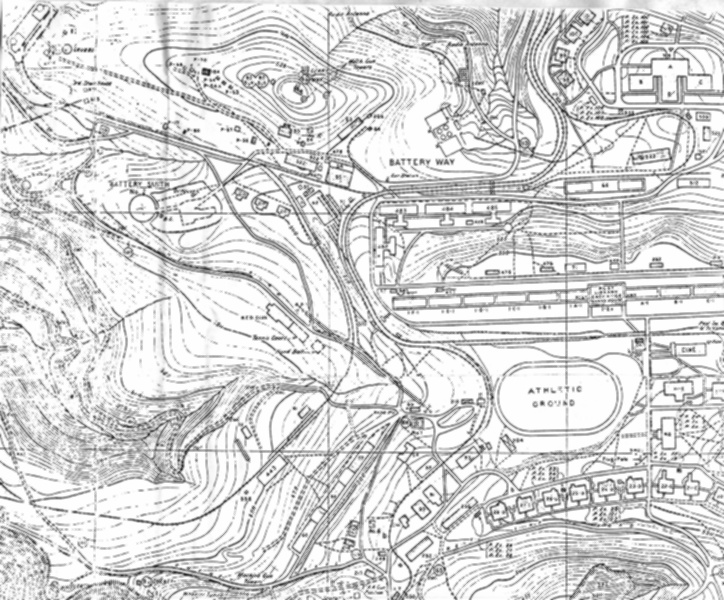 Scan of the '36 Map |
Does anyone know why the Battery which was recorded as
"Smith No. 2" in the 1936 Corps of Engineer Map (1937) map is known to us
now as Btty Hearn? Well, we've had a response from Don Abbott (of the 503rd) who gets us closer to the answer than I once was. "Originally, the most modern guns on the Island were placed and named Smith 1 and Smith 2. Later Smith 2 was named after a CA Officer named Hearn. I forget the rest of his name and why they felt he should have a battery named after him." Our other faithful 503rd contributor, John Lindgren also fills in some of the blanks: Ed, Jungle Fox -oo000oo- Thanks Don, Thanks John. Looks like I'll have to come up with another question to challenge you experts! |
 |
This photo, copyright by LIFE Photographer Carl Mydans,
appears throughout this site by courtesy of The Digital Journalist -oo000oo- |
| George Munson
|
Paul, I greatly appreciate your web site. You are performing a good service for those of us who are interested in the Harbor Defenses of Manila and Subic Bays. I first got interested in Corregidor as a young boy in the 1950s. Then while I was in college, the Belote brothers' book was published. It was wonderful and perked my interest. I first visited Corregidor in 1972. I didn't know a soul who had much interest in the island and the only map available was in the Belote brothers' book. It took me 5 years before I found anyone who had much of an interest in the island. Millie Wood Kennedy, Jim Black, Lee Skinner, Rico Jose, and I were the only ones researching and exploring the island. We never had the opportunity to meet Millie before she died. Jim, Lee, and Rico lived in the Philippines and did most of the exploring. I did most of the research. After 27 years, many nights and Saturdays in the National Archives, thousands of dollars being spent, many phone calls and interviews, and thousands of hours of research, all of which took a terrible toll on my family, I have a good idea of what happened on the forts. I say this because many old enlisted men have written their stories. Articles and books have been published and fiction is being believed as gospel. And I don't like history being rewritten. Battery Reyson came from the imagination of some Filipino. This battery never existed! I will go one step further and say the only reliable Filipino scholar is Rico Jose. Unless your source is a former Philippine Scout, and many of them are too old to remember, don't waste your time. Battery Smith had three guns: Smith number 1, Smith number 2 and a 155mm GPF. I believe that the 155mm gun was Battery Monja, but I have never been able to confirm it. Smith number 1 and number 2 were so far apart that they operated tactically as two separate batteries. Thus, they were split up into two batteries. Battery Monja was transferred to the 92d Coast Artillery and in 1941 & 1942 was manned by Battery G. Howard Brown's claim in the book The American Magic, that he could predict the Foto Joe flights and passed this information on to the the AA batteries resulting in about six planes being shot down is a lie. After obtaining all the 60th Coast Artillery unit histories, interviewing numerous officers, and enlisted men there is no evidence that this took place. I have numerous interviews with battery commanders who knew nothing about Brown's claim. Their communication cables were frequently cut by bombs and shells. They seldom if ever fired at Foto Joe as they wanted to conserve shells and fuses. Also Foto Joe did not climb as he crossed Corregidor. He was already at his operational altitude. Gold and silver. The gold is all gone. It was never stored in Malinta Tunnel or Navy tunnel. The Army stored it in a vault on the south side of Topside along with the paper money. I'm not sure where the silver coins were stored, but I assume they were in the same location. Also, why would the U.S.S. Trout need 25 tons of balast before it could submerge? Submarines have ballast tanks that they fill with sea water when the want to submerge. There were no secret tunnels or vaults in Malinta and Navy tunnels. The people were stacked in those tunnels like cords of wood. There was no privacy. You couldn't do anything without dozens of people watching you. I could go on and on, but I won't. I appreciate truth more than fiction and those who rewrite history. Sincerely, George, I'm not a naval architect and the only maritime experience I've ever had is with a young lady at a boat party, so I don't have anything more than a layman's understanding of the ballast issue. Trout probably needed stability ballast. Submarines have at least two types of ballast - buoyancy ballast which is pumped in and out to make the craft submerge and rise, and stability ballast (situate at the lowest points of the hull, and kept 'dry') to make sure that "up" remains "up" at all times. As the amount of water ballast is finite, if the boat is too light, it still might not dive at its designed parameter. Ed -oo000oo- |
 ©1996 The War Times Journal. All rights reserved. . |
South Beach - probably post-war, as
this was the pre-war site of Barrio San Jose. Photos courtesy of Mrs.
W. A. Campbell
found at the War Times Journal, used by
permission. Jim Burbeck advises there's an account of Dewey's eyewitness account of the
Manila Bay battle in the WTJ's Archives/Accounts section. [It's
worth a read, but "y'all come back now!" - Ed.] -oo000oo- |

|
Ed, My father, Holger L. Holm of New Hartford, Iowa (dec'd May, 1995) was a private stationed with Battery Chicago, 60th Coast Artillery (AA) and was captured with the fall of the island. He was imprisoned at Cabanatuan, Bilibid, Palawan and at Funatsu, Japan. He was taken to Japan aboard the Canadian Inventor. I have some video tapes of him talking at schools on Veteran's Day about his experiences. The talks deal mostly with his experiences as a POW. We have some letters from him written to his sister in law which were written before May 1941 when he arrived on Corregidor and the surrender in May 1942. I also have a diary of my dad's which lists members of his unit with home addresses and the addresses of others with whom he had contact during prison. He also has interesting notes about the contents of Red Cross packages received and a history of his travels from the time he left home until he arrived back home from Japan. Dad was awarded 2 Silver Stars, a Bronze Star, 2 Purple Hearts and various other medals for his actions prior to surrender. I would be happy to share anything that we have of Dad's. Vern Holm, -oo000oo- |
 ©1996 The War Times Journal. All rights reserved. Manila 1945 - It looks like the Congress Building to me, but I wasn't there then. Can anyone clarify where it is, and what building the photo has been taken from? Photos courtesy of Mrs. W.A. Campbell found at the War Times Journal, used by permission. |
Ed, Regarding my father's Corregidor
service--we have copies from the St. Louis archives of the original recommendations for
medals won for gallantry. My dad had a rather mundane job with Chicago Battery (60th
CA). He strung telephone wire which coordinated the firing of the batteries
guns. This got a little more than mundane when the Japs started shelling their
positions from Bataan. Dad also was involved in the rescue of several injured
soldiers who were hit by artillery fire and were in exposed positions. I will try to
put together some information and forward it to you. It runs against my dad's
self-deprecating nature to pat himself on the back for his service (but Vern Holm -oo000oo- |
| CORREGIDOROS ROSTER:
Bob McGetchin, El Cajon, CA is a retired school administrator who is now very much a Corregidoros. He e-mailed us and comments "I have not had the chance to review your website in depth but the few minutes I did...looks great!" He visits the rock annually, where he stays with Joe and Mary Baja, and puts in his time as a voluntary worker for the Corregidor Foundation. "This work involves museum displays at the Pacific War Memorial Museum at Topside. I also do consulting work with Vicky, the teacher at the school and represent the 4th Marines with their financial aid to the school." He's active with the American Defenders of Bataan and Corregidor Organization and is an honourable member of the Parachute 503rd Regimental Combat Team. "I am also a good friend of Capt. Daniel Howell (Ret. USMC) and Curator of the museum on the Rock, and part-time resident on the island for ten years. I guess Danny and I have more footprints on the island than anyone. Danny no doubt, has the most complete library on Corregidor and spends most of his spare time searching bookstores for more! Danny and I have discovered many sites and tunnels which are difficult to identify despite using the 1936 map, consultation with Corregidor vet friends and books." He and Danny, who is presently renovating his "other" home in Florida, plan to return to the Rock in the near future. I hope we can meet sometime Bob - Ed Bob nominates Ed McCarthy, ex-US Navy Warrant Officer of Riverside, CA, whom he says was born on Corregidor and left just prior to WW. Good timing there Ed! Bob McGetchin's article "The Daniel D. Howell Tunnel" is now featured at our Voyages of Discovery Page, where we also publish for the first time on the Web a detailed map of this interesting and mysterious feature. - Ed |
|
 Landing Zone "A" " Be there, bring beer." |
Hugh Zillman (Brisbane,
Australia) sends regards to the Paratroopers (& latent Corregidoros) of Ft. Benning
and announces that he plans to be on the drop zone again in January
2001. Anyone who
wants to be advised of our plans (ie: Be there, bring beer!) and recognises a good
opportunity to visit the Rock without waiting for the 2002 official CDRG visit, should
contact him via Ed. Does anyone want to arrive on the Rock without taking the
boat? E-mails go round and round, and where they stop, nobody knows. Sometimes we get a good one. CORREGIDOR - THEN and NOW has received a poem, originally via Jack Herzig (but original source unknown) called 'Just a Simple Soldier' which deserves a page of it's own, and now gets one. -oo000oo- |
| Ed, I think it was back in the 4th grade in the school library that I ran across Falk's book about Bataan. That is where it all started for me. I guess the shock of Americans surrendering, starving, and being tortured and killed by their captors riveted a kid like me. I was already reading WWII history by then, so this was an extension of that. Over the years, I would watch every movie or documentary that I could. In addition, I bought every book I could lay my hands on, and consolidated my knowledge over the years. While serving on the USS Enterprise from '83 - '85, I had the luck of being on a WestPac deployment that brought me to Olongapo twice. They had the "cheap" tour package to Corregidor, and I took advantage of that tour, both in June and in November 1984. Alas, it was only the quick 2-hour tour, with the 2-peso San Miguel on board the bus. I didn't travel on my own and come back with a buddy then. It was during the Manila riots, and perhaps I felt nervous about straying outside of a "canned" tour package. I would like to go back again and explore on my own, but I'm still young and have to raise my family first, make a living, etc.,etc. I'm 36, an accountant, a full-time night student ten-months away from getting my B.S. in Business Management. I still voraciously read and buy everything I can on Bataan and Corregidor. Oh, and we have two little ones,20-months and 5-months. Kirk J. Poole
|
|

|
To many of us, this is an
"invitation" to discovery. Unfortunately it seems that some within the
Corregidor Foundation have a policy of filling up entrances with debris, or in this case,
garbage. These tunnel entrances are under the big tree at the rear of the Museum (between
Topside and the Telephone Exchange.) I have no idea where they lead. -oo000oo- |
 Enquiries about map copies to Ed. The cost will be US$20.00+$5.00 postage & handling. |
Some people wonder how
extensive the Navy section of Malinta was, and there's been a lot of treasure-hunting
speculation as to where the entrance to the southern section actually is. Here is your
answer. On a map at least! The entire Navy section has remained sealed since the
Japanese exploded it. Landslides covered the southern entrance. Does anyone want to bid on
the shovel concession? [Be very patient when you load this file -
it's 486K, but it illustrates how detailed the 1937 Map is.] -oo000oo- |
| Ed,
I am the grandson of Lt N. Minter Dial of USS Napa, who was captured at Corregidor and later perished (Dec. 13, 1944 on his way to Japan) .I am trying to reconstruct his existence in prison camps while in the Philippines. He was a prisoner of Cabanatuan POW camps #1 and #3 and Bilibid (Manila) during that time. I would dearly love to have any news from anyone who might have known him during that time. I have so far come up with nothing in all my searches. Thank you for anything you might be able to give me ... clues to other sources, etc. Yours truly, [ I have directed Minter to the good guys at the Battling Bastards of Bataan website whom I hear have detailed records that cross-reference dates of death with shipping losses, and can trace prisoners who never made it home. I have also passed him the details of the American Defenders of Bataan and Corregidor website. - Ed.] oo000oo- |
|
 Don't believe the Light and Sound in the Malinta Tunnel which suggests that all the tunnels were dimly lit. It's nothing but theatre hijacking history once again. They were garishly lit by the new lamp technology that we don't normally associate with the pre-war period - the fluorescent tube. |
Capt. Duane Whitlock U.S.N.
(Ret'd) has an article on cryptography and the role that Corregidor played in it entitled The Silent War Against the Japanese.
We've now secured the kind permission of the Naval War College to put the
article on site.
Whitlock agrees that there were some JN-25's decrypted pre Pearl Harbour, but he certainly doesn't subscribe to the conspiracy theory that the code had been so effectively broken well prior to December 7 that some persons in high places within the USN had failed to advise FDR of the true extent of what was known. Conspiracy aficionados and revisionists will no doubt claim that Mr. Whitlock is USN trained, therefore the article is disinformation, and that the USN still conspires with the NSA (and the equivalent bodies of the British and Australian governments) to conceal the real extent to which the contents of pre-war JN-25 messages were known. The conspiracy theory is contained in Betrayal at Pearl Harbour by James Rusbridger and Eric Nave, Summit Books, 1991. A more detailed discussion can be found on this site. The conspiracy theory is comprehensively debunked by the new book "Marching Orders" by Bruce Lee. -oo000oo- |
| CORREGIDOROS ROSTER:
How do you qualify to be a Corregidoros? Well, I figure that you have got to have been on Corregidor at least seven days. People who haven't made it on the Rock for all of 7 days can be called "Corregidoros J.G.'s" ? Hey, it's my Website! I gotta right to be fickle! - Ed -oo000oo- |
|
| Ed, I enjoyed your web site on Corregidor. In partial answer to your request for information about Battery Morrison: It was commenced in December of 1907 and completed and turned over to the coast artillery on November 10, 1910. Cost to date of transfer: $79,845.99 Main source of power was central power plant. Battery also had one 25 kW gasoline motor-generator. Guns: Two 6-inch model of 1905 (Watervliet Arsenal) on disappearing carriage model of 1905MI (Watertown Arsenal). #1: gun # 31 on carriage # 12; #2: gun # 32 on carriage # 13. Battery Commander's station and plotting room located on and in hill directly to rear of battery (it was unusual to have a separate plotting room for a 6-inch battery). Source: Report of Completed Works, January 1, 1920. I too have visited Corregidor, and I hope our group will revisit in 2002 (5 years from last visit). ... I just finished Devlin's book on retaking Corregidor, but did not think it as good as Flanaghans. Do you have a copy of Bunker's diary? (You probably know that Bunker commanded the seacoast defenses.) It is pretty interesting, for those of us who care about such things. B.W. Smith [ I haven't read Devlin YET, which I hear is out of print. I suppose everyone figures I liked Flanaghan, due to the unmerciful plugging I have given his book throughout this site. It's entirely unsolicited, bugger it. No, I don't have Bunker's diary and would appreciate knowing more about it. Those Corregidoros who can't wait for 2002, can e-mail me and meet us there next January - Ed.] -oo000oo- |
|
| Kenneth Y. Ilio
at Northwestern University, Chicago, IL writes us (3 April) that he's just been on
Corregidor and is working on putting up a Corregidor photo page. When it's up, we'll
arrange a link so everyone can see the Rock the way he sees it. Ken has the right idea. There's no sense in keeping those pictures in your album when you have the world to share them with. - Ed -oo000oo- |
| Veterans of Battery B. 462d Prachute Artillery
Battalion My dad, Gertus H. Jones was a sergeant of Battery B. 462d Parachute Artillery Battalion. His poem is included in "Back to Corregidor" by Gerard Devlin.
|
| Ed, April 16, 1999 My name is Nancy LeClear Easterling,
I am looking for information about my father, Lt. Francis Earl LeClear, who was a
prisoner of war; we believe he was captured on Corregidor. Where can I go to locate
information? Thank You. [ I will post your letter in the forum in case it jolts somebody's memory. I do not have any roster material. You should try the Battling Bastards of Bataan site, and the American Defenders of Bataan & Corregidor site, both of which have links on this site. - Ed.] Also look at the links page, which now has info on these, and of the American EX-POW's organization. -oo000oo- |
| Ed, My father was a Prisoner of War and was held captive for approximately 4 years. I believe but might be mistaken though that he was captured shortly after the war started. He fought on Bataan and was in the death march. He talked very little of his experiences while held captive therefore I do not know very much. I know of a ship that he mentioned the Oki Maru I think was the name or something similar. I believe that was the ship that he was on while being transported to prison camp. He also mentioned being only about 50 miles from Hiroshima while in prison. He past away last year and I have tried to obtain his military records but I was told they were destroyed in a fire in St. Louis. I do not know what ever became of any records that he may have had himself. Do you possibly know of another route I could take in finding any information on his military years. He also was an active member in the American Defenders of Bataan and Corregidor. His name was Dewey R. "Red" Smithwick and lived in Hampton, VA. I also know the following members of the ADBC - Howard Morgan, Harold Feiner, Paul Harmon and ? Aquino. Can't remember his first name. I would appreciate any help that you may be able to give me. Suzan Speropoulos -oo000oo- |
| Ed, I've spent 25 of my 36 years reading and researching every shred of documentation I can find on the situation on Bataan and the siege of Corregidor. I have found your site in the past week and have now bookmarked it. You have plenty of material I have not seen or read before. New pictures I have never seen, and the excitement of a newly discovered tunnel to the NE of the Malinta system. (Don't thank me for this one, it's to Danny Howell's credit - Ed) I should like to return to Corregidor one day. I made 2 visits in '84 while in the Navy when we pulled into Subic. Only 2 hours each time. Very angry I didn't take greater advantage by being there to explore more. Thank you for your time. I have become a junky on your site. I eagerly await any updates that are forthcoming. Kirk J. Poole [ I try to please. Why not say thanks by
submitting a little article? Ed ] [Kirk never did submit an article, but he did send us a number of photographs which have now been reproduced throughout the site.- Ed ] -ooOOoo- |
| Ed, Thank you for creating this website. I have been studying both campaigns for years and finally I can see where these events took place. Do you have any plans to include Bataan, or the other fortified islands (especially Fort Drum)? Kenneth L
Schneider [I have not spent sufficient time on Bataan to be familiar with it. There would have been a page on Ft. Drum had Manila Bay not been so choppy on the morning Art and I arranged a boat. Perhaps next visit, unless someone who has been there wants to make a contribution...Ed.] -oo000oo- |
| BOOK REVIEW: Back to Corregidor: America Retakes the Rock By Gerard M. Devlin Reviewed by Bolling W. Smith Corregidor is the holiest site of the Coast Artillery Corps. Only in Manila Bay did American coast artillerymen die manning their guns. This book recounts the recapture of Corregidor by the U.S. Army's 503rd Regimental Combat Team in February 1945. Although immeasurably assisted by overwhelming air and naval power, the recapture of Corregidor from some 5,000 Japanese (only 600 Japanese were expected to be on the island) by half their number of Americans is a monument to both skill and courage. This book must inevitably be compared with Corregidor: The Rock Force Assault, by Edward M. Flanagan (Presidio Press, 1988). Flanagan, a lieutenant general, gives a more organized, systematic account, with a better grasp of the terrain, and he deals more even-handedly with the Japanese defenders. On the other hand, Gerard Devlin was a sergeant in the 503rd Parachute Infantry following the Korean War, and served alongside veterans of the assault on Corregidor. He shows his familiarity with airborne operations and effectively captures the human element. The battle naturally makes a great story, and Devlin tells it well, capturing the valor and skill, the glory and the horror of a desperate contest. Devlin, however, seems unfamiliar with Corregidor. His descriptions of the terrain are sketchy, and his understanding of the seacoast artillery batteries is limited to calling all concrete structures bunkers. Even those who have visited Corregidor will find it difficult to trace the progress of the battle through his narrative. Additionally, Devlin accepted some accounts too uncritically. He reports, for instance, that the Japanese had a 14-inch naval gun on Corregidor, hidden in a cave. The absence of footnotes makes it impossible to identify the sources for such statements. In summary, this was a bloody, desperate struggle against almost overwhelming odds. Devlin set out to do justice to the memory of those who fought and died there, and he does so, in the process telling a great action tale. However, his understanding of Corregidor and its structures may disappoint those with a particular interest in the island itself. Bolling W. Smith BOOK REVIEW (2): Gerard Devlin is a paratrooper and a fighting man. He probably understands paratroopers and fighting men better than any other writer, and it shows. He knows what it's like to get a slugging match, and he brings that gutwrenching feeling into his writing. Yet he is able to meld the stories of the men into a factual and human history, never departing from the essential spirit of the troopers. When a person gets serious about Corregidor, this is one of the acquisitions that needs to be made. No exemptions. The Belotes, Devlin, Flanaghan and Guthrie. Most people start with the Belotes - yet one of the greatest experts on Corregidor, Danny Howell, has painstakingly analysed this widely respected book and critiqued it virtually into mincemeat. One can only begin to appreciate Devlin's skill as he grappled with the difficulty of establishing the humanity of what was essentially, a most inhuman campaign - moving and killing. Unfortunately, Devlin has not been in print for several years, and must be located either through used book dealers or the internet auction houses. Finding him in a second-hand book store is a jewel in the dust. Find it and buy a lottery ticket. Either way you win. If you haven't got it, get it, and enjoy it. One wonders how many Corregidoros we need to get together to persuade St. Martin's Press to release a new printing of this book. I would hope they have heard of us here at CT&N. For those interested in the history of paratroopers, Devlin's book PARATROOPER also traces the history of the entire U.S. Airborne effort, and is also worth the acquisition. It too is unfortunately out of print. ISBN 0-312-07648-7 -oo000oo- |
| WHY I PERSEVERE
WITH THIS SITE Fortunately there are still those of us who believe that we can't own history, only hold it in trust for our children. People who experience, achieve and survive something extraordinary, when others have not, voluntarily shoulder certain obligations upon themselves, not just for society, but also for those of their contemporaries who did not survive. This is Speilberg's premise, isn't it, of Saving Private Ryan? One of the more poignant obligations of surviving is to relate the experience, on behalf of those who cannot. The knowledge of surviving veterans, whose time is shortly upon them, is a living treasure. Their memories, but our treasure. One of the obligations of the generation that follows them is to record their human experiences, their humanity, and not just their history. Fragments of their humanity are our treasures in trust, valuable only when we can renew their experience by passing them on. So called historians can come along a hundred years later, and tell us what their history was. Yet only those of us who can sit with the veterans in their 'virtual' parlour, and who listen closely, can record their humanity. There's a climactic soliloquy in the cult-movie Blade Runner which goes towards explaining the primary reason I'm trying to gather, and at the same time, educate what to many may seem an esoteric "knowledge" of the Rock. The astonished Blade Runner is watching helplessly as a tired looking Baty slumps down in a lotus position before him. Still cradling a dove, Batty smiles, almost bashfully, before saying:
Ed -oo000oo- |